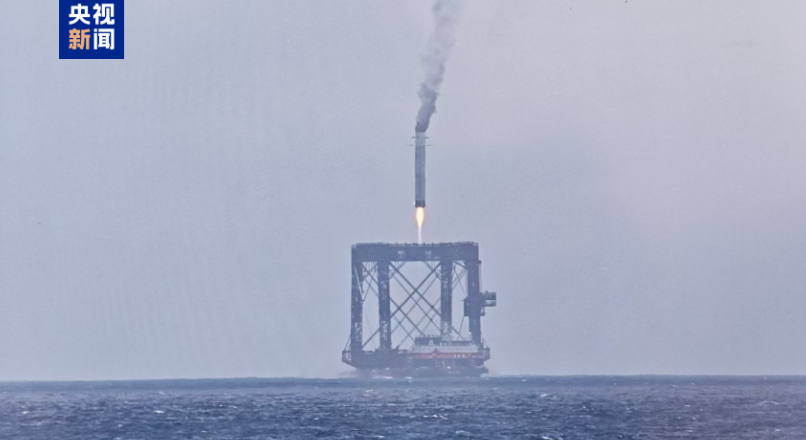
At about 12:00 on July 10, 2026, the Long March 10B carrier rocket was ignited and lifted off at the Wenchang Commercial Space Launch Site in Hainan, successfully completing its first flight mission. One sub-stage was successfully captured and recovered by my country's first rocket network recovery offshore platform "Navigator". At this point, China has achieved a milestone breakthrough in large-capacity recyclable rocket technology, and is also the first country in the world to engineer "sea network recovery" technology.
The success of this mission means that the national team is the first in the field of recyclable rockets to complete the entire closed-loop process of "launch into orbit + successful recovery" and form a joint technical research effort with private forces. Coupled with the three major catalysts of the acceleration of mega-constellation networking in the second half of 2026, the intensive verification of industry-wide technologies, and the IPO sprint of leading companies, China's commercial aerospace is ushering in a critical transition period from technology exploration to commercialization.
Long March 10B’s maiden flight: The actual recovery of offshore network systems was successful
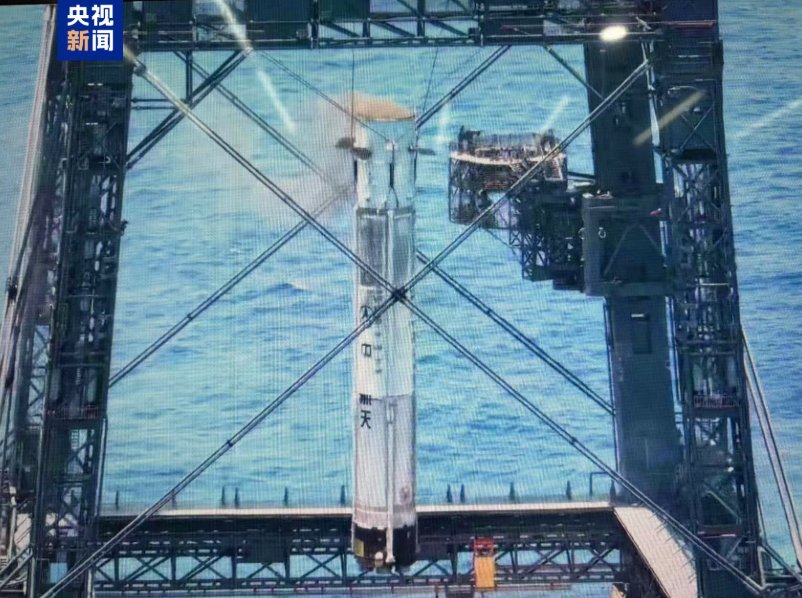
The most eye-catching aspect of the first flight of Long March 10B is the recovery of the first-class offshore network system.
Different from the mainstream vertical landing scheme, the Long March 10B-1 sub-stage canceled the landing legs and retained a special hook at the bottom of the rocket body. After the rocket re-entered the atmosphere, it was captured by the giant flexible blocking net deployed by my country's first rocket network recovery offshore platform "Navigator".
Xu Xuelei of the China Aerospace Science and Technology Corporation has previously publicly stated that compared with the current mainstream recovery scheme, net-system recovery is more friendly to the landing indicators of the rocket. This is mainly due to the fact that when the rocket enters the net and is connected, most of the kinetic energy and potential energy are absorbed by the ground buffer mechanism, which greatly reduces the design requirements for the buffer structure on the rocket. In response to rocket landing point deviation, the recovery system can improve adaptability by simply and efficiently adjusting the size of ground equipment, which can also reduce the requirements for rocket engine thrust adjustment capabilities.
Looking at the Long March 10B again, public information shows that this type of rocket was developed by the First Academy of the China Aerospace Science and Technology Corporation. It is a two-stage 5-meter-diameter unassisted rocket. The first stage uses a liquid oxygen kerosene engine, and the second stage uses a liquid oxygen methane engine. The 200-kilometer LEO orbit recovery state has a transport capacity of not less than 16 tons. It aims to create a low-cost, reusable large-scale commercial launch vehicle to serve the space station's low-cost freight, satellite Internet networking and other tasks.
The "Navigator" responsible for this recovery mission has a length of 144 meters, a width of 50 meters, a full load displacement of 25,000 tons, and DP2-level dynamic positioning capabilities. It is the world's first offshore platform designed specifically for the recovery of rocket network systems.
In February 2026, the "Navigator" completed its first actual combat assessment during the Long March 10 low-altitude flight test, achieved level 5 sea state dynamic positioning in an unmanned state, and successfully guided the first stage of the rocket to splash down in the preset sea area.
A person from a rocket company told a reporter from the Financial Associated Press that the Long March 10 series has chosen a step-by-step route, first completing splashdown recovery at sea, and then iterating to capture and recovery on offshore platforms. This step-by-step verification method reduces the technical verification risk of large rocket recovery.
Debate over technical routes: Why should we find another way to recycle offshore network systems?
The current global rocket recovery technology shows a pattern of parallel development of three routes, namely vertical take-off and landing recovery (including sea and land), sea splash recovery and ground capture recovery.
At this stage, maritime recycling is relatively more economically advantageous. Relevant people from Jianyuan Technology told reporters from Cailian News that even the industry benchmark "Falcon 9" that adopts vertical take-off and landing recovery accounts for more than 80% of its use of maritime recovery methods. Vertical take-off and landing land recovery requires returning to the recovery site, and the capacity loss is about 40%. The offshore platform recovery follows the natural flight trajectory of the rocket and does not need to return to the launch site and other factors, and the capacity loss can be reduced to about 23%.
Regarding the sea splash recovery method, industry insiders told reporters from the Financial Associated Press that taking the "Starship" as an example, there is no need to return to the launch point after the second stage separation. Since the recovery reserve fuel is less and the landing leg is cancelled, the loss of carrying capacity can be reduced to about 10%. The "chopstick clips" flying back to land are recycled, and the capacity loss is about 15%.
In terms of civilian and commercial rockets, Arrow Technology has also adopted the sea capture and recovery route. In May 2025, it successfully achieved sea splash recovery through the Yuanxingzhe 1 verification rocket to verify key technologies. In this regard, a relevant person from the company told a reporter from the Financial Associated Press, "This has laid the foundation for subsequent iterations to capture and recover the 'chopstick clip' on offshore platforms."
As a rising star, Huosheng Aerospace also plans to use net-system recovery. The company's planned Qitian-2 is a two-stage reusable heavy-duty launch vehicle. The first stage adopts a net-system recovery scheme under the route. It does not need to return to the launch site. It has low control difficulty, low propellant consumption, and high recovery efficiency.
A few days ago, Xu Xuelei publicly stated that most of the current reusable rocket legs and other devices need to be customized and fly with the arrow, and the net recovery system can help simplify the rocket structure and improve efficiency and effectiveness. At the same time, the system can adapt to different scales of rocket recovery through the serial design of some indicators.
It is worth mentioning that a reporter from the Financial Associated Press recently attended an institutional seminar on the first flight of the Long March 10B and learned that if the maritime network system of this model is successfully recovered, other private and commercial rocket companies will theoretically follow suit. But this requires the development of new rocket models and supporting offshore recovery ships, which takes a long time. However, once this model is proven and mature, it may become an efficient new technology path due to its high fault tolerance and small capacity loss.
Second half of 2026: triple resonance of constellation networking, rocket verification and IPO
The successful first flight of Long March 10B coincides with a key node for China’s commercial aerospace industry in the second half of 2026. The explosive demand for constellation networking has forced recyclable rockets to accelerate technology verification and engineering implementation. The increased certainty of technology and orders has become the core valuation support for rocket companies’ IPO sprint. The three forces converge here and form a resonance.
At the constellation networking level, domestic mega-constellation networking will accelerate in the second half of 2026. According to agency statistics, as of June 5, 2026, the "Thousand Sails Constellation" has completed the 12th batch of launches, and has delivered 92 satellites during the year, which is nearly twice the number of launches in 2025 (54 satellites). According to the target of launching 216 satellites for the whole year, another 124 satellites will be launched during the year.
On April 3, at the 2026 Space Computing Power Industry Conference, Zhang Xiaodong, chief designer of Blue Arrow Aerospace Zhuque 3, said that based on the constellation deployment target of hundreds of thousands of satellites commonly mentioned in the industry, his team's preliminary calculations believe that based on the number of launches and deployments of 220,000 satellites, in the next 7-10 years, there will be 500 medium and large launch vehicles in China every year to meet such demand.
In terms of rocket verification, the second half of 2026 is a critical year for domestic commercial aerospace recovery verification. Blue Arrow Aerospace's Suzaku-3 Yaoyi flight successfully entered orbit in December 2025, but the recovery section failed. The Yao-2 rocket plans to conduct a recovery test again this year, and strive to try a reuse flight in the fourth quarter of this year based on the recovery test results.
China Aerospace Lijian 2 Yao-1 successfully made its maiden flight in March this year. Yang Haoliang, commander-in-chief of Lijian 2, once told reporters from the Associated Press that the company has fully verified core technologies such as re-entry deceleration and recovery and rocket body precise impact point control through the maiden flight of Lihong 1, and plans to conduct a 100-kilometer-level recovery test this year.
Relevant people from Jianyuan Technology told reporters from Cailian News that the first "Yuanxingzhe 1" launch vehicle developed by it is the first rocket model in China to adopt the "stainless steel + liquid oxygen methane + sea recovery" solution. It is also expected to make its first flight at the end of 2026.
Public information shows that Galaxy Dynamics Pallas II is expected to achieve its first flight before the end of 2026; Interstellar Glory Hyperbolic III is scheduled to achieve its first flight and sea recovery from the end of 2026 to early next year.
At the IPO sprint level, Blue Arrow Aerospace and China Science and Technology Aerospace simultaneously updated the Science and Technology Innovation Board prospectus on June 29, 2026. The review status was both Inquired, and the competition for the first share of commercial aerospace has entered a fierce stage.
According to the updated prospectus, Blue Arrow Aerospace is expected to achieve profitability as early as 2029. The core prerequisites include the mass production and regular reuse of Suzaku-3. China Science and Technology Aerospace expects to make profits in 2029 under optimistic and neutral assumptions, and in 2030 under conservative assumptions.
The profit forecasts of both companies are highly dependent on the commercialization progress of recyclable rockets. The fifth set of listing standards on the Science and Technology Innovation Board requires companies to have obvious technical advantages and achieve phased results. The successful launch of recyclable medium and large rockets into orbit is a core landmark node for commercial aerospace companies to prove their technological maturity and impact their listing.
What is even more benchmarking is that SpaceX completed its Nasdaq listing debut on June 12, 2026 with a market value of US$2 trillion, opening up the capital closed loop of low-cost rocket launches, Starlink network communications, and AI, and providing a new international reference frame for the valuation of domestic commercial aerospace companies.