According to Nikkei Chinese website, as chip foundry giants prioritize the production of high-end AI chips, the supply of mature chips is tightening, which has brought development opportunities to Chinese wafer factories that started late.TrendForce data shows that in the global wafer fab revenue rankings in the first quarter of 2026, three wafer fabs in mainland China have ranked among the top ten.
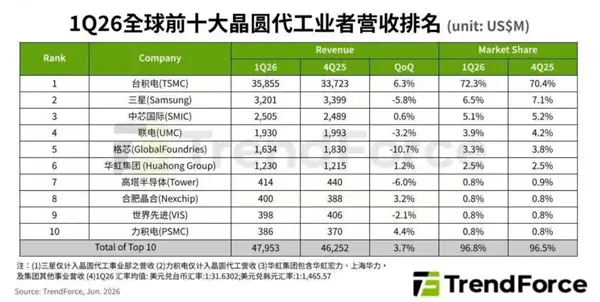
TSMC continues to rank first in the world, with revenue exceeding US$35.8 billion and a market share of 72.3%. SMIC ranks third in the world, behind TSMC and Samsung. Huahong Group ranked sixth and Jinghe Integrated Group ranked eighth.
The explosion of the AI industry has consolidated TSMC's leading position in the advanced foundry field, while other manufacturers are competing on mature process tracks.
In February this year, TSMC and Samsung announced adjustments to mature process production capacity, gradually reducing or even closing some 8-inch production lines, and fully focusing on 12-inch wafer manufacturing. A large number of orders for 8-inch production lines have been transferred to local Chinese companies.
According to SEMI forecasts, the global monthly production capacity of 8-inch wafer fabs will reach 7.7 million pieces in 2026, and Chinese companies will account for 1.7 million pieces, about 22% of the market share.
U.S. export controls have hindered China's development of advanced manufacturing processes, but have prompted Chinese wafer fabs to shift to mature processes. Today, China has made significant progress in the fields of power chips, display driver chips, sensors, and power devices.
SMIC, Huahong, and Jinghe Integration have all begun to deploy 12-inch mature chip manufacturing, forming a development trend of full 8-inch production capacity and large-scale expansion of 12-inch.
The demand in the mature chip market is huge, but profits are far less than those of advanced nodes, and revenue needs to be generated by scale. China's mature process industry is creating market pressure on international competitors. The market that TSMC and Samsung have actively withdrawn from is being quickly filled by Chinese companies.