On July 21, Google suddenly launched two new models: Gemini 3.6 Flash and Gemini 3.5 Flash-Lite. Without any precautions or worries, they just appeared in the model selectors of Google AI Studio and Gemini.

Of these two models, one focuses on stronger code and agent capabilities, and the other focuses on lower-cost large-scale calls.
As for the flagship model, Gemini 3.5Pro, despite repeated calls, it still can’t be released.
According to the previous plan, the 3.5 Pro was supposed to be launched in June. Now that July is more than half over, this model with high hopes has still not been officially unveiled.
The answer sheet representing the strength of the flagship has been delayed. Google first took out two "draft papers". What does it mean?
01
3.6 Flash: Cheaper than the previous generation, no smarter than the previous generation
Google said that compared with the previous generation Flash model, Gemini 3.6 Flash further improves coding, reasoning and tool calling performance, while reducing operating costs by reducing output tokens.
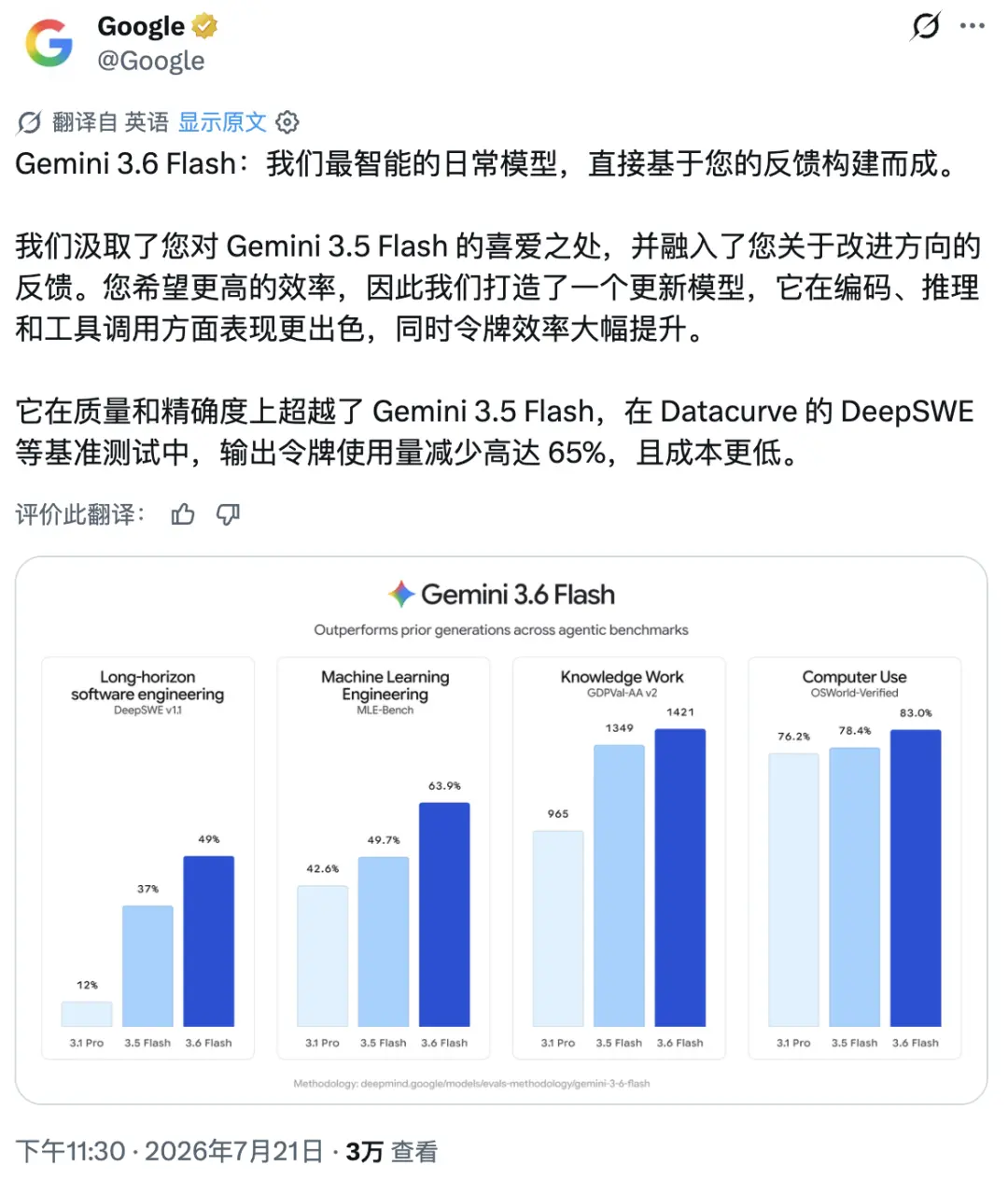
Gemini 3.6 Flash is positioned as an efficient model for real production environments, or to be more straightforward, to serve Agents.
In the Agent era, a task may require dozens of rounds of model calls, which means that the model must not only be smart, but also fast and cheap enough.
Google has previously strengthened this route on Gemini 3.5 Flash. According to the official API document, Gemini 3.5 Flash supports a long context of 1 million tokens, which can process a large amount of information at one time. It also supports code execution, calling external tools, searching files, etc., and can complete more complex and longer tasks.
Gemini 3.6 Flash continues this line. What it pursues is not the quality of a single answer, but a position that "can afford daily real work."
Gemini 3.6 Flash is priced as follows:
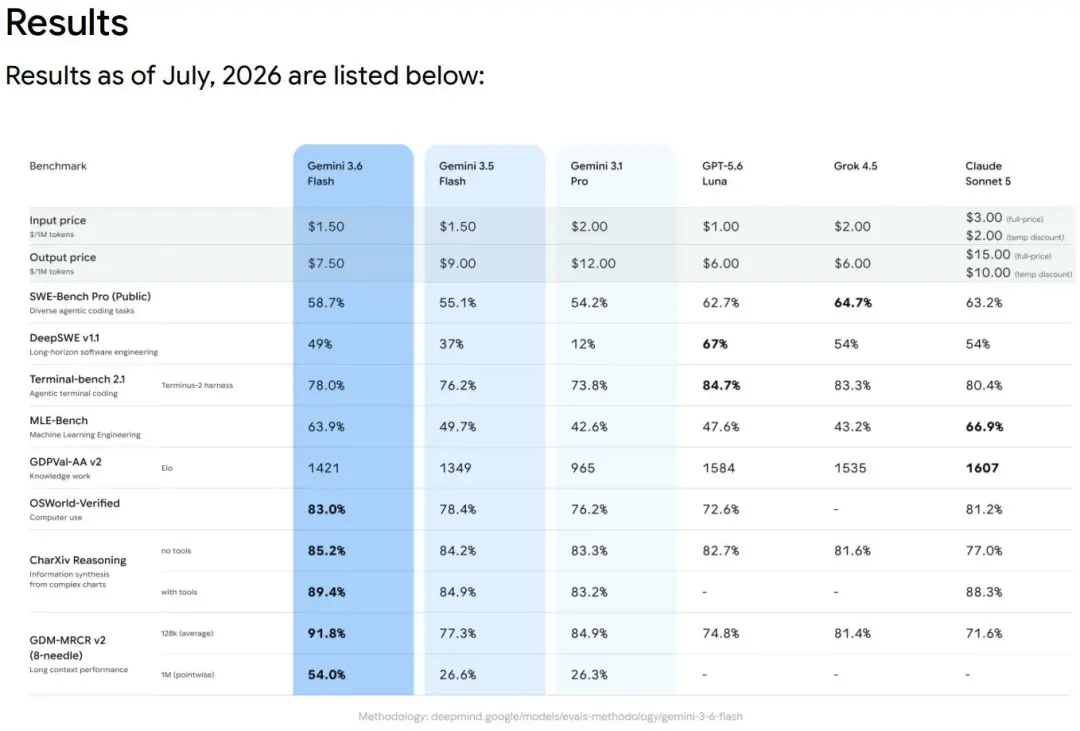
Input: 1.50 USD/million tokens
Output: $7.50/million tokens
Compared with the previous input price of Gemini 3.5 Flash of US$1.5 per million tokens and output price of US$9, the input cost has not changed, but the output cost has further dropped.
For companies that need to use AI heavily, this cost change may be more important than a few percentage points improvement on the benchmark.
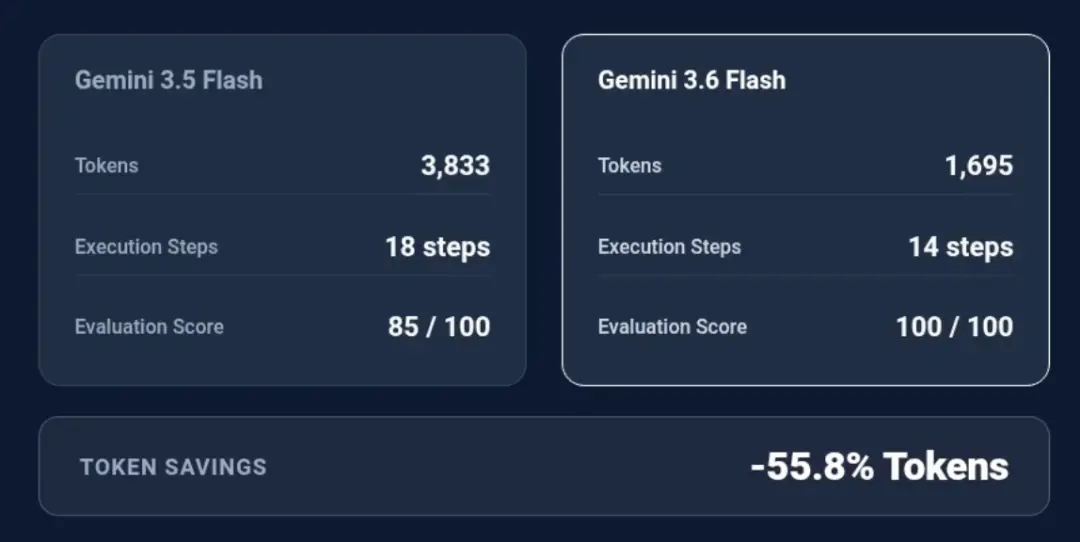
In addition, an internal test displayed by Google showed that when completing the same task, Gemini 3.6 Flash reduced token consumption by 55.8% compared to 3.5 Flash, while increasing the task score from 85 points to 100 points.
Of course, this is just Google's own test results and can only indicate the direction Google hopes to show:
The new model is not only more economical, but can accomplish the same or even better tasks with less computation.
In those public benchmarks, Google mainly emphasizes coding capabilities and agent capabilities.
In the DeepSWE code evaluation, Gemini 3.6 Flash scored 49%, higher than the previous generation's 37%. Google said that the new model can reduce invalid code modifications and repeated execution processes.
In the OSWorld-Verified evaluation, which tests the ability of AI to operate computers, Gemini 3.6 Flash scored 83%, exceeding 3.5 Flash's 78.4%.
In the MLE Bench for machine learning tasks, Gemini 3.6 Flash scored 63.9%, which was significantly improved compared to the previous generation's 49.7%.
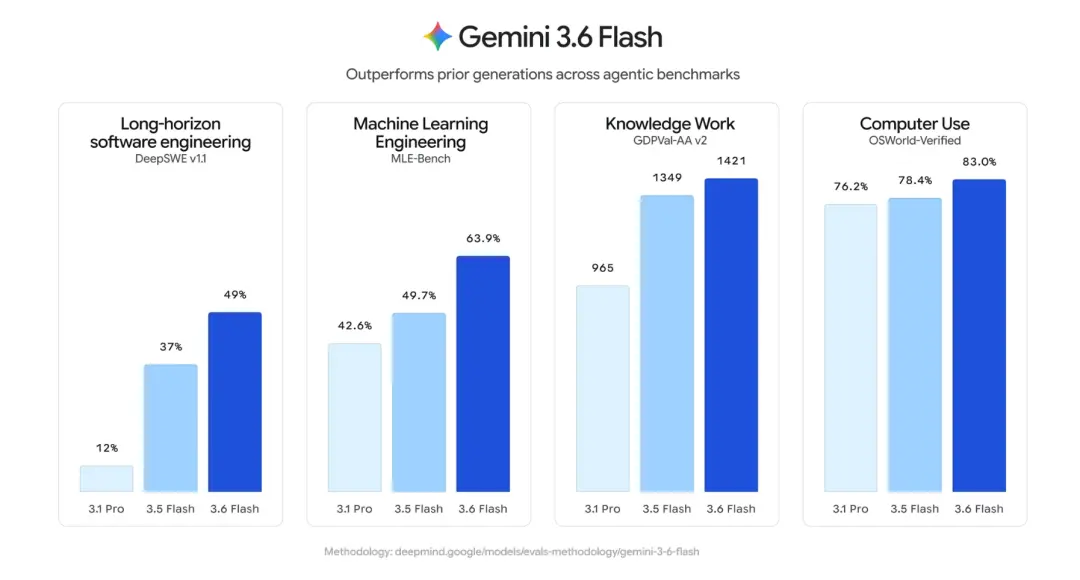
However, the above data shows that Gemini 3.6 Flash has improved compared to the previous generation.
If we compare it horizontally in the current large model competition, Google’s chosen opponents are GPT-5.6 Luna, Grok 4.5 and Claude Sonnet 5 (the positioning of this product can also be seen here).
Judging from the results, Gemini 3.6 Flash does not lead across the board. GPT and Claude's models still maintain their advantages in complex software engineering and knowledge work tasks.
But this is actually the meaning of the existence of the Flash series:
It doesn’t have to be the most powerful model, it just needs to provide adequate capabilities at a significantly lower cost than the flagship model.
In addition to the official evaluation, according to Artificial Analysis' pre-release test, Gemini 3.6 Flash scored 50 points on the Intelligence Index, which is the same as Gemini 3.5 Flash.
This means that if you only look at the overall "intelligence" of the model, there is no upgrade in Gemini 3.6 Flash.
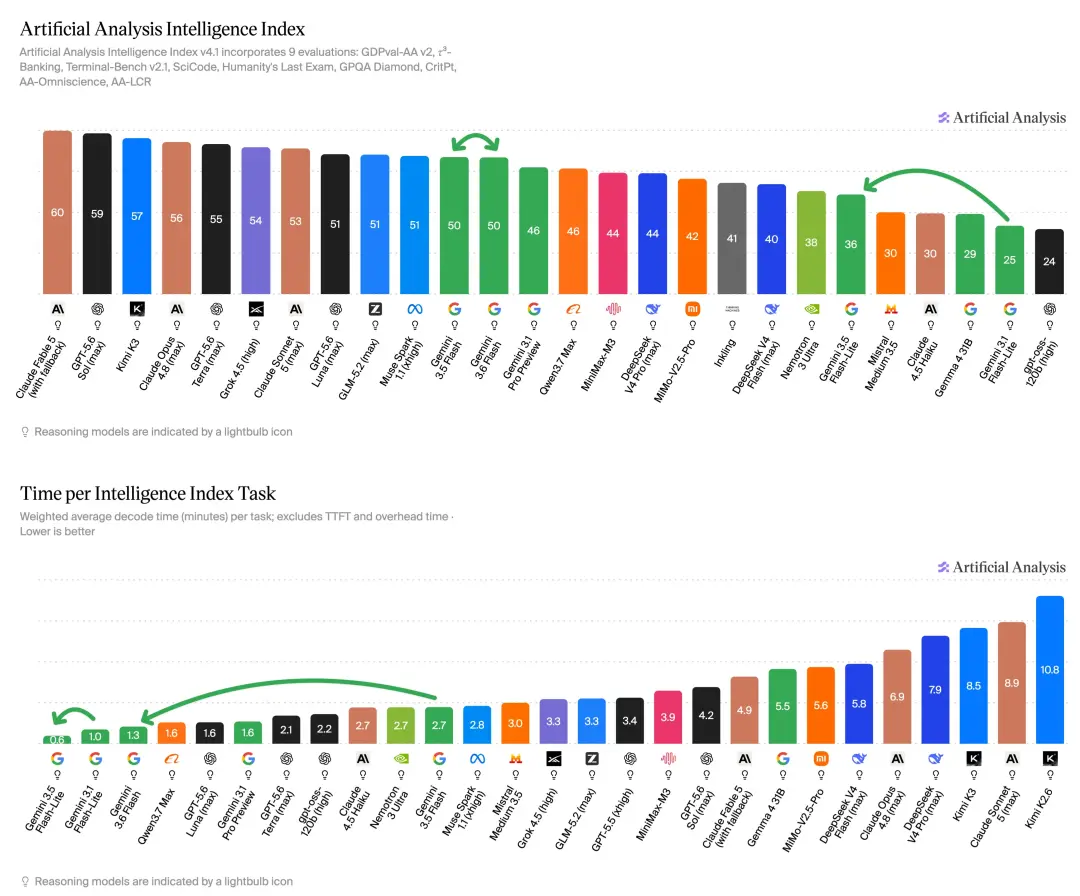
However, its speed more than makes up for this.
Artificial Analysis also counts the average time it takes for the model to complete the Intelligence Index task. The results show that each task of Gemini 3.6 Flash takes an average of about 1.3 minutes, which is reduced by half compared to about 2.7 minutes of the previous generation 3.5 Flash.
At the same time, the task completion time of Gemini 3.5 Flash-Lite has also dropped from about 1.6 minutes of the previous generation 3.1 Flash-Lite to about 0.6 minutes.
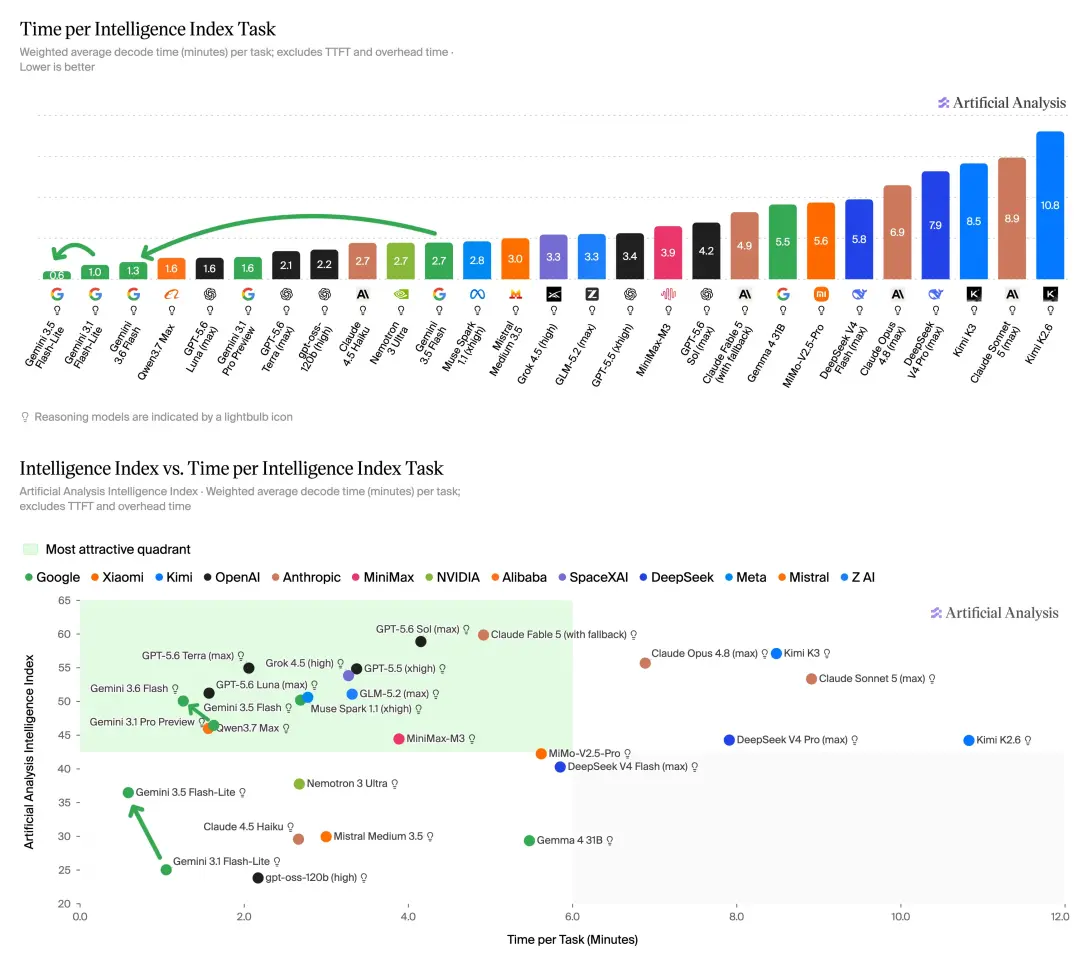
In general, the upgrade direction of Gemini 3.6 Flash is actually efficiency - less token consumption, lower operating costs, and agent capabilities more suitable for long-term operation.
For users who are accustomed to using Gemini 3.5 Flash, it is indeed a very good upgrade.
02
3.5 Flash-Lite: Faster, but not as cheap as the previous generation
Then let’s look at another model Gemini 3.5 Flash-Lite.
As the name suggests, Flash-Lite is a lighter version of the Flash series. Compared with Flash, it sacrifices part of its upper limit of capabilities in exchange for lower cost and faster speed.
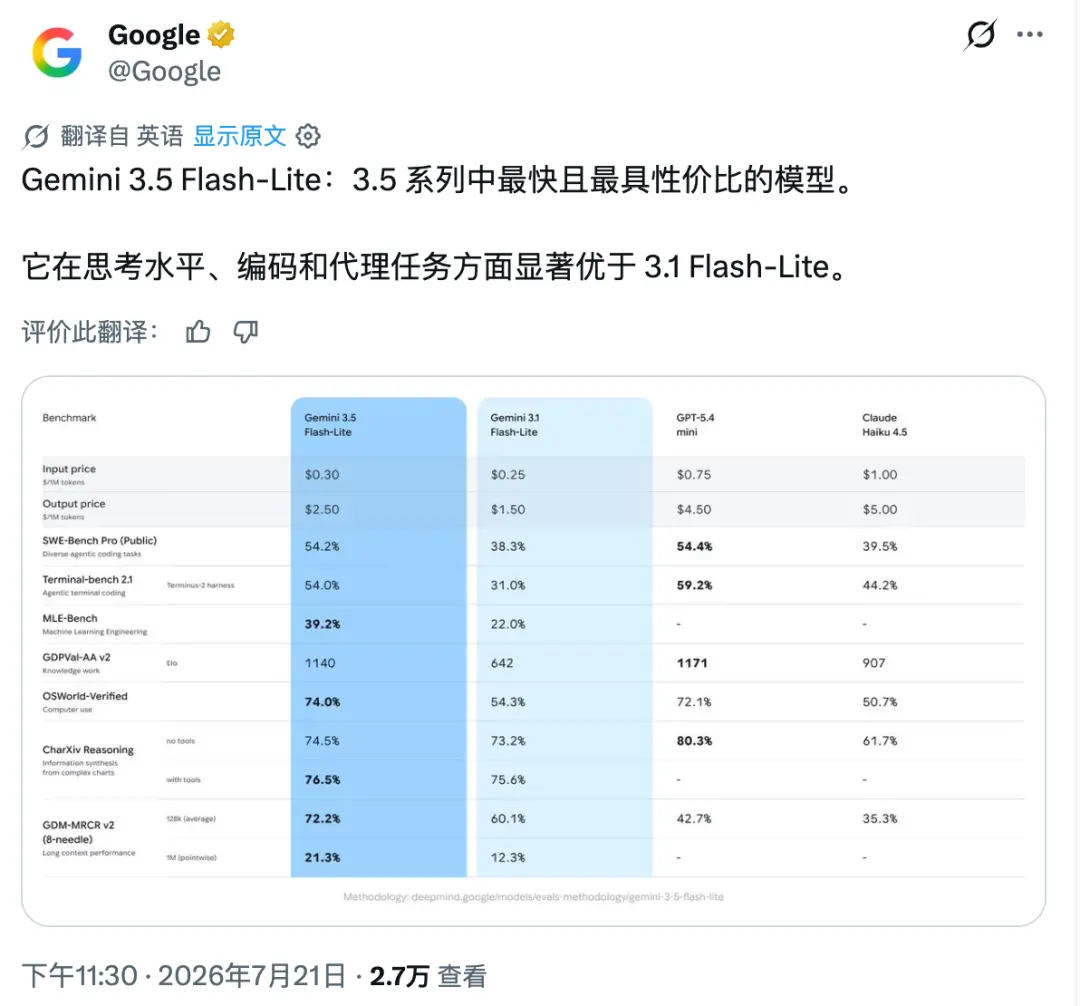
As mentioned earlier, the task completion time of Gemini 3.5 Flash-Lite dropped from about 1.6 minutes of the previous generation 3.1 Flash-Lite to about 0.6 minutes.
3.5 Flash-Lite is also the fastest model in the 3.5 series. According to Artificial Analysis test data, its generation speed reaches about 350 tokens/second, which is already at the high-speed level among current mainstream large models.
Gemini 3.5 Flash-Lite is priced as follows:
Input: $0.30/million tokens
Output: $2.50/million tokens
Compared with Gemini 3.6 Flash, the input price is about 1/5 and the output price is about 1/3. However, the new model does not see a further price reduction compared to the previous generation Gemini 3.1 Flash-Lite.
Although Gemini 3.5 Flash-Lite can reduce some costs by reducing output due to its improved capabilities, overall, it is still difficult to offset the increase in unit price.
According to official documents, compared with the previous generation Gemini 3.1 Flash-Lite, the new model has significant improvements at different thinking levels. Developers can adjust the depth of thinking of the model based on task requirements.
In addition, Gemini 3.5 Flash-Lite also has built-in Computer Use capabilities, which can help Agents operate the computer environment more reliably and complete cross-application tasks.
In specific tests, Gemini 3.5 Flash-Lite has also significantly improved compared to the previous generation model: in the Terminal-Bench 2.1 programming agent test, the score increased from 31% to 54%; in the GDM-MRCR v2, which tests long context understanding ability, the score increased from 60.1% to 72.2%; in the GDPval-AA v2 task execution test, which is closer to real work scenarios, the score improved from 642 to 1140.
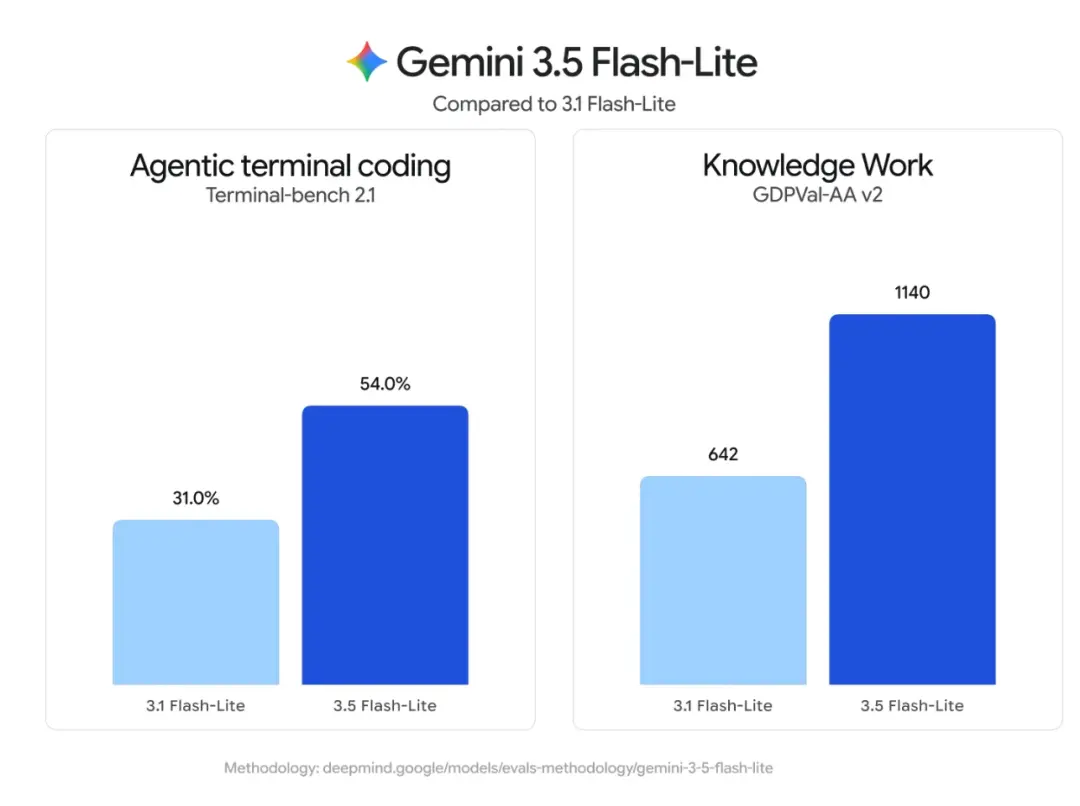
It is worth noting that in some Agent and code-related tests, Gemini 3.5 Flash-Lite even surpassed the higher-positioned Gemini 3 Flash model of the previous generation.
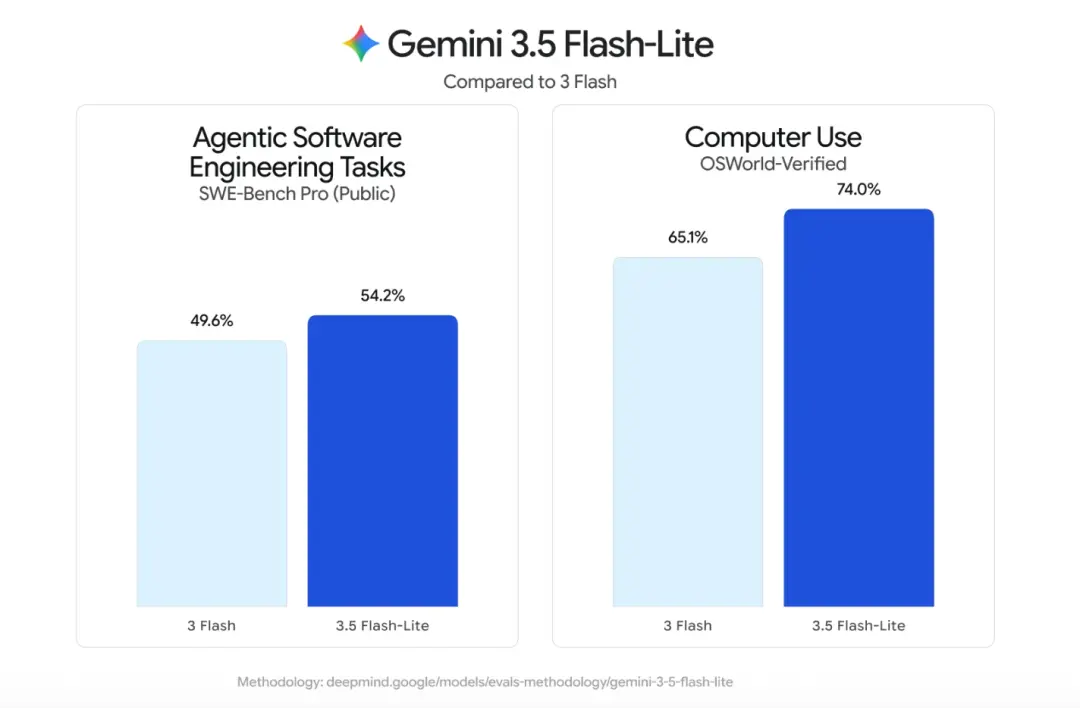
For example, in the SWE-Bench Pro software engineering test, Gemini 3.5 Flash-Lite scored 54.2%, higher than Gemini 3 Flash's 49.6%; in OSWorld-Verified, which tests the ability of AI to operate computers, Gemini 3.5 Flash-Lite also scored 74.0% higher than Gemini 3 Flash's 65.1%.
This means that as model capabilities continue to improve, some Agent tasks that used to require larger models are gradually being reduced to cheaper and faster models.
By the way, in addition to the first two general models for ordinary users, Google also launched Gemini 3.5 Flash Cyber.
It is mainly targeted at network security scenarios. According to official documentation, in the CodeMender system, multiple Gemini 3.5 Flash Cyber Agents can work together to complete different analysis tasks, and finally summarize them into a complete report. Flash Cyber also achieved near-leading model performance in the cybersecurity benchmark CyberGym.
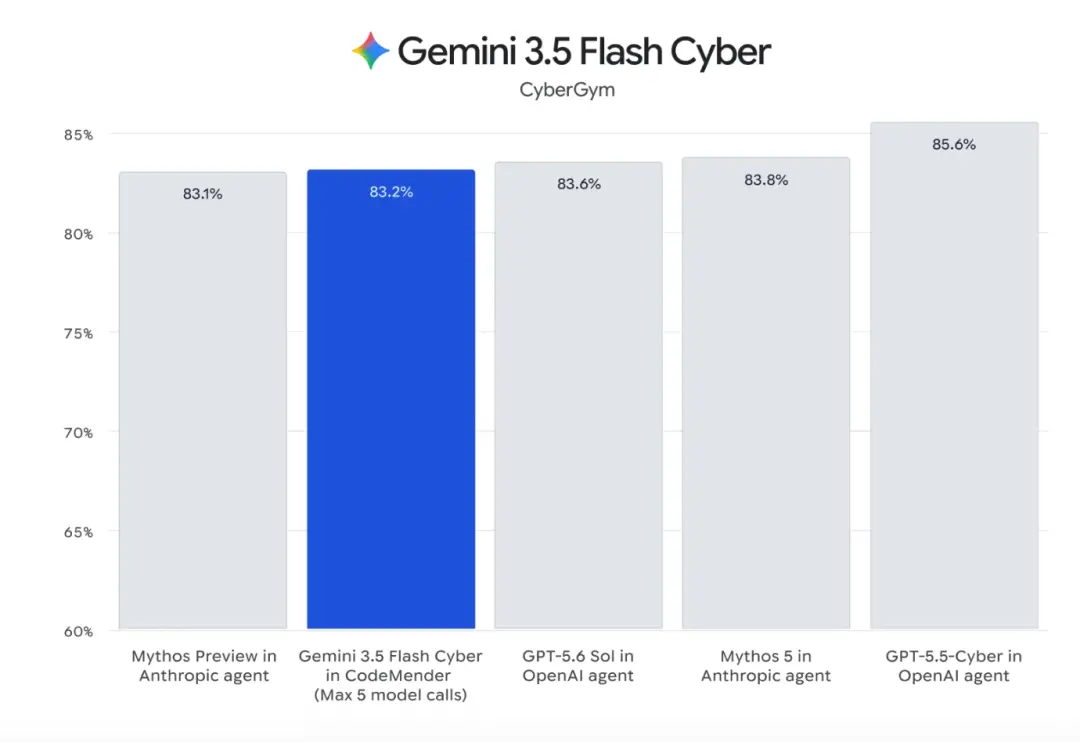
The model will not be publicly available at this time and is only available to governments and trusted partners through the CodeMender platform.
03
3.5 Pro: The flagship answer sheet that Google has been unable to deliver
If Gemini 3.6 Flash and Gemini 3.5 Flash-Lite can be seen as Google's judgment on the large-scale application of AI, then Gemini 3.5 Pro represents the upper limit of Google's model.
But the problem is: this answer sheet has not been handed over yet.
At the I/O in May, Google said that Gemini 3.5 Pro would be launched "in the next month or so", which is expected to be online in June this year. It's now more than half of July.
According to a report by Bloomberg on July 16, the release time of Gemini 3.5 Pro is already several months behind the original plan. Google is continuing to optimize model capabilities, especially coding performance, hoping to achieve internally set goals.
The latest report from Reuters shows that as of now, Google has not announced a specific launch time, only stating that the model is being tested with partners and will be launched "soon"; another press release revealed that the training work of Gemini 4 has already begun.
And we all know that "soon" means uncertainty.
When Gemini 1.0 was released, it was questioned due to demonstration controversy; Gemini 1.5 Pro briefly regained the situation with the context of millions of tokens, but then Claude and the GPT series quickly caught up; it was not until the release of the Gemini 3 series that Google regained the evaluation of "returning to the forefront of competition."
Now that Gemini 3.5 Pro has been postponed again, the market is no longer paying attention to not only when a model will be launched, but also whether Google can maintain the competitive rhythm of flagship models.
What's more, the coding performance revealed by Google is not as good as expected, and it is not a small problem that is easy to solve.
As Agents begin to enter enterprise workflows, the importance of coding capabilities is rapidly increasing. Whether a model can understand complex projects, modify real code, and complete multi-step development tasks has become an important indicator of whether it has actual production value.
Reuters noted that Wall Street is waiting for Gemini 3.5 Pro because it will become an important indicator of whether Google DeepMind can keep up with OpenAI and Anthropic.
Of course, Google is not without action. The several models launched this time just show that Google is strengthening another route: making AI cheaper and easier to scale.
Google CEO Sundar Pichai has recently emphasized the cost advantage many times and said that if enterprises migrate most of their AI workloads to the Gemini model, they can save more than $1 billion per year.
But the problem is that the market is looking forward to an "answer sheet" that proves the strength of Google's model, but what Google has handed over is two "draft papers" about efficiency and cost - it is difficult not to make people feel that Google is using the Flash series to fill the gap left by the Pro delay.
Interestingly, while Gemini 3.5 Pro is being delayed, the AI competitive landscape is changing.
In the past, when people discussed AI leaders, they mainly focused on the "three royal companies" overseas: OpenAI, Anthropic and Google DeepMind.
But recently, domestic models such as GLM-5.2 and Kimi K3 have also begun to enter the cutting-edge competition and triggered a lot of discussion.
The pace of catching up with cutting-edge models is accelerating, which makes Google’s problems more urgent. Of course, it can continue to vigorously launch Flash models, but only if its flagship model is powerful enough - as long as the hard power is enough, there will be great scholars to defend it.
If Google finally launches a truly leading flagship model, then the Flash route will become part of the complete system: Pro is responsible for breaking through the upper limit of capabilities; Flash is responsible for large-scale applications.
But if Gemini 3.5 Pro continues to lag behind, the market is likely to continue to ask: Google has the strongest AI research resources, why can't it consistently outperform its competitors?
People will likely ask for more details about the Gemini 3.5 Pro when Alphabet holds its second-quarter earnings call this week.