According to reports, the latest report released by market research organization Counterpoint Research shows that global PC shipments in the second quarter of 2026 are expected to be approximately 65 million units, a year-on-year decrease of 4%. This is the first year-on-year decline in the global PC market since the first quarter of 2025.
The report points out that an important reason for the cooling of the PC market is the continued rise in prices of core components such as DRAM memory. The surge in DRAM memory prices has put significant pressure on the cost of the entire machine.
The increase in DRAM prices in the past year has been mentioned many times in the industry. The core reason is the unprecedented strong demand for high-speed memory, especially HBM, in the AI and data center markets. Memory manufacturers have shifted their production capacity to more profitable enterprise-level product lines. As a result, the memory supply in the consumer market has been squeezed, and PC manufacturers have to spend more money to purchase the same memory capacity.
Looking specifically at the performance of each company, the three giants in the PC industry, Lenovo, Dell, and HP, all experienced single-digit year-on-year declines in shipments this quarter. Among them, Lenovo continues to rank first in the world with a market share of 25.6%. Its deep supply chain relationships have buffered the cost impact to a certain extent, while Dell's commercial customer business has helped it reduce the impact of the memory crisis.
However, not all manufacturers are falling. Apple's Q2 PC shipments bucked the trend and increased by 13%, mainly due to the launch of new entry-level products such as MacBook Neo, which boosted sales. Asus also achieved a positive growth of 4%. The report analysis believes that this is related to Asus taking the lead in adopting new generation processor technology and vigorously deploying the consumer AI PC market.
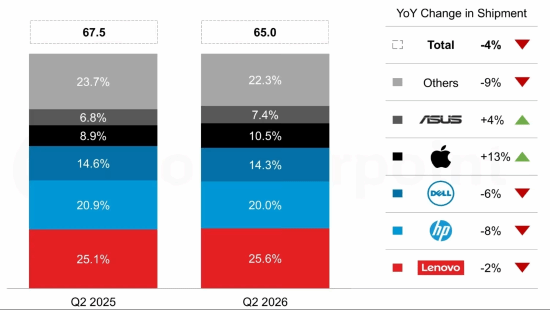
Counterpoint pointed out in the report that the Windows system migration cycle and the popularity of AI PCs are still supporting some commercial replacement demand, but the continued rise in memory prices and component costs are squeezing OEM manufacturers on both sides:
On the one hand, it drives up the material cost of the entire machine, forcing manufacturers to either increase prices, cut off low-priced models, or focus on high-end product lines with high gross profits.
On the other hand, consumers tend to postpone or cancel purchase plans in the face of rising computer prices. If this situation of weak supply and demand continues, the recovery process of the PC market will be further delayed.
As memory prices continue to fluctuate at high levels, the era of "buying a decent computer for three to four thousand dollars" may be fading away.