According to actual measurements by The Verge, the performance of Microsoft's entry-level Surface notebook, which starts at $899, is worrisome: This Snapdragon laptop, equipped with only 8GB of memory, freezes when opening 10 browser pages.You must know that for the past two years, Microsoft has been promoting to the market that 16GB of memory is the necessary threshold to run Windows 11 smoothly. However, as memory prices continue to soar, Microsoft suddenly changed its tune and said that 8GB of memory is enough for daily use, and launched this new Surface machine with only 8GB of memory and a price of up to US$899 (approximately RMB 6,400).
Judging from the paper specifications, this Surface equipped with Qualcomm Snapdragon chip seems to have no problem handling basic tasks such as web browsing, document processing, and audio and video playback, but the actual test results gave the completely opposite answer.
When about 10 Chrome tabs are open in the background at the same time, plus resident communication software such as Slack and Signal, the machine can no longer handle video streaming smoothly. Even in light-load scenarios such as opening a Google Docs online document, the system will become stuck or even crash without warning.
The most embarrassing thing is running Microsoft's own Teams video conferencing software. Severe freezes that last for several seconds or even screen freezes frequently occur. Even the own software cannot be used, which is really unreasonable.
According to actual measurement data, there is only one main reason for the freeze, and that is that the 8GB memory is not enough.
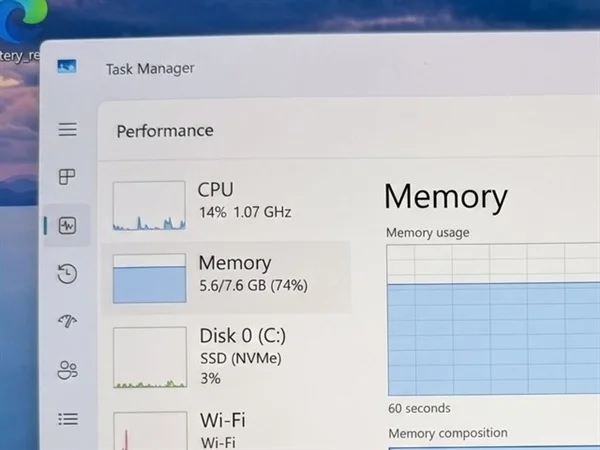
The Windows 11 system natively installed on this machine consumes more than 4GB of memory when it is turned on. More than half of the 8GB of memory is lost in an instant. In daily use, it maintains a high memory usage of 6.7GB for a long time.
At this time, if you run other programs, after the physical memory is drained, the system can only use the SSD as virtual memory. A large amount of data is frequently transferred between the memory and the hard disk. The read and write speed of the hard disk is not at the same level as the memory. This is reflected in the actual experience, which is various inexplicable pauses and freezes.
It is worth noting that Microsoft’s official minimum memory requirement for Windows 11 is only 4GB, but now it seems that not to mention 4GB, even 8GB is far from enough.
In the final analysis, Microsoft's move is more like a helpless compromise under the rising storage prices. Memory is expensive and the cost of the whole machine cannot be kept down. It has no choice but to reduce the configuration and add a set of arguments that 8GB is enough.
But for consumers, it is obviously not cost-effective to spend $899 on a laptop that can’t even open video conferencing smoothly. If you plan to use your next Windows laptop safely for three to five years, 16GB of memory is still the bottom line that cannot be saved.