Fusion energy startup Thea Energy announced that it has received $20 million in funding from the U.S. Department of Energy’s Advanced Research Projects Agency (ARPA-E). The funds will be used specifically to support the production and manufacturing of the company's modular high-temperature superconducting (HTS) magnets.
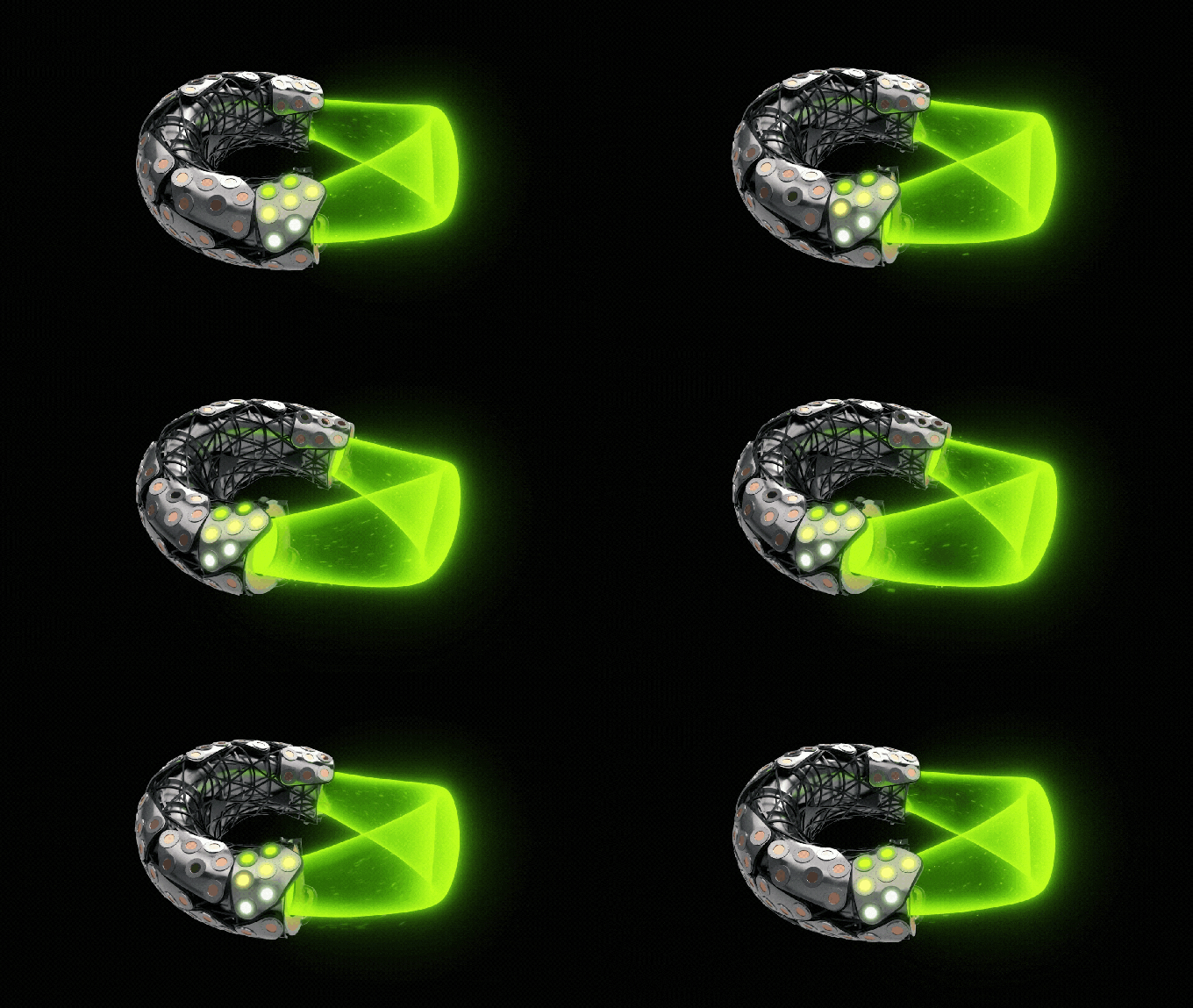
In magnetic confinement nuclear fusion reactors, high-temperature superconducting magnets are extremely critical and costly core components. This technology is also one of the two main directions for commercial nuclear fusion exploration. The reactor generates a strong magnetic field to confine and compress the plasma, heating it to extremely high temperatures, thereby promoting nuclear fusion of the fuel and releasing huge amounts of energy.
The reactor developed by Thea Energy is based on the Stellarator design. Traditional stellarators, which look like a twisted and squeezed tire liner, can more effectively confine plasma, but they usually require magnets to be completely customized to complex shapes, which is extremely expensive to build.
In order to significantly lower the production and manufacturing threshold, Thea Energy has made innovative optimizations in design and reduced the types of magnet specifications. In its reactor, the 12 large magnets responsible for the main confinement tasks only require 4 standard templates, while the more than 300 small magnets used for precise fine-tuning of plasma have completely unified specifications. These small magnets are arranged around the reactor like pixels on a computer screen and are precisely controlled by specialized software. This layout reduces the stringent requirements on manufacturing tolerances and is expected to significantly reduce construction costs.
As one of the nuclear fusion start-ups with the largest financing scale currently, Thea Energy just completed US$100 million in financing in May this year, and previously received US$20 million in Series A financing in 2024. Like most competitors in the industry, Thea Energy plans to build a commercial-scale fusion power plant by the mid-2040s.