
Abstract:
The long-standing bottleneck of video memory capacity in the graphics card industry may usher in an important breakthrough in the next few years. The latest news shows that memory chip manufacturers are planning to launch GDDR7 video memory particles with a single capacity of 4GB and 6GB. If the relevant plans proceed smoothly, the next generation of consumer and professional graphics cards is expected to obtain video memory configurations that far exceed the current level.
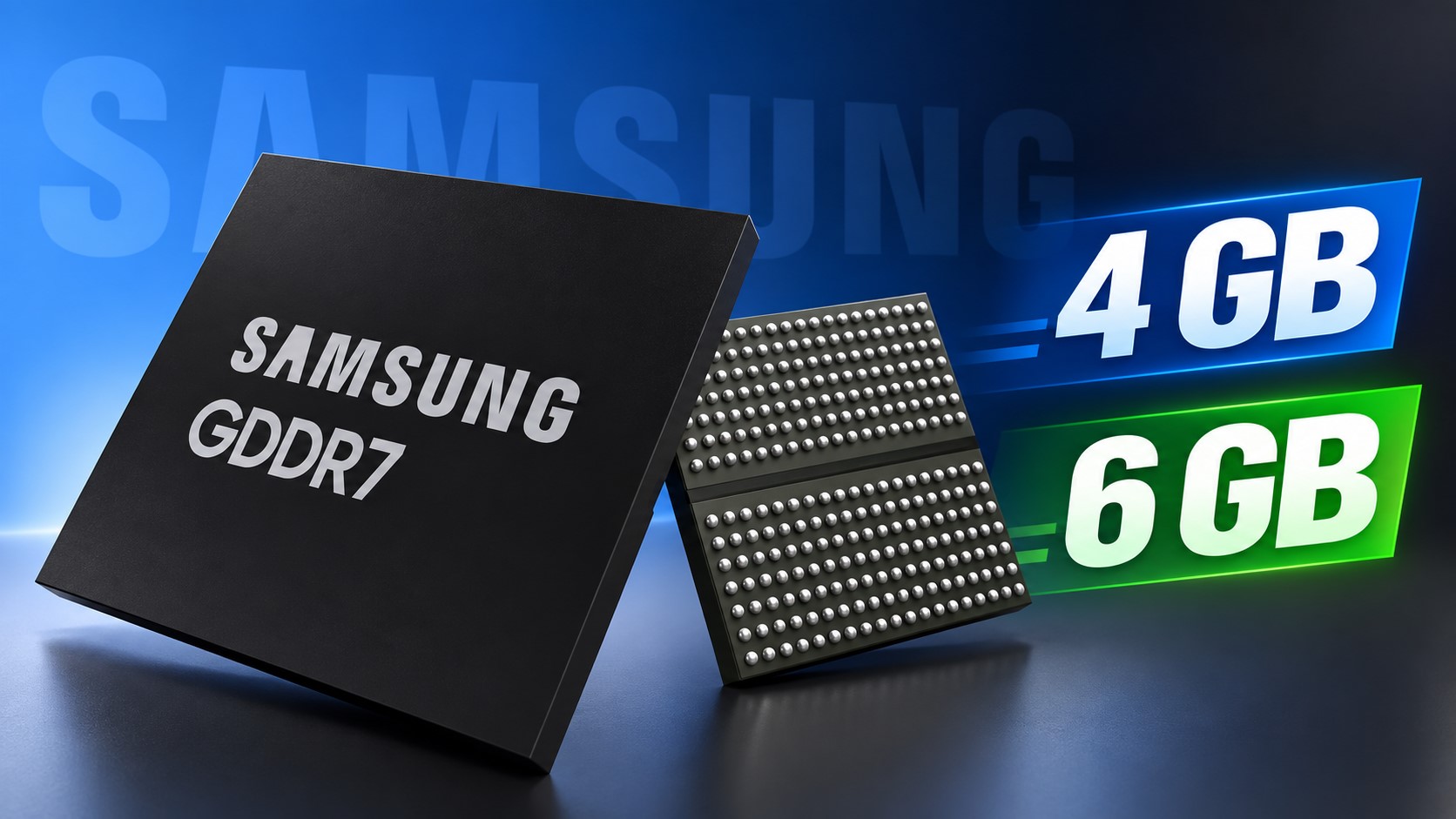
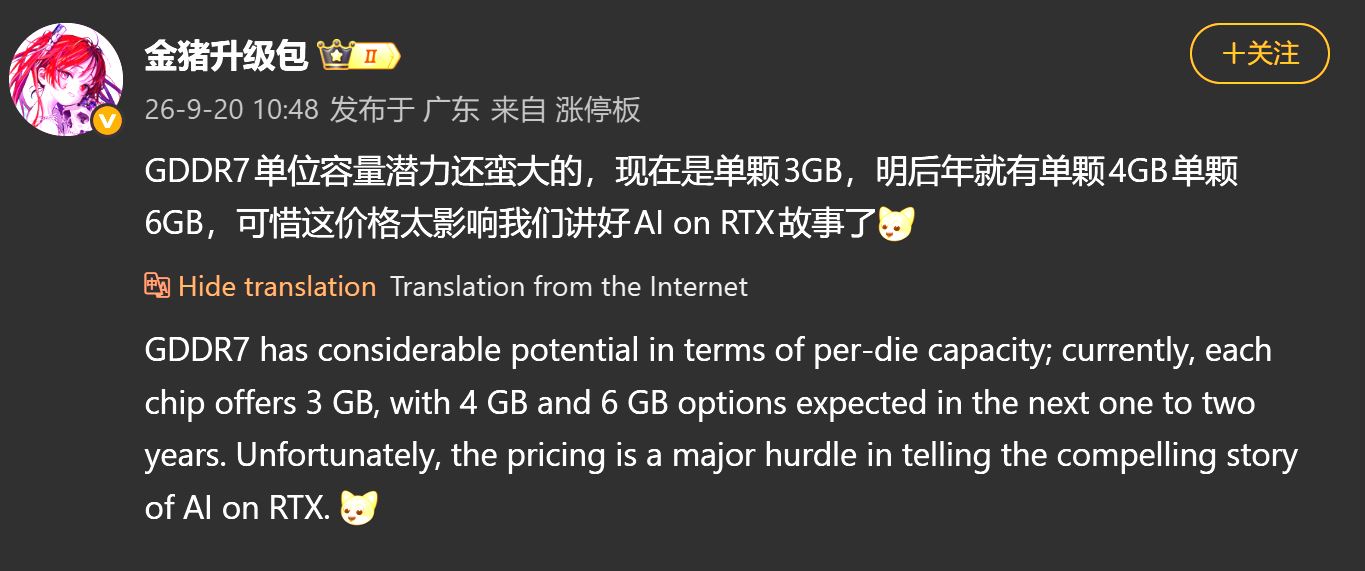
The news comes from "Golden Pig Upgrade", a well-known whistleblower in the industry. According to it, storage manufacturers are expected to successively launch 4GB and 6GB capacity GDDR7 video memory particles between 2027 and 2028. Although it is still information that has not been officially confirmed, considering that the relevant whistleblower has a relatively high accuracy rate in the past, it has attracted widespread attention in the hardware industry.
Most of the mainstream GDDR7 video memory products currently on the market are designed with a single 2GB capacity. Taking NVIDIA's existing Blackwell architecture GeForce RTX 50 series graphics cards as an example, the video memory configuration is still mainly built around 2GB GDDR7 particles. This is also an important reason why a large number of mid-range and entry-level graphics cards have stayed at the 8GB, 12GB or 16GB video memory level for a long time.
It has been previously reported in the market that NVIDIA plans to introduce 3GB GDDR7 particles in the RTX 50 SUPER series to achieve a more flexible graphics memory combination. However, as of now, the relevant SUPER series products have not been officially announced, and there is also uncertainty in subsequent progress.
In fact, major storage manufacturers such as Samsung, SK Hynix and Micron have begun to promote the production of 3GB GDDR7 particles. However, due to tight supply and cost issues, such products have not yet entered the consumer graphics card market on a large scale.
Reports indicate that NVIDIA originally even planned to launch an RTX 5050 graphics card equipped with 9GB of video memory, but the product was eventually canceled due to storage supply issues. Therefore, although 3GB GDDR7 particles already exist in industry planning at this stage, there is still a certain distance from being fully popularized.
In this context, the emergence of 4GB and 6GB GDDR7 particles is considered to be of great significance.
If future graphics cards continue to use the existing memory bus design, higher-capacity particles will directly lead to a significant increase in the size of the graphics memory. For example, a mainstream graphics card using a 128-bit bus and equipped with 4 video memory chips can currently only get 8GB of video memory using 2GB chips; if it uses 4GB chips, it can be directly upgraded to 16GB; if it uses 6GB chips, it can reach 24GB.
For 192-bit bus products, the video memory capacity can be increased from 12GB to 24GB or even 36GB; and under the 256-bit bus configuration, there is an opportunity to achieve a large video memory scale of 32GB or even 48GB.
Industry insiders believe that this will completely change the current situation of mid-range graphics cards being limited to 8GB of video memory for a long time. As the image quality of games continues to improve, the scale of local AI models continues to expand, and the demand for creative software grows, video memory capacity is becoming more and more important.
At the same time, future high-end graphics cards and professional computing products will also benefit from higher-density graphics memory technology. Some accelerator cards for the fields of artificial intelligence, 3D rendering and scientific computing are expected to achieve higher capacity without increasing the PCB area and the number of video memory particles.
Judging from the timing, this revelation coincides with NVIDIA’s next-generation product planning. The market generally expects that NVIDIA's RTX 60 series graphics cards, codenamed "Rubin", will not be released before 2028. Therefore, when the RTX 60 series comes out, higher-capacity GDDR7 particles may have entered the mature mass production stage.
If this trend becomes a reality, it will no longer be difficult for mid-to-high-end graphics cards to exceed 20GB or even 30GB of video memory capacity in the future.
However, increased capacity does not necessarily mean that product prices will decrease. In fact, the biggest problem faced by 3GB GDDR7 particles before was the high cost, which is also an important reason why some related products have not been launched.
Therefore, even if 4GB and 6GB GDDR7 particles are successfully mass-produced in the future, their initial price may still be quite expensive. For ordinary consumers, whether higher graphics memory configurations can truly become popular will still depend on memory chip price trends and changes in market demand.
Nevertheless, this news still sends a positive signal to players and creators who have long paid attention to the development of graphics cards. As higher-density GDDR7 video memory technology gradually matures, the video memory capacity limitation that has plagued mid-range graphics cards for many years may finally see a substantial breakthrough.
Comments