
Abstract:
Chinese memory chip company Changxin Memory (CXMT) is expected to officially launch mass production of HBM3E high-bandwidth memory before the end of 2026, marking the first time that a local Chinese manufacturer has entered the advanced HBM market. This progress is regarded as an important milestone for China's artificial intelligence industry chain to improve its independent supply capabilities.
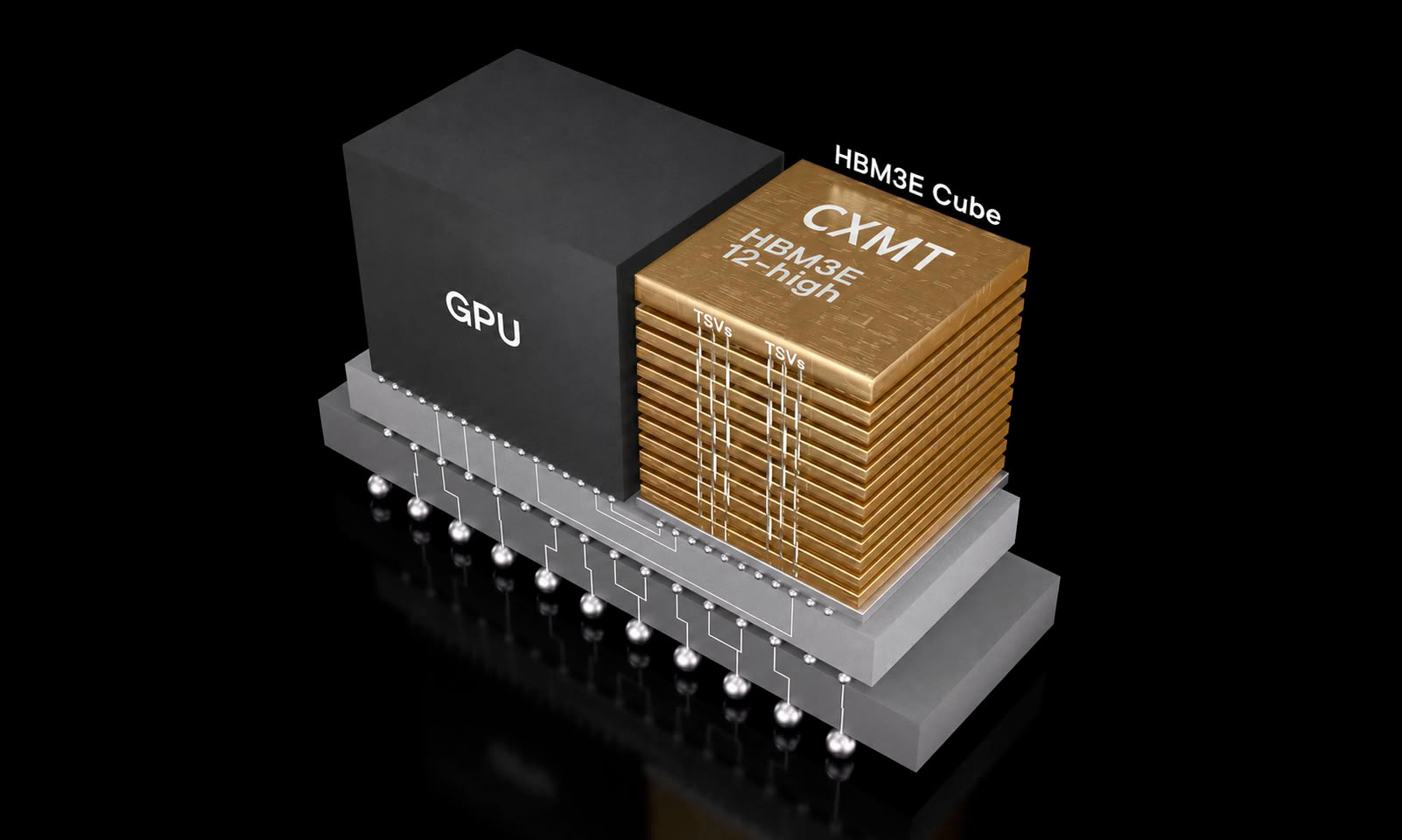
According to the latest news in the industry, Changxin Storage plans to start mass production of HBM3E within the next two months. In August this year, the company started risk trial production of HBM3E and provided samples to some customers. Today, related products are gradually advancing towards the commercialization stage.
HBM is one of the most critical storage technologies for current artificial intelligence accelerators, data center GPUs and high-performance computing systems. Due to its ability to provide much higher bandwidth than traditional DRAM, HBM has become an indispensable core component for training and running large-scale artificial intelligence models. At present, the global HBM market is mainly controlled by SK Hynix, Samsung Electronics and Micron.
According to JEDEC standards, HBM3E adopts a 1024-bit bus design, and the single-pin transmission speed can reach 9.2Gbps to 12.4Gbps. The mainstream configuration is usually 9.6Gbps. Its total bandwidth is approximately 1.2TB/s, and it can provide capacity configurations from 24GB to 36GB, including two mainstream solutions: 8-layer stacking and 12-layer stacking.
However, mass production is not easy for Changxin Storage. Industry news shows that HBM3E is still facing yield challenges. Since HBM uses multi-layer DRAM dies to be vertically stacked through TSV through-silicon via technology, which requires extremely high manufacturing and packaging processes, yield rate has become an important factor restricting production capacity expansion.
Sources revealed that the current overall yield rate of Changxin Storage HBM3E is about 20% to 30%, which is significantly lower than the level of leading international manufacturers. Among them, the yield rate in the front-end wafer manufacturing stage is about 30%. After entering the back-end packaging, the pass rate can be further improved by about 70%. However, in the end, the overall yield rate still has a lot of room for improvement.
Industry analysts believe that the biggest technical challenge for Changxin Storage currently comes from the maturity of TSV technology. Compared with international manufacturers, there is still a certain gap in its stacking process. For example, Samsung uses about 5,000 TSV connections on a single layer in the HBM2 era, while SK Hynix has exceeded 8,000 on HBM3 products. Changxin Memory is trying to use about 3,000 TSVs to implement the HBM3E design, which places higher requirements on manufacturing accuracy and reliability.
Limited by relevant technical factors, Changxin Storage is expected to focus on 8-layer stacked HBM3E products in the short term and will not rapidly advance to 12-layer stacked products with larger capacity for the time being.
At the same time, multiple news agencies disclosed that Changxin Memory has provided two versions of HBM3E samples to domestic AI chip companies, including a standard version and a new version optimized for yield. Relevant samples are currently being tested and verified on the customer side.
In terms of performance, preliminary tests show that the overall performance of Changxin Storage's current HBM3E products is closer to SK Hynix's previous generation HBM3, but there is still a gap compared with internationally advanced HBM3E products. However, industry insiders pointed out that for manufacturers that have just entered the HBM track, achieving mass production itself is a major breakthrough.
Analysts believe that even if the current yield rate is not high, Changxin Storage still has the motivation to continue to promote mass production. As China's AI chip manufacturers' demand for high-bandwidth memory grows rapidly, the importance of local HBM supply sources continues to increase. Faced with the tight supply of advanced AI storage and the pressure brought by import restrictions, there is obvious demand for HBM products in the domestic market.
The market has seen an increase in AI chip prices recently, and the supply of high-bandwidth memory is generally regarded as one of the important reasons. Chip companies including Alibaba Pingtouge and Cambrian have previously been exposed to testing domestic HBM solutions in the hope of reducing their dependence on overseas supply chains.
The industry predicts that if customer verification goes smoothly, domestic AI accelerator products using Changxin Storage HBM3E are expected to enter the market as soon as 2027. Although there is still a technology gap of one to two generations compared with the world's leading manufacturers, Changxin Storage's entry into the HBM field means that China's local AI hardware ecosystem is completing key pieces of the puzzle and is beginning to challenge the high-end AI storage market.
Comments