
Abstract:
The Japanese graphics card market is facing a new round of price increases. As the supply of video memory is tight and the demand for artificial intelligence computing continues to squeeze out hardware resources, the price of NVIDIA GeForce RTX 50 series graphics cards has increased significantly in the Japanese retail market. Among them, some retail quotations for the mid-range RTX 5060 Ti 16GB version have exceeded US$1,200; the higher-end RTX 5080 has also exceeded US$2,400. Graphics cards originally aimed at mainstream gamers are becoming increasingly unaffordable.
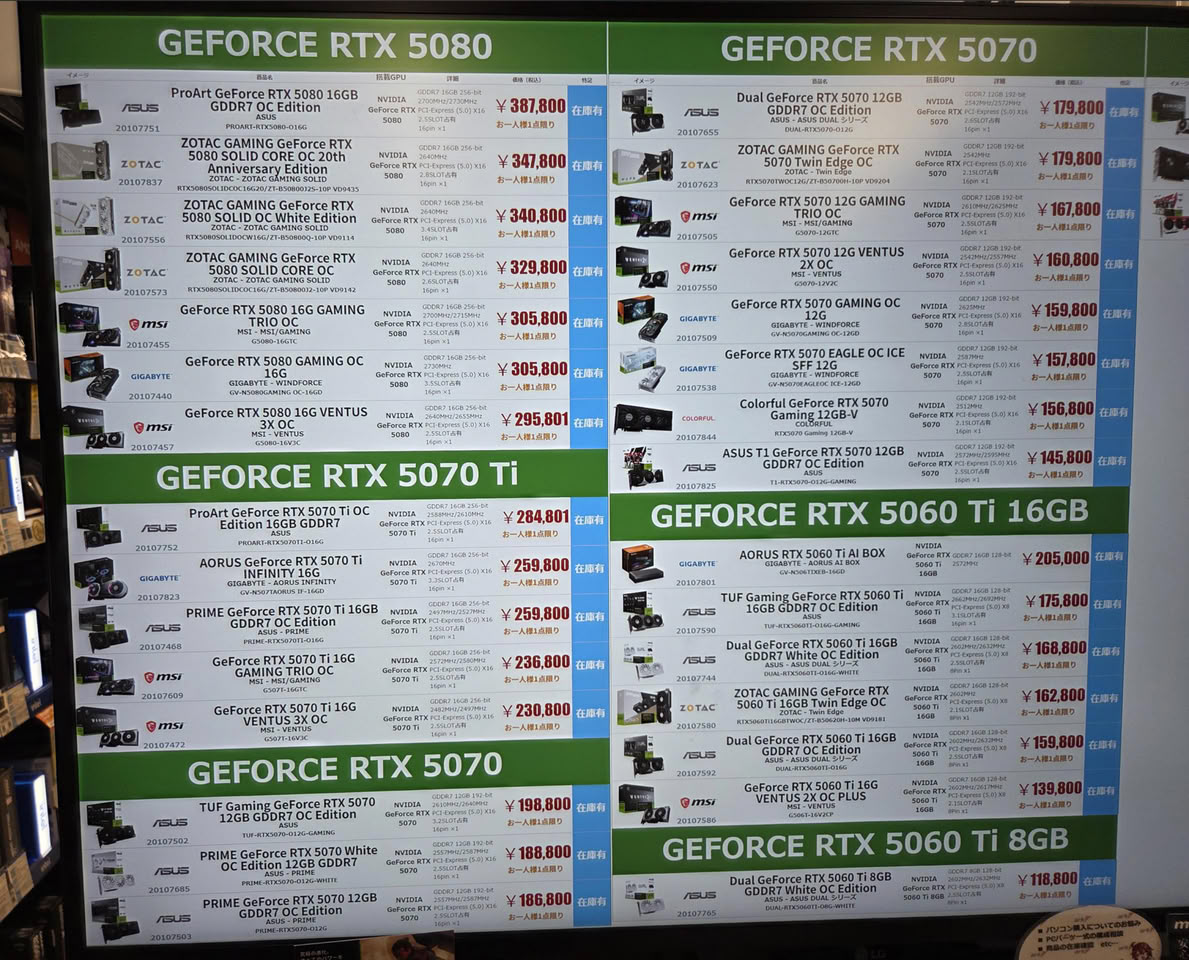
According to recent quotations from Japanese retailers and surveys by overseas media, the prices of multiple models of the RTX 50 series have increased. The highest offer for the RTX 5060 Ti 16GB is about $1,292, while the 8GB version also appears for about $749. The prices of the RTX 5070 series and RTX 5080 are also at a high level, and the selling prices of some products have significantly deviated from consumers' expectations for the positioning of the corresponding products. It's important to note that these numbers are derived from retail market quotes and do not mean that all stores sell them at the same price, nor do they represent an equal change in the graphics card's official suggested retail price.
From the specific price point of view, the increase of RTX 5060 Ti 16GB is particularly outstanding. The Japanese market price of this model when it was launched was about 85,000 yen, which is equivalent to about 530 US dollars according to the exchange rate used in the report; now the price quoted by retailers has risen to 139,800 to 205,000 yen, which is equivalent to about 881 to 1,292 US dollars. The highest quotation increased by approximately 144% from the initial stage of listing. Even based on the low end of the quotation range, the increase reached approximately 66%.
In comparison, the price of the RTX 5060 Ti 8GB version is not optimistic. Its initial price on the market was about 75,000 yen, equivalent to about 472 US dollars. Now the price has reached 118,800 yen, about 749 US dollars, an increase of about 59%. This means that even if consumers choose a model with a smaller memory capacity, it will be difficult for consumers to avoid the impact of price increases.
What is even more surprising is that the quotations of some RTX 5060 Ti 16GB are close to or even exceed those of the RTX 5070. The latter's current price in Japan is about 145,800 to 198,800 yen, which is equivalent to about 914 to 1,253 US dollars. The price has also increased by about 32% to 82% compared with the initial stage of listing. For consumers, if the price of the RTX 5060 Ti is close to the higher-level RTX 5070, the product selection originally based on cost performance will be seriously disrupted.
The situation is even more pronounced for high-end models. The Japanese market price of the RTX 5080 when it was launched was about 198,000 yen, equivalent to about 1,260 US dollars, and the current quotations from some retailers have reached 288,000 to 378,000 yen, equivalent to about 1,864 to 2,444 US dollars. Compared with the initial stage of listing, the price increase is approximately 48% to 94%. This also shows that the price increase does not only affect a few entry-level products, but has also affected multiple grades of RTX 50 series graphics cards.
This price increase may be related to a variety of factors. First, video memory supply and cost pressures are affecting graphics card manufacturing and retail. Graphics cards need to be equipped with dedicated video memory. Increased prices or limited supply of video memory may increase manufacturers' production costs and further affect terminal selling prices. At the same time, the demand for GPU and related semiconductor resources for artificial intelligence computing infrastructure continues to be strong, and the market is also concerned that consumer-grade graphics cards may be affected by changes in supply resource allocation.
However, all price increases cannot be simply attributed to the demand for artificial intelligence. The final selling price of a graphics card is also affected by product inventory, dealer pricing, the Japanese yen exchange rate, import costs, and supply and demand for different brands and models. Current retail quotations reflect sales in a specific market and at a specific time and are not sufficient to prove that all regions will see price increases of the same magnitude.
Price changes in the Japanese market have also attracted the attention of consumers in other regions. Tom's Hardware compared Japanese retail quotations with the prices of related products on Amazon in the United States and found that some RTX 50 series graphics cards in the Japanese market are significantly more expensive. Among them, the price gap between RTX 5060 Ti 8GB is particularly significant. However, cross-market comparisons also need to consider factors such as taxes, exchange rates, specific brands, models, and promotions. Therefore, it cannot be concluded that the actual purchase costs in various regions are exactly the same based on the U.S. dollar conversion price alone.
For ordinary gamers, the RTX 5060 Ti 16GB was originally a mainstream mid-range graphics card. Its 16GB video memory capacity also makes it attractive for high-resolution games, some creative tasks, and local AI applications. But when the price exceeded US$1,200, there was an obvious misalignment between its product positioning and its actual price. In this case, consumers may turn to higher-performance graphics cards, AMD Radeon products of the same price range, or postpone their upgrade plans.
What is more noteworthy is that the increase in graphics card prices does not necessarily mean a sudden improvement in the performance of the product itself. The RTX 5060 Ti is still a product with original specifications, and the price increase mainly reflects changes in supply and market environment, rather than a corresponding increase in its gaming performance. If consumers pay a much higher price for the same graphics card than it did when it first came on the market, the actual performance value gained will decrease.
It is still unclear how long the high prices in the Japanese market will last, nor can we conclude that the global graphics card market will fully enter a long-term price increase cycle. However, as factors such as memory costs, supply conditions and AI computing demand have not yet been significantly alleviated, consumer GPU prices may still face pressure. For users who plan to purchase a new graphics card, in addition to paying attention to the price tag of a single model, it is also necessary to compare the actual performance, memory capacity and power consumption of products in the same price range, and pay attention to the price differences between different retailers.
Comments