
Abstract:
A research team from the University of Gothenburg in Sweden announced that they have successfully prepared for the first time a new carbon allotrope, Diamondiyne, which was previously only a theoretical model. This breakthrough means that after diamond, graphite, fullerene, carbon nanotubes and graphene, a new member of the carbon family has been added.
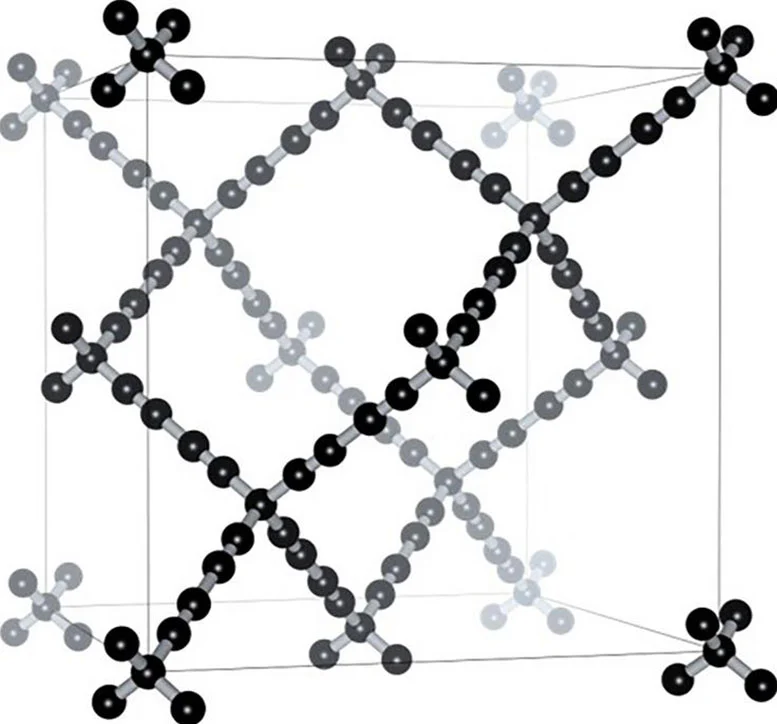
Carbon is known for its rich and diverse bonding methods, allowing it to form a variety of structures with vastly different properties. Among them, diamond is known for its extremely high hardness, while graphite is soft and conductive due to its layered structure. For decades, scientists have been discovering new carbon structures, and Diamondiyne is the latest to be successfully realized.
In fact, Diamondiyne was first predicted to exist by theoretical chemists 35 years ago. However, due to its complex structure and harsh formation conditions, it has not been confirmed in experiments, so it has long been regarded as a material that only exists in theoretical calculations.
The research was led by Karl Boyeson, professor of physical chemistry at the University of Gothenburg. The research team finally constructed a new three-dimensional crystal structure by connecting carbon atoms to each other with three bonds. The structure consists of a large number of tetrahedral units connected to each other by vertices, forming a regular network in three-dimensional space.
Compared with traditional diamond, the biggest feature of Diamondiyne is the existence of natural voids inside. The researchers said the structure could be understood as a "porous diamond." Because there are pores between the tetrahedrons, the material has obvious porous characteristics.
More importantly, making Diamondiyne does not require the extreme high-pressure environment that the formation of natural diamonds does. The research team used relatively cheap experimental equipment to generate an extremely thin film at the interface formed by the contact between the two liquids, and successfully induced the carbon atoms to arrange themselves in the desired manner.
To verify the authenticity of the structure, the researchers collaborated with scientists from Stockholm University and Chalmers University of Technology to analyze the material using advanced electron microscopes. The observation results show that a repeating lattice structure that is highly consistent with the theoretical model has been formed in some areas of the film surface.
The research team stated that they have successfully observed Diamondiyne’s unique repeating arrangement pattern in a tiny area with a side length of about 10 nanometers. Although the scale is still very limited, the images obtained are highly consistent with theoretical predictions, providing strong evidence for the existence of this new material.
Boyerson said that this achievement was hard-won. Since there are many uncertain factors in the assembly process of carbon atoms that may lead to failure, the team went through a long period of exploration before finally finding the correct preparation method. He admitted that he felt very gratified to be able to see this theoretical structure become reality with his own eyes.
This research actually stems from the team’s long-term research on covalent organic framework materials. In recent years, porous materials have become an important research direction in materials science. The metal-organic frameworks (MOFs) recognized by the 2025 Nobel Prize in Chemistry are important achievements in this field, and Diamondiyne has demonstrated new possibilities for porous materials composed entirely of carbon.
Scientists believe that although there is still a long way to go before mass production and practical application, Diamondiyne's unique three-dimensional porous structure makes it possible to be used in fields such as energy storage, batteries, electrocatalysis, gas storage and advanced electronic materials in the future.
From diamond to graphene and now, for the first time, Diamondiyne, carbon continues to demonstrate amazing structural creativity. The researchers believe that this result not only confirms long-standing theoretical predictions, but also opens up new research directions for the development of new functional materials.
Comments