
Abstract:
At the bottom of the human brain, there is a gland that is only the size of a pea, but it is in charge of the secretion of various hormones throughout the body. It is the pituitary gland, which is often called the "endocrine commander-in-chief" of the human body. Once pituitary function is damaged, patients often need to take lifelong medication every day to replenish the missing hormones. Now, a research team from Nagoya University in Japan has taken a crucial step. They used human stem cells to grow pituitary tissue and successfully transplanted it into primates for the first time, restoring their ability to secrete hormones.

This result was published in the international journal "Stem Cell Research and Treatment". The first author of the paper is Tatsuma Kondo, a visiting researcher at the Graduate School of Medicine, Nagoya University.
Although hypopituitarism is not a common disease, patients require lifelong management and their quality of life is often significantly affected.
1. Pituitary gland: small gland, big responsibility
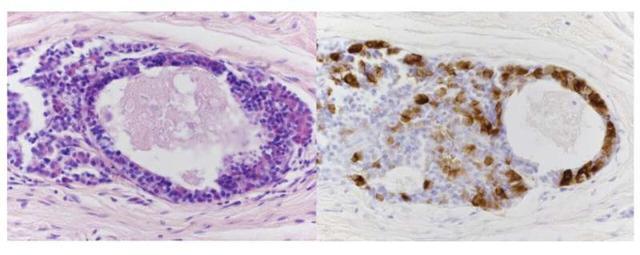
Although the pituitary gland is small, it plays an important role.
The adrenocorticotropic hormone it secretes stimulates the adrenal glands to produce cortisol. Cortisol is a key hormone for the body to cope with stress and maintain blood pressure and blood sugar stability. Without it, people will suffer from fatigue, loss of appetite, weight loss, and in severe cases, it may even be life-threatening.
The pituitary gland also secretes growth hormone, thyroid-stimulating hormone and other hormones. This study mainly focused on adrenocorticotropic hormone, which is related to cortisol.
Patients with hypopituitarism due to tumors, surgery, trauma or congenital factors currently mainly rely on oral drugs to supplement hormones.
However, this treatment method has obvious limitations. The hormones naturally secreted by the human body will adjust in real time according to the circadian rhythm and external pressure. However, it is difficult to accurately simulate this dynamic change by taking medication at regular times every day.
Especially during infection, surgery or severe mood swings, the body's need for cortisol will increase sharply, and it is difficult for patients taking medication to adjust their dosage in time.
Insufficient dosage may lead to dangerous adrenal crisis, while excessive dosage may cause side effects such as osteoporosis and metabolic disorders.
If patients can regain a "living pituitary gland" that can adjust themselves, it would undoubtedly be a more ideal solution.
2. The leap from mouse to monkey
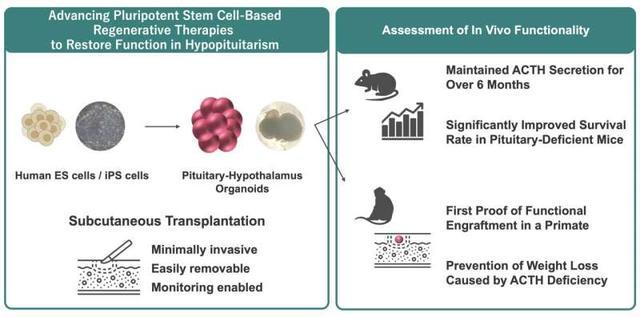
The research team’s idea is to use organoid technology.
Organoids are miniature tissues formed from stem cells cultured in the laboratory, which can simulate the structure and function of real organs to a certain extent. Nagoya University has many years of experience in cultivating pituitary tissue using human stem cells.
As early as 2016, a team from the school reported in Nature Communications that they used human embryonic stem cells to grow functional anterior pituitary tissue in vitro.
The researchers first transplanted the cultured human pituitary organoids into mice whose pituitaries had been surgically removed, just under the skin.
The results are encouraging. These organoids continued to secrete adrenocorticotropic hormone for more than 6 months and significantly extended the lifespan of the mice.
Six months is a long time for mice whose life span is only two or three years. The ingenuity of the research is to transplant it under the skin instead of deep into the brain. The subcutaneous surgery is less invasive and simple to operate, and it can be easily removed if problems arise.
On this basis, the team further conducted experiments on a macaque whose pituitary gland had been removed. To prevent rejection, researchers used immunosuppressive drugs.
After transplantation, the artificial pituitary tissue worked normally in the monkeys for 6 weeks, successfully secreting adrenocorticotropic hormone and increasing cortisol levels. Three months after surgery, the researchers were still able to detect viable transplanted cells.
What's more, the transplant slowed the monkeys' weight loss caused by hormone deficiency. The researchers also examined organs such as the lungs and liver and found no tumors or abnormal cell growth.
3. Security is the biggest concern
A major concern with stem cell therapy is that transplanted cells may proliferate out of control and even form tumors.
This time no tumors or abnormal growths were observed in mice or monkeys, providing preliminary evidence for the safety of this technology.
Primates are closer to humans in terms of physiological structure and immune response, so success in monkeys is seen as an important step towards clinical application.
Of course, this research is still in its early stages.
The primate experiment involved only one macaque, and the sample size was very limited. The effective working time of transplanted tissue in monkeys is 6 weeks, which is much shorter than the performance in mice. How to extend its long-term function requires further exploration.
In addition, immunosuppressive drugs themselves have side effects. In the future, if stem cells prepared from the patient's own cells can be used to cultivate pituitary tissue, it may be possible to avoid rejection and reduce dependence on immunosuppressive drugs.
4. The Japanese power of regenerative medicine
This research continues Japan’s tradition of leadership in stem cells and regenerative medicine.
Japanese scientist Shinya Yamanaka won the 2012 Nobel Prize in Physiology or Medicine for the invention of induced pluripotent stem cell technology. Since then, Japan has carried out a large number of clinical explorations in the use of stem cells to treat Parkinson's disease, retinal diseases, heart disease, etc.
The idea of turning a small piece of tissue under the skin into a "hormone factory" that can regulate itself is moving from science fiction to reality. The researchers believe that this method may provide a hormone replacement solution for hypopituitarism that is closer to the natural physiological state than taking daily pills.
Of course, it usually takes several years and a strict approval process to move from animal experiments to human clinical trials. If follow-up research can address issues such as long-term survival, immune rejection and large-scale production, future patients may only need a simple subcutaneous transplant to be freed from the burden of lifelong medication.
Comments