
Abstract:
A research team led by the New Jersey Institute of Technology in the United States has developed an artificial intelligence system that can identify extremely weak warning signals in advance before solar active areas actually appear on the visible surface. Research shows that the system can detect signs of the formation of new active areas nearly nine hours in advance on average, providing new possibilities for predicting solar storms in the future.
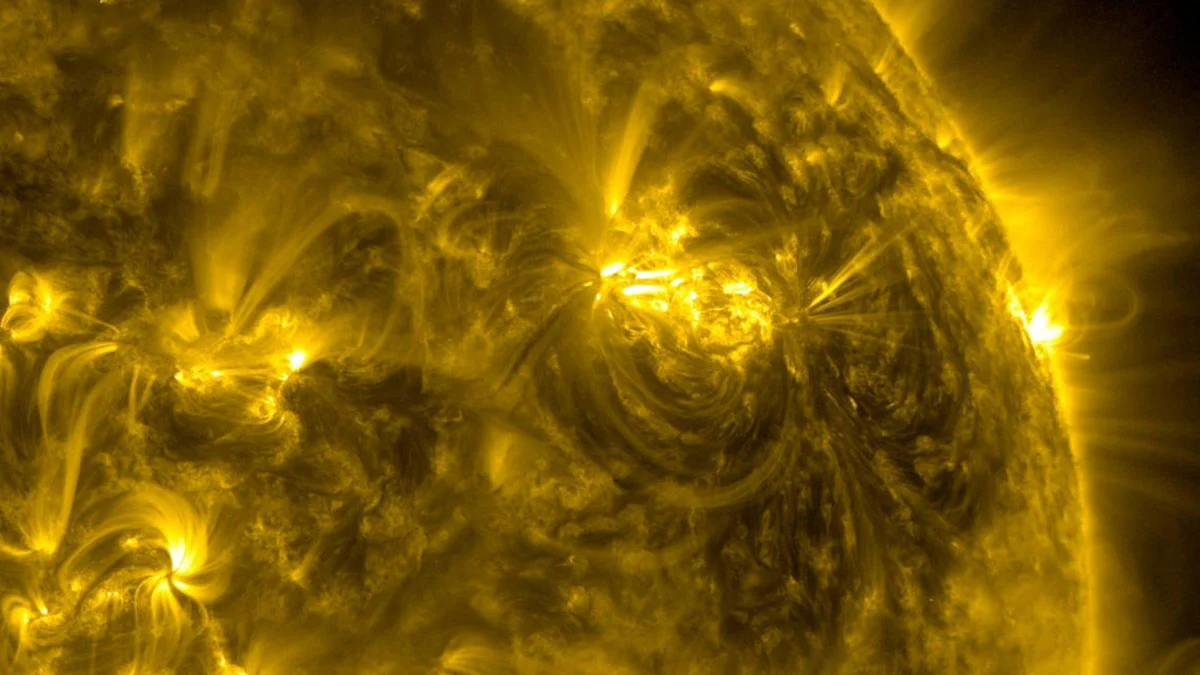
Before sunspots darken the sun's visible surface, the magnetic activity that creates them is actually developing quietly inside the sun. These early changes are so weak that they have long been difficult for scientists to stably identify. Now, an artificial intelligence model called "EarlyDetect" is able to find relevant clues in the sun's acoustic activity and magnetic field changes, detecting the precursors of new solar active regions an average of 9.24 hours before they become visible.
This study was completed by the New Jersey Institute of Technology research team, and the results were published in the "Journal of Geophysical Research: Machine Learning and Computing" on August 14. The model was developed by Jonas Tirona, an undergraduate researcher at the New Jersey Institute of Technology in collaboration with computer scientists and solar physicists at the school, as well as researchers at Princeton University and NASA's Ames Research Center. The study used data from NASA's Solar Dynamics Observatory.
Tirona said that the greatest value of this work is that it proves that machine learning can predict in advance when solar active areas will appear. If reliable early warning systems can be further developed, satellite communications companies and power grid operators may be able to take measures in advance to reduce the potential damage caused by solar storms.
The solar active region is an area with extremely strong magnetic activity, where sunspots usually form. It often takes several hours for an active region to appear and reach the sun's surface, and it may take one to several days to fully form.
Before these regions reach the Sun's surface, the rising magnetic field has subtle effects on the sound waves traveling through the Sun's interior. Scientists can study these vibrations through "helioseismology," using the waves propagating inside the sun to analyze internal processes that cannot be directly observed.
EarlyDetect looks for abnormal patterns before the formation of active regions by analyzing acoustic power maps generated every hour and combining them with solar magnetic field measurement data. The acoustic data come from the Helioseismic and Magnetic Imager at the Solar Dynamics Observatory. The instrument records acoustic measurements every 45 seconds, allowing researchers to construct a picture of the acoustic activity inside the Sun.
Alexander Kosovichev, Distinguished Professor of Physics at the New Jersey Institute of Technology and co-leader of the project, pointed out that the main difficulty faced by the research is that the solar active region is initially formed below the visible surface, and scientists cannot directly observe its magnetic structure. As a result, researchers can only look for extremely small changes in the Sun's magnetic field and sound wave propagation patterns. The process is like discerning subtle changes in rhythm in a noisy orchestra.
EarlyDetect uses the Transformer architecture. This type of artificial intelligence technology is also widely used in large language models such as ChatGPT. However, EarlyDetect does not analyze language, but looks for statistical patterns in solar observation data that may indicate changes in solar activity.
During the research process, the team also found that the filtering method originally used to remove noise and help the model identify important solar signals actually reduced the prediction effect.
When Tirona joined the project, the researchers were using a filtering technique hoping to highlight important solar patterns on short time scales. But test results show that filtering observational data degrades the model's prediction quality. Kosovichev said that the research team initially thought that filtering could isolate useful signals, but found that it averaged out the weakest but earliest fluctuations.
Tirona likened the process to noise reduction technology. Typically, noise reduction can remove strong noise and make overall trends clearer, but the researchers found that in almost all cases, noise reduction had a negative impact. The filtered signals are precisely the important information that helps the model determine when the active area appears.
The researchers used data from NASA's Solar Dynamics Observatory and the Helioseismic and Magnetic Imager to train EarlyDetect, and then asked the model to analyze solar active areas that did not appear in the training data to test its generalization ability.
The results show that the best-performing model was able to identify relevant precursors on average 9.24 hours before solar active areas became visible, outperforming the standard Transformer model and previously used baseline methods.
Mengjia Xu, assistant professor of data science at the New Jersey Institute of Technology and project leader, said that machine learning has not yet been widely used in solar activity prediction, but this study shows that advanced machine learning models may open new directions for future space weather forecasting.
This research is also one of the first projects supported by the Grace Hopper Institute for Artificial Intelligence at the New Jersey Institute of Technology. The institute was established in 2025 to promote interdisciplinary research in the field of artificial intelligence. The project also received support from NASA's Heliophysics and Space Weather research programs, including the Center for Science-Driven Research and Innovation and the Consequences of Fields and Flows in and Out the Sun.
In order to promote follow-up research, the team also disclosed relevant data resources. They released the Solar Active Area Formation Dataset, or SolARED. This is a database of solar active areas compiled based on observations from the Solar Dynamics Observatory. In addition, the researchers also established a solar active area portal to provide users with interactive observation data browsing functions.
Xu said that this is the first solar active area formation data set open to the public and can provide a common resource for the machine learning and heliophysics research communities to develop and test new prediction methods.
However, the research team emphasized that EarlyDetect cannot yet be used as a real-time operational forecasting system. The model was trained on known solar active region formation events and may still issue false alarms or give predictions after active regions have already occurred.
Furthermore, identifying that a solar active region is forming does not mean that a solar flare or coronal mass ejection is imminent. Many solar active regions do not ultimately produce large-scale outbursts. The researchers also need to further test the model using a larger number and a wider range of solar events.
Tirona expressed the hope that this research will make more people aware of the potential of machine learning in the field of solar physics. It would be very interesting if some kind of model could help predict space weather events in the future. However, current research is still some distance away from this goal, and this result is just an exciting starting point.
Comments