
Abstract:
Alibaba announced its most radical artificial intelligence development plan to date at the 2026 Yunqi Conference in Hangzhou. Company CEO Wu Yongming announced that Alibaba is preparing to train a new generation of artificial intelligence models with parameter sizes between 5 trillion and 10 trillion, further expanding its layout in the fields of large models, AI chips and cloud computing infrastructure.
According to the information disclosed by Alibaba, the new model under development will become an important follow-up product of the Qwen series. The company stated that the Qwen team is currently continuing to promote model architecture innovation and data optimization research, hoping that future models can handle more complex tasks with longer time spans, and move towards artificial super intelligence (ASI).
Parameter scale is usually regarded as one of the important indicators to measure the size of large models. Alibaba's current most powerful flagship model, Qwen 3.8 Max, has approximately 2.4 trillion parameters, and the new model being planned will be two to four times larger in size, making it one of the world's largest artificial intelligence systems.
Wu Yongming revealed that Alibaba has made important progress in the direction of recursive self-improvement. In this mode, the model can actively discover the boundaries of its own capabilities, design experiments, generate data, and continuously optimize itself, thus forming a self-evolution cycle. The company believes that this capability will become an important foundation for more advanced artificial intelligence systems in the future.
In addition to model development, Alibaba also simultaneously announced the new generation of AI chip "Zhenwu V900".
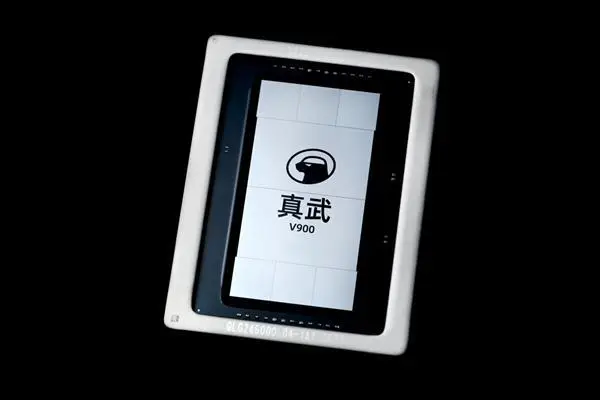
This processor was developed by Alibaba’s Pingtouge Semiconductor team. Wu Yongming said that Zhenwu V900 is currently the most powerful artificial intelligence chip in China, and its computing power is three times that of the previous generation product M890.
According to the introduction, a single AI cluster built on Zhenwu V900 can support up to 500,000 accelerator cards working together for cutting-edge large model training and inference tasks. Alibaba expects that the chip will be mass-produced and officially commercialized in the first quarter of 2027.
At the same time, the company's existing M890 AI super node can already support large model inference tasks with parameter sizes exceeding 2 trillion. Wu Yongming said that currently there are very few companies in the world that can achieve this capability.
Facing the growing demand for artificial intelligence, Alibaba also announced its infrastructure expansion plan in the next few years.
The company plans to increase the total capacity of Alibaba Cloud's global data centers to more than 20 gigawatts by 2032 to further expand the scale of AI computing power supply. Alibaba said that currently enterprise customers have extremely strong demand for artificial intelligence services, which has become an important driving force for Alibaba Cloud's revenue growth.
However, the company also admitted that the global artificial intelligence industry chain is facing problems such as insufficient supply of data center equipment, power resources and related infrastructure. These factors are limiting the speed of expansion.
Wu Yongming said that in the medium to long term, the growth rate of industry demand still far exceeds supply capacity. Alibaba is currently accelerating the deployment of AI super nodes and plans to start large-scale commercial operations from this quarter.
In his speech, Wu Yongming also gave a broader outlook on the future development of artificial intelligence. He believes that human society is entering an important turning stage similar to the industrial revolution and will usher in the "machine intelligence era."
According to his judgment, the current "total amount of thinking" generated by machines is still less than 3% of all human thinking activities, but in the future this number is expected to increase to more than 1,000 times the total amount of human thinking. At the same time, the products and applications that will truly define this era in the future may not yet exist.
He also compared the currently popular AI programming applications to the light bulbs in the early electrical age, believing that this is only the starting product in the artificial intelligence revolution, not the final form. As model capabilities continue to increase, artificial intelligence will take on complex decision-making and long-term task execution in a wider range of areas in the future.
As the United States continues to tighten export restrictions on high-performance chips, Chinese technology companies are accelerating the construction of an independent AI industry chain. Alibaba's simultaneous promotion of the construction of ultra-large-scale models, self-developed chips and data centers is regarded as an important step in building a complete AI ecosystem.
As 5 trillion to 10 trillion parameter-level models enter the planning stage and the Zhenwu V900 chip is officially unveiled, Alibaba is further transforming from a cloud computing service provider to a full-stack artificial intelligence platform. For the global artificial intelligence industry, this also means that competition around ultra-large models, computing infrastructure and next-generation AI chips is entering a new stage.
Comments