
Abstract:
AMD recently released a latest technical white paper surrounding the sixth-generation EPYC 9006 "Venice" server processor, focusing on its performance in data centers, cloud computing, high-performance computing and agent artificial intelligence (Agentic AI) scenarios.
Multiple test results in the white paper directly target Nvidia's latest Vera server CPU platform, and also include Intel Xeon 6980P as a comparison object. However, since all data comes from AMD itself or quotes public information from competitors, relevant conclusions still need to be verified by third-party independent evaluation.
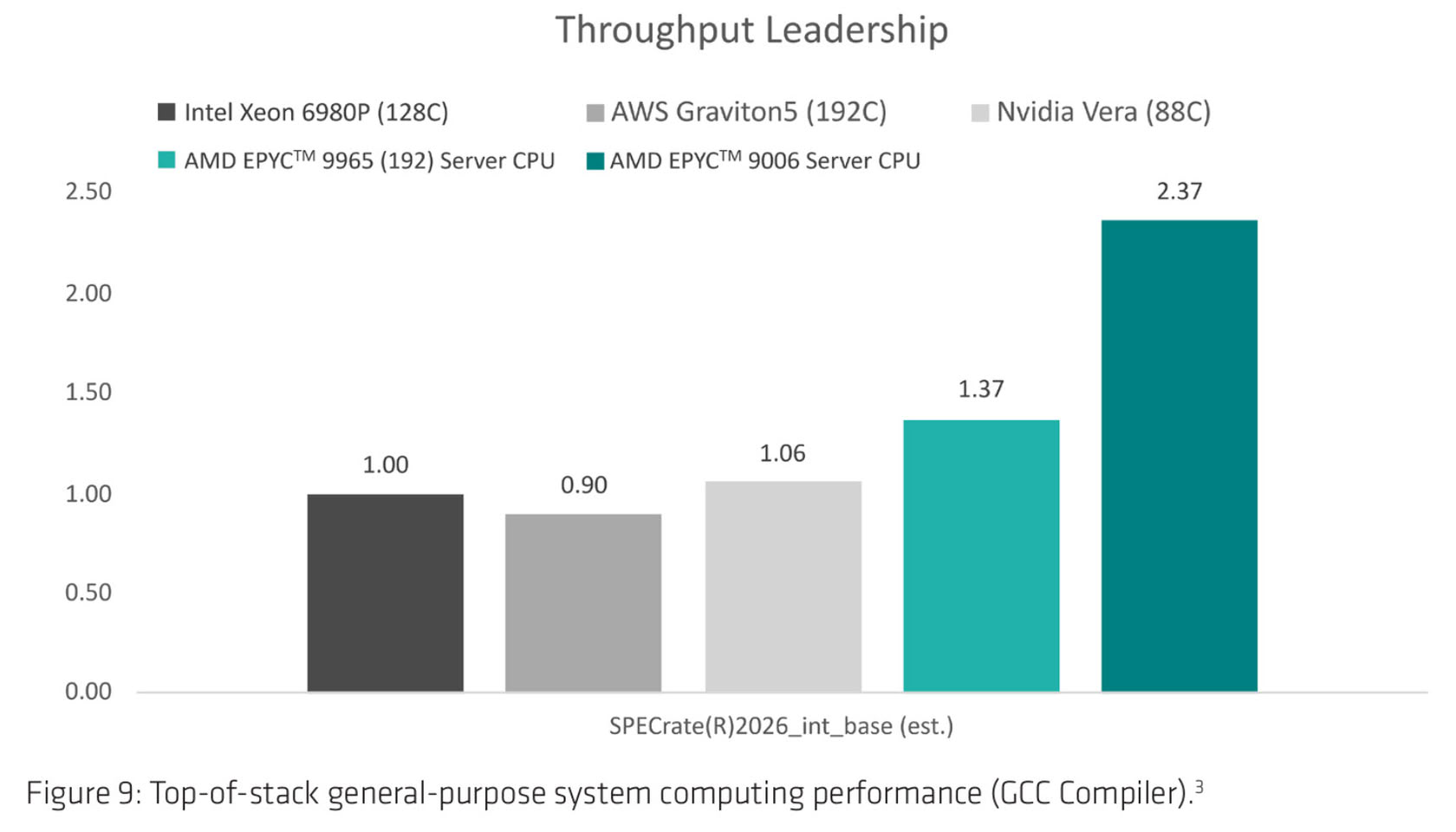
According to data released by AMD, in the SPECrate 2026 Integer overall throughput test, the flagship 256-core EPYC 9996 processor can provide 2.24 times the performance of the NVIDIA 88-core Vera platform, while reaching 2.37 times the level of Intel Xeon 6980P. Compared with the previous generation 192-core EPYC 9965, the performance of the new product is improved by about 78%, which has become one of AMD's key selling points this time.
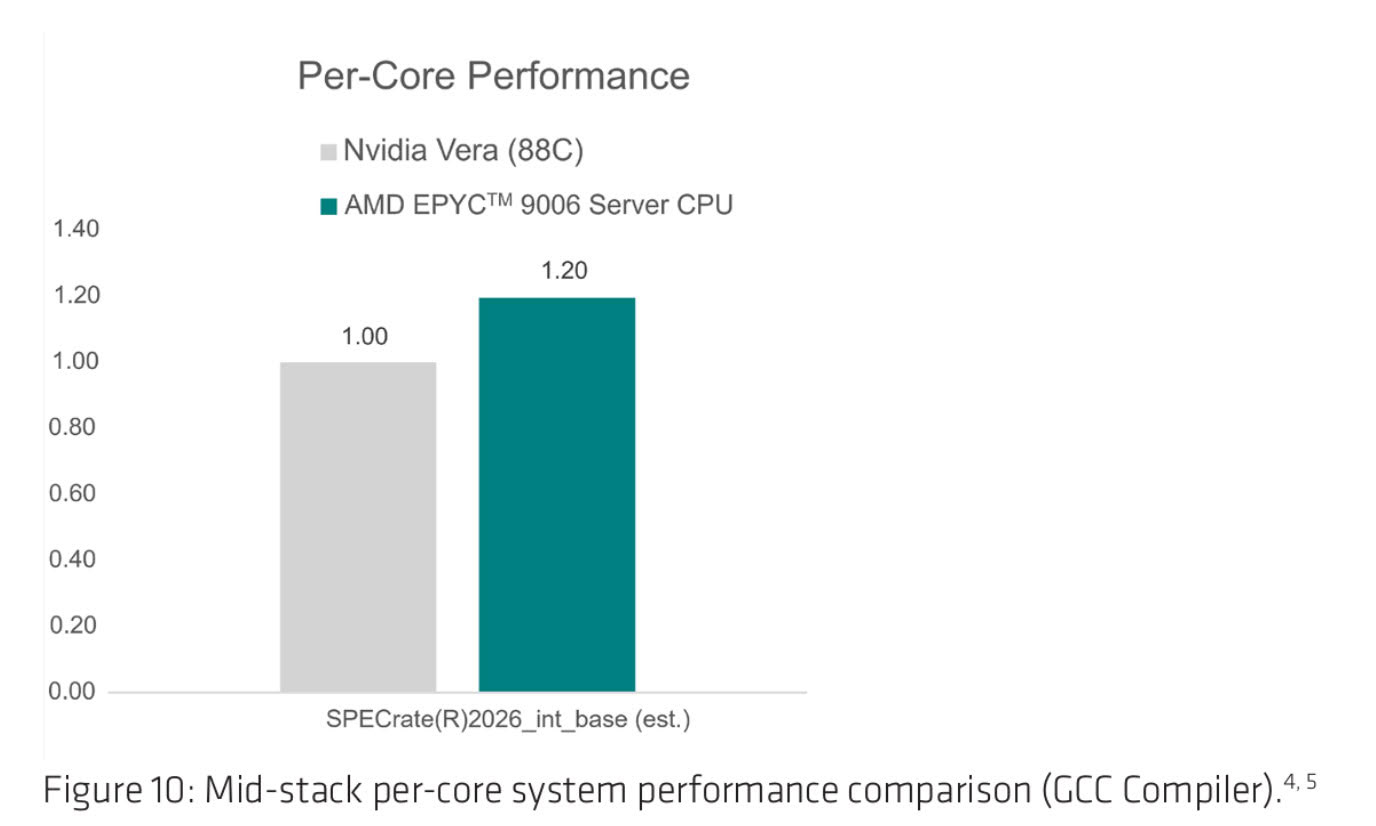
In addition to platform-level performance comparisons, AMD also places special emphasis on single-core performance advantages. The company stated that in the SPEC CPU 2026 Integer test, a high-frequency version of the Venice processor with a 96-core configuration achieved approximately 20% higher unit core performance than NVIDIA's 88-core Vera. AMD believes that this type of performance is particularly important for coordination and control tasks in inferential computing, database processing, online services, real-time translation, and agent-based artificial intelligence workloads.
The white paper further announced the results of multiple subdivided test projects. In server-side Java, multi-instance Java virtual machine, OpenSSL encryption operation, MongoDB database, Redis cache, NGINX web server and transaction processing workloads, AMD claims that EPYC 9996 can achieve approximately 2.4 times to 3.7 times performance improvement compared to Intel Xeon 6980P. In the field of high-performance computing, including applications such as GROMACS molecular dynamics simulation, materials modeling and weather prediction, AMD's lead is up to 3.13 times.
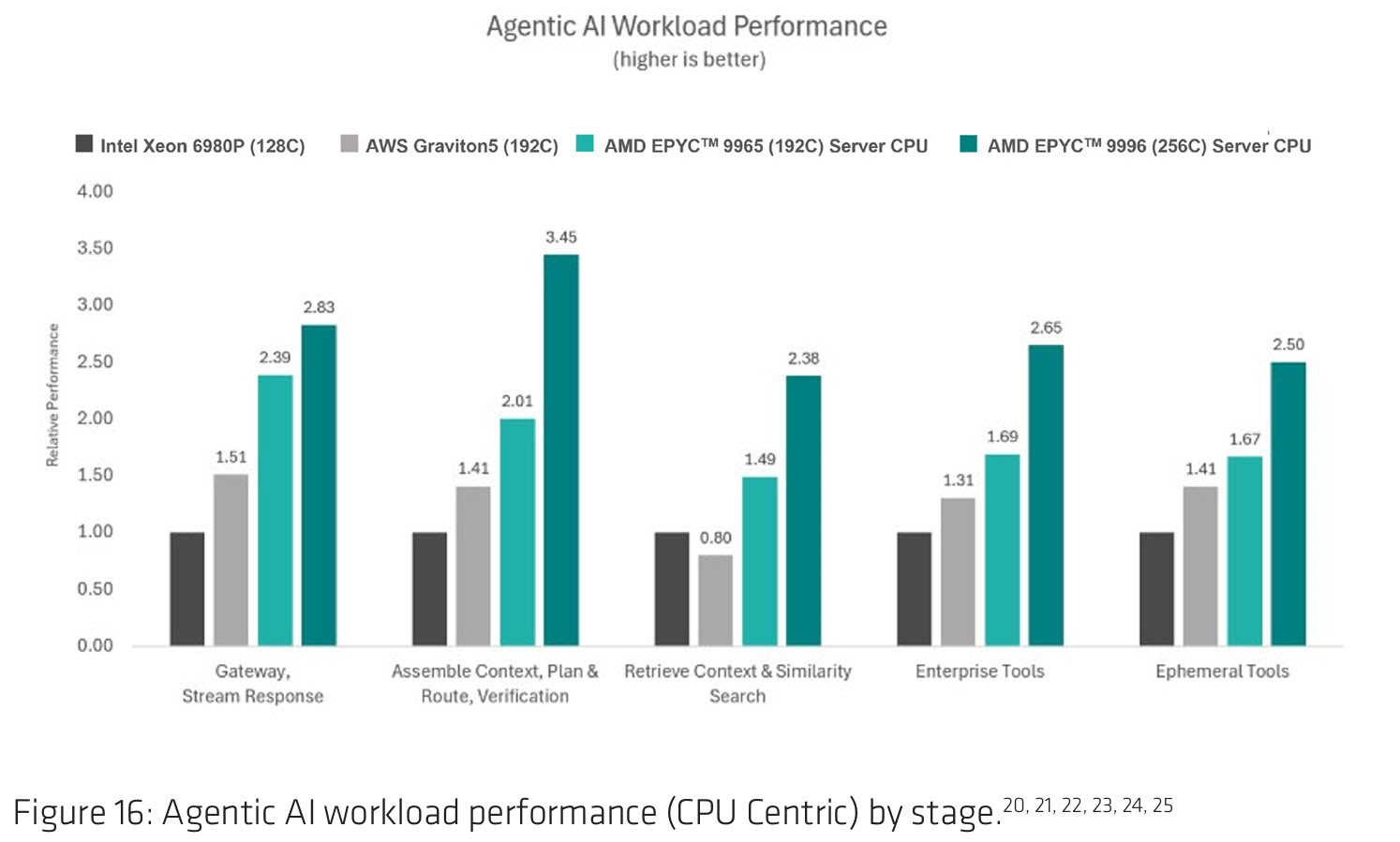
In response to the agent-based artificial intelligence infrastructure that is currently receiving widespread attention, AMD positions the CPU as the core component of the "control plane" in the AI system, responsible for database, cache, API services, middleware, and task orchestration. The company believes that in this type of application scenario, CPU performance, memory bandwidth and rack-level deployment efficiency still have important value.
AMD also announced a rack-level performance model for the first time. Calculated based on the company's 100-kilowatt data center rack power consumption budget, the overall throughput of the platform equipped with the EPYC Venice processor can reach approximately 3.3 to 3.4 times that of the NVIDIA Vera solution. AMD stated that this calculation comprehensively refers to the performance of multiple workloads such as SPECrate Integer, Java services, NGINX, Redis, Memcached and databases.
In terms of memory performance, AMD quoted some third-party test data and used EPYC 9996 downgraded to 96 cores for Stream memory bandwidth testing. According to its published results, the overall memory bandwidth of the Venice platform is about 18% ahead of Vera, and the single-core bandwidth advantage is about 8%. This result is of concern because some independent tests have previously shown Vera to be significantly competitive in the memory bandwidth project.
However, the data released by AMD this time also caused doubts among some industry insiders. First of all, when comparing single-core performance with Vera, AMD uses a 96-core version cut from the 256-core flagship model. This test configuration has the same 600-watt power budget as the flagship product, and future mass-produced 96-core models are usually rated at 500 watts, so the test environment may give the processor more room for performance release.
Secondly, compiler version differences have also become a focus of controversy. AMD used the GCC 16.1 compiler for some tests, while Nvidia used GCC 15.2 when it previously announced Vera results. Because GCC 16.1 is more deeply optimized for the Zen 6 architecture, it is possible to produce executable programs with higher performance. Analysts pointed out that directly comparing test results in different compiler environments is not strictly a best practice, and the gap between the two parties may change in a unified software environment.
In addition, some Vera results do not come from AMD's actual test equipment, but are extrapolated based on NVIDIA's public information and third-party test results. AMD explains in the white paper that some relevant data are obtained by proportional conversion of Grace platform results, so they are not entirely based on direct comparisons of the same test platform.
Despite the methodological controversy, the data disclosed by AMD still shows the strong potential of the Zen 6 architecture in the server market. Compared with horizontal comparisons with competitors, many analysts believe that what deserves more attention is its nearly 80% performance improvement compared to the previous generation EPYC products. As major server manufacturers continue to launch relevant platforms, and cloud service providers begin to deploy Venice processors, AMD's authenticity and actual value of these performance data will soon be tested by the market and third-party evaluation agencies.
Comments