
Abstract:
An AMD Ryzen 9 5900X3D engineering sample that has never been officially released before has recently appeared. Its biggest feature is that it is equipped with a 128MB L3 cache. If the relevant information is true, this means that AMD actually explored an X3D processor with higher specifications than Ryzen 7 5800X3D during the Zen 3 era, but did not ultimately push it to the consumer market.
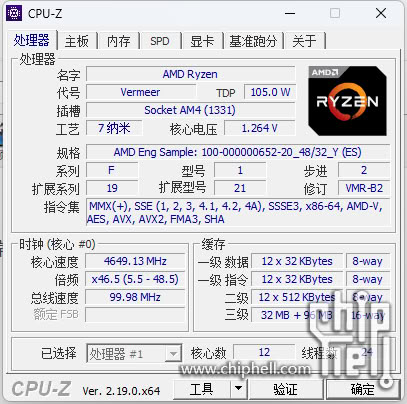
Judging from the exposure information, this processor belongs to the engineering sample of the Ryzen 5000 series, and the model is identified as Ryzen 9 5900X3D. It uses Zen 3 architecture, has 12 cores and 24 threads, and adds 3D V-Cache technology based on the traditional Ryzen 9 5900X.
Ryzen 9 5900X itself adopts a 12-core 24-thread design and has a 64MB L3 cache, while the first-generation consumer X3D processor Ryzen 7 5800X3D has 8 cores and 16 threads, and an additional 64MB 3D V-Cache is stacked to bring the total L3 cache to 96MB. The 5900X3D exposed this time further increases the total L3 cache to 128MB.
In other words, if calculated according to the design logic of the final product, the 5900X3D is likely to add an additional 64MB 3D V-Cache to the 12-core Zen 3 CCD, thus forming a "64MB native L3+64MB 3D V-Cache" configuration.
The reason why this processor deserves special attention is that AMD’s final Zen 3 X3D product line is actually quite restrained. Launched in 2022, Ryzen 7 5800X3D is AMD’s first 3D V-Cache processor for the consumer market. Although it only has 8 cores, with its 96MB L3 cache, it has achieved very good performance in the gaming field and has become one of the most representative processors in the later life cycle of the AM4 platform.
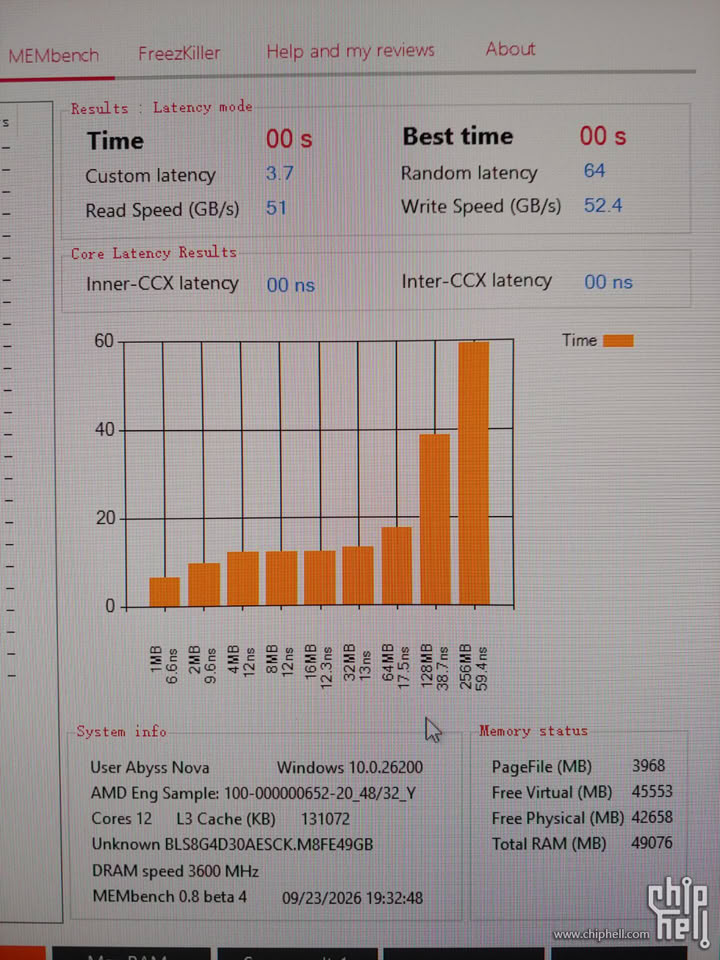
In contrast, AMD has not launched the 12-core Ryzen 9 5900X3D, nor has it launched the 16-core Ryzen 9 5950X3D. Therefore, this engineering sample means that AMD has at least once manufactured and tested a higher core count Zen 3 X3D processor.
The 128MB L3 cache is particularly potentially valuable for gaming loads. 3D V-Cache allows the processor to save game data in a larger cache space, thereby reducing the number of system memory accesses. In some cache-sensitive games, a larger L3 cache can effectively reduce the impact of memory latency on performance.
However, adding 3D V-Cache does not mean that all applications will receive the same performance improvement. For productivity tasks that rely heavily on multi-core computing power rather than cache capacity, the 12 cores themselves may be more important than the extra cache. Therefore, if the 5900X3D is officially launched that year, its main competitive advantages are likely to still be concentrated in games and some cache-sensitive applications.
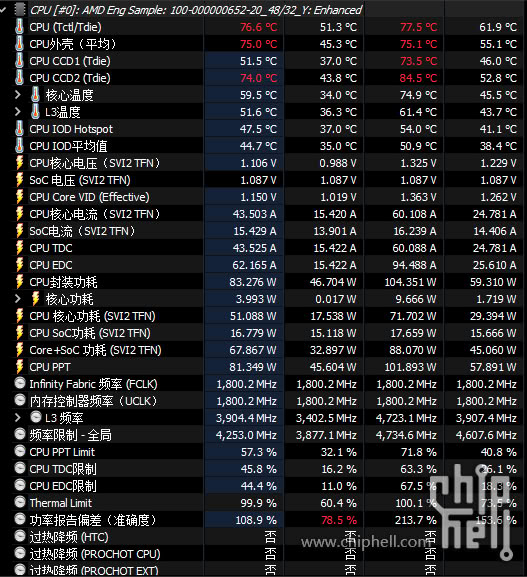
In addition, there are clear differences between engineering samples and final retail products. The exposed processor may be in AMD's internal testing stage, and its frequency, voltage, power consumption, and cache working methods may not be completely consistent with the final product. Therefore, the final performance of a hypothetical 5900X3D cannot be deduced simply based on the specifications of engineering samples.
From a product strategy perspective, it is reasonable for AMD to choose to launch the 8-core 5800X3D first. The AM4 platform has entered the later stage of its life cycle, and 3D V-Cache was a relatively new packaging technology at the time. Choosing a single CCD, 8-core product as the first consumer-grade X3D processor can reduce product complexity and verify the actual effect of 3D V-Cache on desktop processors.
Facts have proved that this strategy has achieved good market response. The 5800X3D later became a very special upgrade product for the AM4 platform, allowing a large number of users who already own Ryzen 3000 or even some Ryzen 2000 platforms to obtain significant game performance improvements without replacing the motherboard and memory.
As subsequent architectures such as Zen 4 and Zen 5 continue to use 3D V-Cache, AMD has gradually expanded its X3D product line. Looking back now, this 5900X3D engineering sample that has never been launched also shows from the side what product exploration AMD has conducted in the early stages of 3D V-Cache technology.
If more sample information is finally available about this processor, its frequency, CCD configuration, power consumption and actual test results will be particularly worthy of attention. Because these data can further explain whether AMD did not launch the 12-core Zen 3 X3D processor that year was more restricted by product positioning, cost, yield or technical conditions.
Comments