
Abstract:
Spain's Bizum, Italy's BANCOMAT, Wero under the European Payment Initiative, Portugal's SIBS-MB WAY, and Nordic Vipps MobilePay jointly established the "European Network for Payments, ENP", headquartered in Madrid.
The current services of the five founding institutions collectively cover 13 European countries and approximately 130 million users, covering more than 70% of the population of the European Union and Norway. The new entity will build and operate a common interconnection hub to connect existing payment systems everywhere, rather than creating a new unified brand from scratch.
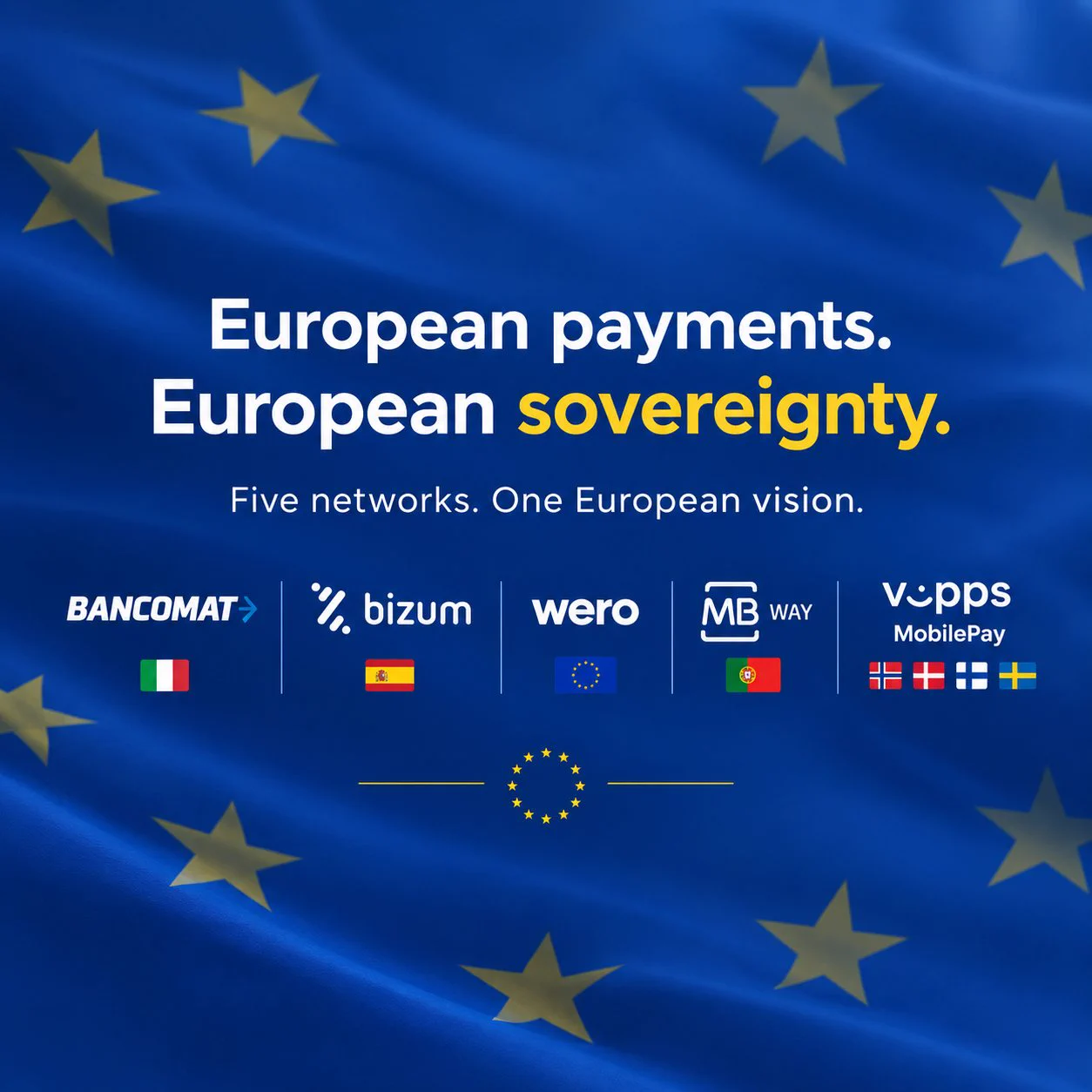
The ENP plan adopts a common technical and operational architecture based on European standards and is based on instant account-to-account payments, allowing participants to gradually realize cross-border transfers and merchant payment interoperability. The official plan is to advance in stages, first opening up person-to-person cross-border payments, and then expanding to e-commerce and offline physical store payments. Users will still be able to use the local services, brands and interfaces they are familiar with; cross-border interoperability will be supported by common back-end infrastructure. The five founding parties will hold equal shares in the new company and jointly decide on the technical development of the infrastructure and whether to admit new members.
This collaboration aims to respond to the long-term fragmentation of the European payments market. The ECB pointed out that the euro zone currently does not have a European digital payment option covering the entire region, with 13 of the 20 member states relying on international card organizations for bank card payments. The ENP hopes to make local European payment services available across borders and reduce the dominance of U.S. networks such as Visa and Mastercard in regional payments infrastructure. However, the new entity has just been established and is still formulating the final operating structure; the initial operating costs will be borne by shareholders, and only after the network reaches sufficient scale can it hope to maintain operations through its own fees. At this stage, it is not a complete payment network that has been launched and can immediately replace Visa or MasterCard. Merchant acceptance and regulatory coordination in various countries will still affect its expansion.
The digital euro promoted by the European Central Bank is another independent plan. The digital euro will be issued by the central bank and can be used for in-store, online and personal transfers. It is expected to be piloted first in 2027; if relevant EU legislation is passed in 2026, the central bank hopes to be ready for a possible first issuance in 2029. The European Central Bank positions it as a complement to cash and existing private payment services. Reuters reports also pointed out that the digital euro may run parallel to ENP in the future rather than be directly replaced by ENP.
Comments