
Abstract:
More model information of Intel’s next-generation Nova Lake-S desktop processor has been recently exposed. A newly leaked product list shows that Intel may be preparing at least seven Core Ultra 400 series desktop processors. The flagship model will be named Core Ultra 9 4970K BFC and use 8 P-Core, 16 E-Core and 4 LP-E cores, bringing the total core number to 28. At the same time, this processor will also be equipped with a larger last-level cache configuration and support vPro.
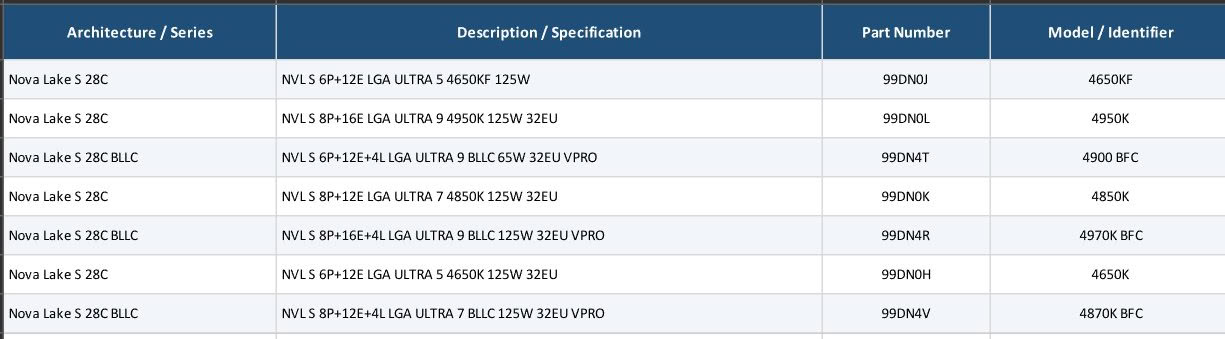
This leaked information comes from X platform user LC Tech Leaks. The exposed models cover three product levels: Core Ultra 9, Core Ultra 7 and Core Ultra 5. It is worth noting that these models all use four-digit numbers, which is obviously different from the current three-digit naming method of the Core Ultra 200 series, which means that Nova Lake-S may officially launch the new Core Ultra 4000 series naming system.
The highest-end model exposed is the Core Ultra 9 4970K BFC, which uses 8 P-Core, 16 E-Core and 4 LP-E cores, for a total of 28 cores. The basic power consumption of the processor is marked as 125W, and the core display has 32 EUs and supports vPro. More importantly, this model is marked as having bLLC, which is a larger-capacity version of the Last Level Cache.
In comparison, Core Ultra 9 4950K also uses 8 P-Core and 16 E-Core, with a total core count of 24, but there are no 4 LP-E cores and no bLLC configuration. Its TDP is also 125W and equipped with 32 EU core display, but it does not support vPro.
This means that if the final retail model is consistent with the leaked information, the difference between the Core Ultra 9 4970K BFC and the 4950K is not just a difference in frequency. The 4970K BFC not only has 4 more LP-E cores, but also has a larger last-level cache, so it may have greater advantages in multi-threaded tasks and some workloads that are sensitive to cache capacity.
The Core Ultra 7 series also has a similar product layout. Among them, Core Ultra 7 4870K BFC uses 8 P-Core, 12 E-Core and 4 LP-E cores, with a total core count of 24. It is also equipped with bLLC, 32 EU core display and vPro, with a TDP of 125W.
Core Ultra 7 4850K uses 8 P-Core and 12 E-Core, with a total of 20 cores. There is no LP-E core, no bLLC and vPro. It is also equipped with 32 EU core display and 125W TDP.
The Core Ultra 5 series currently exposes two products: Core Ultra 5 4650K and 4650F. Both use 6 P-Core and 12 E-Core, for a total of 18 cores and a TDP of 125W. Among them, 4650K is equipped with 32 EU nuclear display, while 4650F cancels nuclear display. Both models lack LP-E core, bLLC and vPro.
In addition, there is a Core Ultra 9 4900 BFC. This model uses 6 P-Core, 12 E-Core and 4 LP-E cores, for a total of 22 cores, the TDP is reduced to 65W, and has 32 EU core display, bLLC and vPro. From a positioning perspective, it may become a product in the Nova Lake-S family that emphasizes energy efficiency and enterprise features, rather than a flagship model that pursues the highest performance.
The exact meaning of the suffix "BFC" has not yet been confirmed. However, judging from the existing leaked information, it seems to be related to bLLC, which is the large-capacity last-level cache configuration. Previous revelations about Nova Lake-S have repeatedly mentioned that Intel will provide larger LLC cache for some models, so this time the suffix appears on 4970K BFC, 4870K BFC and 4900 BFC at the same time, further strengthening this speculation.
Previous leaked information shows that Nova Lake-S may adopt multiple computing module designs, and the complete product line may even reach 52 cores in the future. However, the 7 processors exposed this time do not have 52-core dual computing module versions, but mainly focus on single computing module products. Among them, the 28-core model is believed to be the first batch of Nova Lake-S products to be launched.
According to the previously exposed roadmap, Nova Lake-S is expected to use the new LGA 1954 socket and be paired with the Intel 900 series desktop chipset. Intel has begun to certify industry standards such as USB and PCIe for this platform. Nova Lake platform information has appeared in the relevant records of PCI-SIG and USB-IF, which indicates that the new platform has entered an important preparation stage before being launched.
From the core architecture point of view, Nova Lake is expected to use the new Coyote Cove performance core and Arctic Wolf energy efficiency core, and introduce LP-E low-power core design. The previously exposed 28-core version is composed of 8 P-Core, 16 E-Core and 4 LP-E cores. This configuration now basically corresponds to the latest 4970K BFC model. It should be noted that these architectures and specifications are still leaked information and have not been officially confirmed by Intel.
Another important change in Nova Lake-S is cache size. Previous news said that some Nova Lake processors may provide bLLC cache up to hundreds of MB, and some high-end models are even rumored to be up to 288MB. If such a large cache is eventually implemented, it will become one of the important features of Nova Lake compared to existing Core Ultra desktop processors. However, it is still unclear how many MB cache the 4970K BFC exposed this time has.
In terms of power consumption, it has been previously reported that the high-end 28-core version of Nova Lake-S may have a very high peak power consumption limit, even reaching about 296W. This number is not inconsistent with the 125W TDP in the leaked table, because 125W usually represents the nominal base power consumption of the processor, and the upper limit of power consumption in the actual turbo frequency state may be significantly higher. However, 296W is also leaked data that has not been confirmed by Intel, and the final retail version may change.
From a product planning perspective, Intel seems to be establishing a more obvious product differentiation for Nova Lake by adding LP-E cores and expanding cache capacity. Compared with the product layout of Arrow Lake-S with up to 24 cores, the first batch of 28-core models of Nova Lake-S have already achieved an increase in the number of cores. If the higher-end multi-computing module version in the future really reaches 52 cores, it may further widen the gap with existing desktop platforms.
The latest news currently shows that Nova Lake-S is expected to enter mass production in the fourth quarter of 2026. The first batch of 28-core products may be officially launched in the first quarter of 2027, while models with higher core counts may be launched later.
If this batch of leaked information is ultimately verified, the Core Ultra 9 4970K BFC will become one of the most noteworthy models among the first batch of Nova Lake-S products. It not only has 28 CPU cores, but also combines 4 LP-E cores and a large-capacity last-level cache, and uses the new LGA 1954 platform. However, until Intel officially announces the frequency, cache capacity, actual power consumption, and final product name, these specifications should still be regarded as leaked information at this time and not as final retail configurations.
Comments