
Abstract:
AMD quietly released a new ray tracing graphics technology that can significantly reduce memory usage and enable millions of animated triangles to run at a stable frame rate. However, it is still unclear whether and when AMD's graphics technology breakthrough will have a real impact in the gaming field.
As one of the leaders in the technology industry, AMD is the manufacturer of Ryzen processors and Radeon graphics cards. In addition, PS5 and Xbox Series X/S game consoles also use AMD hardware. Despite AMD's technological prowess, the PC graphics card market has long been dominated by its main competitor, Nvidia. However, Nvidia's flagship graphics card, the RTX 5090, sells for over $6,500 on third-party sellers such as Amazon and Newegg. By comparison, AMD's Radeon RX 9070 XT graphics card starts at just $799 direct from retailers.
AMD’s Tetrahedral Cage structure may reduce GPU memory usage
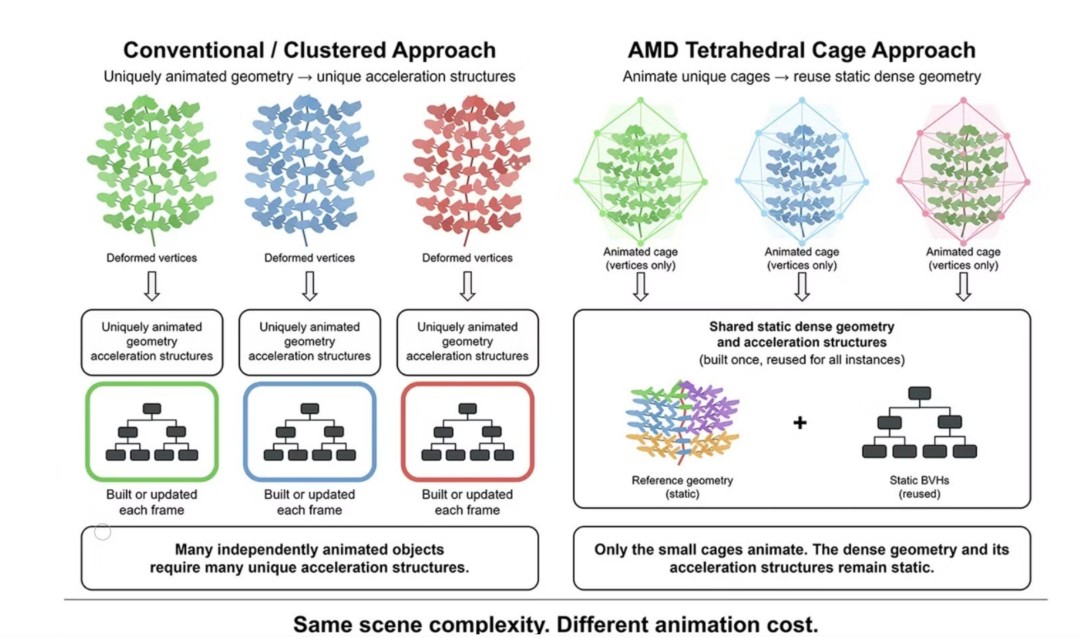
While AMD users already benefit from Microsoft's Advanced Shader Memory (ASMM) technology, a new ray tracing technology may further narrow the gap between AMD and Nvidia.
AMD academician Holger Gruen said that AMD's Tetrahedral Cage Approach will allow developers to perform ray tracing around the unique cage structure in animations, thereby reducing the workload's demand for video memory. AMD shared a technology demonstration video showing lush grass and trees built using tetrahedral cage-like structures. Although this technology has not been used in games so far, it is expected to help developers create more complex and sophisticated environments without taking up too much memory.
AMD said the demo used a Radeon RX 9070 XT graphics card with 16GB of GDDR6 video memory and ran at 60 frames per second at 1080p resolution. Although the traditional clustered approach can provide developers with more precise control of vertex animation, it also requires high graphics memory.
In comparison, the tetrahedral cage technology used in the video only takes up 1.7GB of video memory. If clustered technology is used, more than 80GB of video memory is required.
In short, traditional cluster technology and tetrahedral cage technology each have their uses, with the latter probably being better suited for ray tracing vegetation and distant characters.
If game developers adopt AMD's tetrahedral cage architecture, this will have an impact on current and future game consoles. Microsoft and Sony have both stated that Project Helix and PS6 will use AMD hardware respectively. This decision by the two companies will continue a trend that has been going on since the PS4 and Xbox One era in 2013. AMD said that PS6 and Project Helix will use customized AMD processors, and both consoles will have built-in RDNA 5 graphics architecture and Zen 6 CPU architecture.
As the DRAM memory shortage crisis continues to spread, causing the prices of memory sticks, graphics cards and solid-state drives to soar, any attempt to reduce graphics memory usage will benefit gamers using older or low-end hardware. It remains to be seen how many developers will apply AMD's research results in next-generation gaming hardware.
Comments