
Abstract:
Foreign media GameGPU analyzed previously leaked specifications and estimated that the theoretical performance of the PS6 console can reach up to 80 TFLOPS, which may exceed Nvidia's RTX 5080, but the relevant specifications have not yet been officially confirmed.
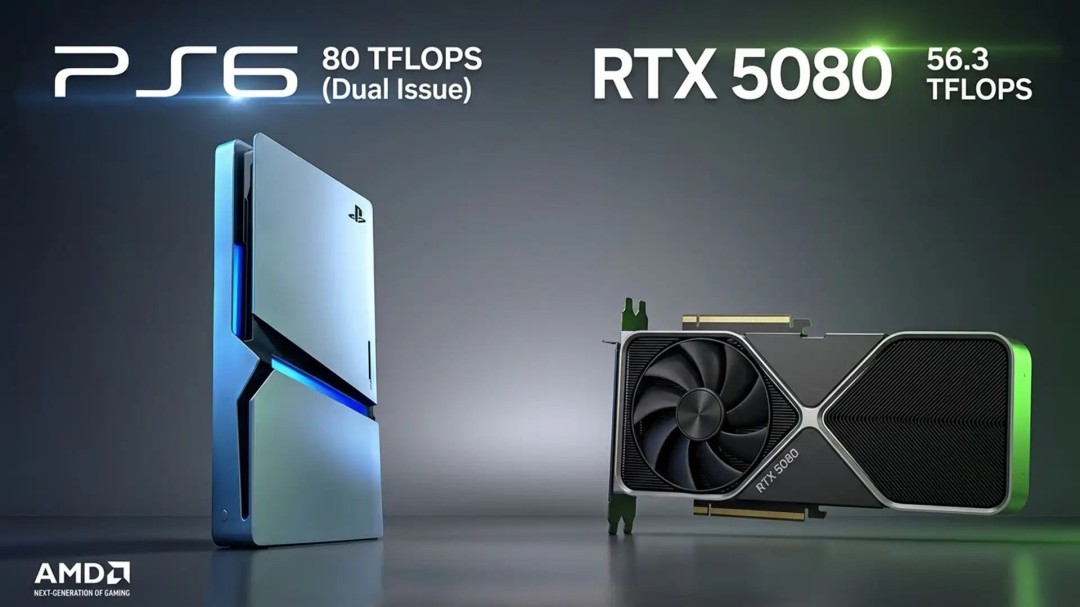
The leaked parameters used in this analysis show that this AMD custom graphics chip may use RDNA 5 custom architecture and TSMC 3nm process, equipped with 54 computing units, with a maximum frequency of 3.6GHz. Its video memory interface is 160-bit GDDR7, with a maximum speed of 32Gbps and a thermal design power consumption limit of 160W.
Estimated based on the above parameters, the raw raster performance of PS6 GPU is about 34 to 40 TFLOPS, which is roughly close to Radeon RX 9070 and RX 9070 XT. For comparison, RX 9070 XT uses RDNA 4 architecture, has 64 computing units and a 256-bit memory interface, consumes approximately 304W, and operates at a frequency of approximately 2.9 to 3.0GHz.
Analysis believes that although the PS6 graphics chip has fewer computing units, its higher frequency and architectural optimization may narrow the performance gap. In sustained high-load raster scenarios without the use of AI algorithms, the RX 9070 XT is still expected to be about 5% to 10% faster. The wider memory interface is one of its advantages.
However, if Dual Issue and PSSR 3 are included, the estimated results will change. According to the analysis, the RDNA 5 dedicated architecture unit supports the parallel execution of Dual Issue instructions, which can increase the theoretical computing power of FP32 from about 40 TFLOPS to 68 to 80 TFLOPS; in full path tracing games, its performance may be 70% to 100% higher than that of RX 9070 XT.
Based on the theoretical peak calculation, the GeForce RTX 5080 is 56.3 TFLOPS and the GeForce RTX 5090 is 104 TFLOPS. This results in the PS6 GPU's extrapolation being somewhere in between. The analysis also predicts that with the upgraded PSSR 3, its effective graphics output speed can be increased by 35% to 50% compared to the nominal value, but the above conclusions are based on leaked specifications and theoretical calculations.
Original text of foreign media report:
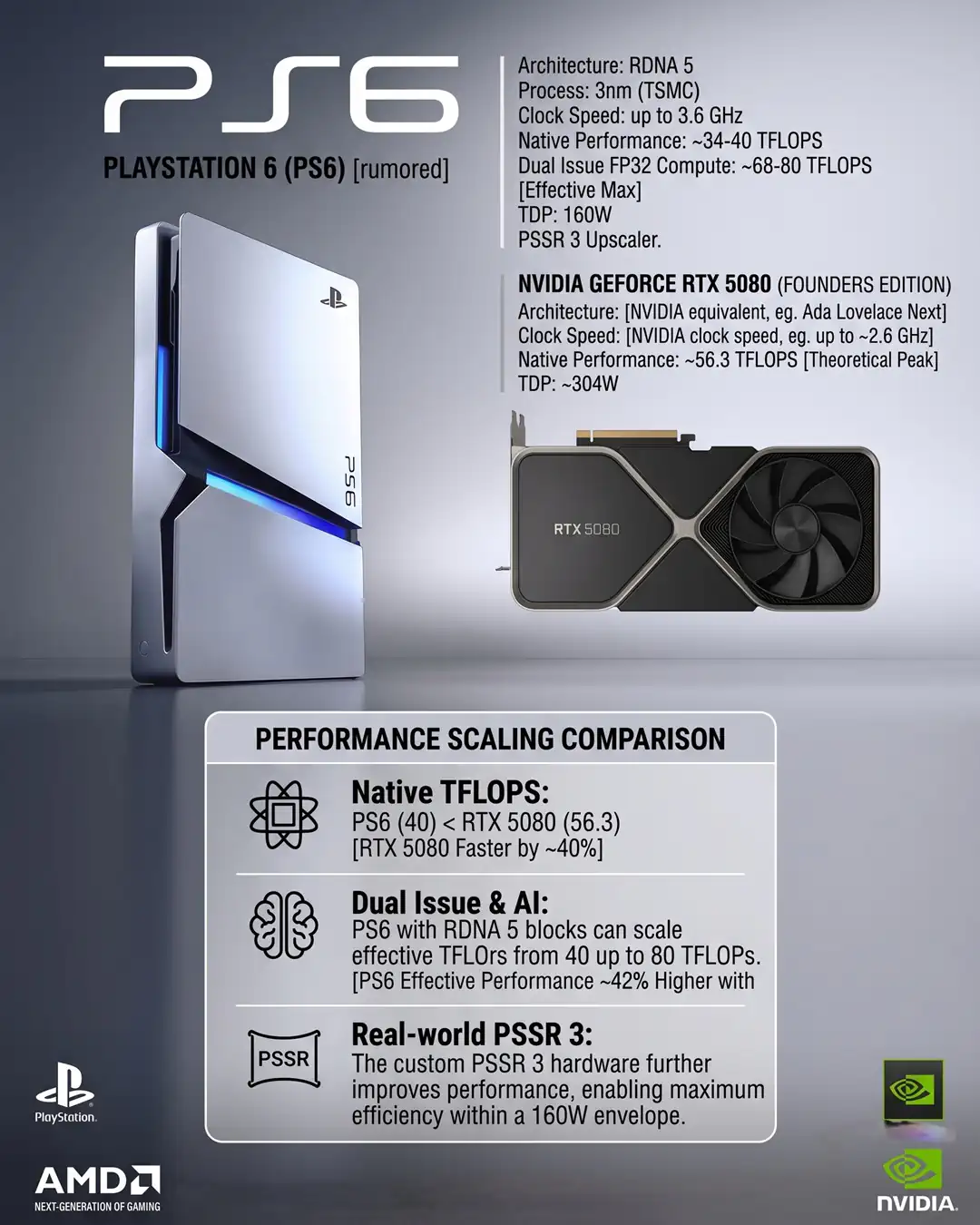
According to analysis of previously leaked specification information, AMD's custom-made GPU for PS6 may use a customized version of RDNA5 architecture, built using TSMC's 3nm process, equipped with 54 sets of computing units (CU), with a maximum frequency of 3.6GHz, and equipped with 160-bit GDDR7 memory bandwidth, with a memory rate of up to 32Gbps. The TDP of this GPU is said to be 160W, and the theoretical raster performance is about 34 to 40TFLOPS. The overall performance is roughly comparable to AMD's Radeon RX 9070 and RX 9070 XT.
If you compare the PS6 GPU directly with the Radeon RX 9070 XT, there are obvious differences in the hardware specifications of the two. RX9070
According to this analysis, thanks to RDNA 5’s architectural optimization for high-frequency operation and performance, the traditional graphics performance of each set of CUs in PS6 may be about 15% to 20% higher than that of RX 9070 XT. However, in pure raster rendering without considering AI technology, since the RX 9070 XT has a wider video memory bandwidth, it may still be about 5% to 10% faster than the PS6 GPU when running continuously for a long time.
The real gap may be Dual Issue and PSSR 3. According to the leaked information, in games with full path tracing turned on, the actual performance of the PS6 GPU may even be 70% to 100% higher than that of the RX 9070 XT. The dedicated architecture module of RDNA 5 supports Dual Issue parallel execution, which can further improve the computing power of FP32, increasing the theoretical peak of the GPU from the nominal 40 TFLOPS to about 68 to 80 TFLOPS.
If you simply compare the theoretical computing power, this means that the peak performance of the PS6 GPU will be between the 56.3 TFLOPS of the GeForce RTX 5080 and the 104 TFLOPS of the RTX 5090. Combined with the rumored PSSR 3 super-resolution technology, the effective output performance of the final game screen is said to be 35% to 50% higher than the theoretical performance, thereby further tapping the GPU performance under the 160W power consumption limit.
Comments