
Abstract:
According to a latest poll jointly released by ABC News, The Washington Post and Ipsos, a majority of American adults have a negative view of the development of artificial intelligence and oppose the continued large-scale construction of data centers. The survey shows that 57% of the respondents believe that artificial intelligence will do more harm than good to society, and 66% oppose the construction of new data centers in the United States; if the data center is built in their own community, the opposition proportion further rises to 72%.
The survey was conducted from October 9 to 13, 2026, interviewing 2,545 U.S. adults through Ipsos’ KnowledgePanel probability sampling survey platform, with an overall margin of error of approximately plus or minus 2 percentage points. The survey results show that the development of artificial intelligence technology is accelerating, but the public's views on its potential benefits and risks are clearly divided.
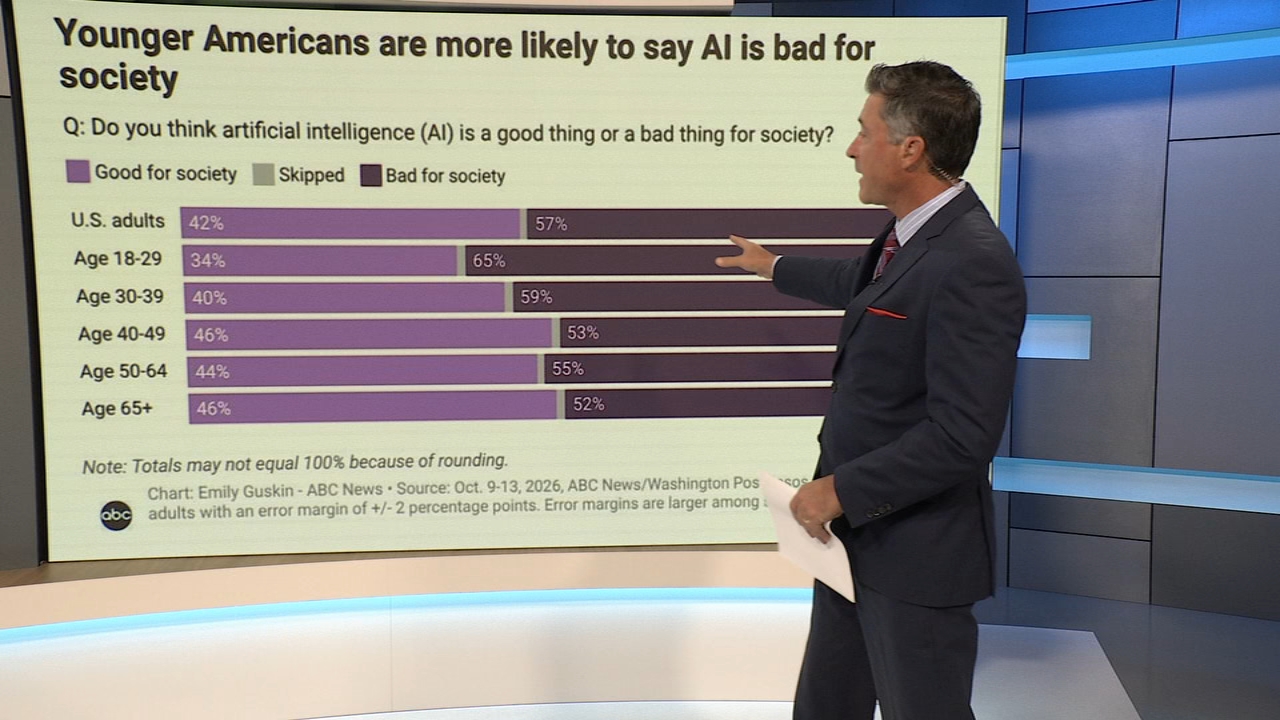
In the evaluation of the overall social impact of artificial intelligence, 57% of respondents believe that AI is harmful to society, and 42% believe that it is beneficial. The proportion of people who think AI is “extremely harmful” to society reaches 17%, while only 2% think it is “extremely beneficial”. This shows that the public’s negative evaluation is not only reflected in general concerns, but also that a considerable number of people are strongly skeptical of the development of artificial intelligence.
Different age groups have different views on AI. Among respondents under the age of 30, 65% believe that artificial intelligence will be harmful to society; among those aged 30 to 39, this proportion is 59%; among those aged 40 and above, 53% hold the same view. Young people’s higher level of pessimism about AI may be related to their concerns about employment prospects, career development, and the impact of technology on their personal lives.
Political affiliation also affects respondents’ attitudes. Among Democratic Party supporters, 63% believe that AI will be harmful to society; among independents, this proportion is 58%. The views of Republican supporters are relatively similar, with 51% believing AI will be beneficial to society and 47% believing it is harmful.
It is worth noting that when the question shifted from the overall impact on society to individual experience, the survey results changed subtly. 50% of respondents believe that AI will be beneficial to them, while 49% believe that it will be harmful to them. In other words, although some Americans are worried about the long-term impact of AI on society, they still recognize its practical value in personal life. However, 15% of respondents believed that AI would be “extremely harmful” to them, which is five times the proportion of those who believed that AI would be “extremely beneficial”.
The survey also asked in detail the public’s judgment on the potential risks of artificial intelligence. 73% of respondents believe that the development of AI may lead to attacks on secure computer systems, posing a higher risk. This is one of the highest-profile risks in the survey, reflecting public concerns about AI being used in cyberattacks, intruding into critical systems and committing sophisticated cyber crimes.
Employment issues have also attracted widespread attention. 65% of the respondents believe that artificial intelligence has a high risk of causing the disappearance of a large number of jobs. The survey shows that this concern spans different age groups, political stances and income groups, and is not concentrated only on one type of worker.
In addition, 62% of respondents believe that people may gradually lose the ability to make independent decisions and increasingly rely on advice provided by artificial intelligence. 54% are worried that AI will exacerbate economic inequality and believe that the benefits brought by technology may be more concentrated in a small number of enterprises and high-income groups, while ordinary workers may not be able to equally share the value created by increased productivity.
For more extreme risks, 33% of respondents believe that the development of artificial intelligence may bring a high risk of human extinction. While this is lower than concerns about risks such as cybersecurity, employment and personal autonomy, it still means that about one-third of U.S. adults see AI as a technology that could threaten humanity's long-term survival.
Compared with risk perception, the public’s expectations of the benefits that AI can bring are relatively limited. 34% of respondents believe that AI is likely to make daily tasks easier; 30% believe that AI has a greater chance of helping the United States gain a dominant position in the field of artificial intelligence technology. Only 20% believe that AI is very likely to improve people's productivity, and another 38% believe that AI has little or no possibility of improving productivity.
Public expectations are more cautious regarding job creation. Only 13% of respondents believe that AI has a high chance of creating a large number of new jobs, while 52% believe that this is almost impossible to happen. The survey results reflect a clear concern: The public is more likely to see the risk that AI may replace existing jobs, but is not yet generally convinced that new technologies can create enough new jobs to make up for the losses.
On the issue of supervision, about two-thirds of Americans believe that the federal government currently does not implement sufficient supervision on the development and application of artificial intelligence. Among Democratic supporters, this proportion reached 80%; among independents, 66%; and 54% of Republican supporters also held the same view. Only 22% of respondents believe that the government's current regulatory intensity is generally appropriate.
U.S. President Trump’s handling of AI has also been criticized. The survey showed that 66% of respondents disapproved of Trump's handling of artificial intelligence issues, while only 30% approved. The disapproval proportions of Democratic Party supporters and independents reached 92% and 75% respectively. Within the Republican Party, there are also differences between Trump supporters and other Republicans, with MAGA camp supporters approving at a significantly higher rate.
At the same time, the public generally lacks confidence in the ability of the two major political parties to properly handle AI issues. 26% of respondents trust the Democratic Party more in handling artificial intelligence issues, and 19% trust the Republican Party more, but 49% said neither party is trustworthy. Compared with the April 2026 survey, the public's trust in the two parties' handling of AI issues has changed, but the proportion that does not trust either party is still close to half.
Data center construction is another focus of this survey. As AI model training and inference require a large amount of computing resources, American technology companies are accelerating the construction of large data centers. However, these facilities consume large amounts of electricity and cooling water, and may affect the local grid load, residents' energy bills, and the surrounding community environment, thus causing increasing controversy.
Survey shows that 66% of American adults oppose the construction of new data centers across the country. If the construction site is located in the respondent's own community, the opposition rate rises to 72%. Only 30% of respondents support building more data centers across the country.
This opposition is not limited to any one political camp. Regarding the construction of new data centers in their own communities, 81% of Democratic supporters opposed the construction of new data centers in their own communities, 76% of independents, and 58% of Republican supporters. Even among Republicans who support the development of the artificial intelligence industry, most people are still unwilling to build new data centers near their residences.
The level of opposition also varies from region to region. 78% of residents in rural areas oppose the construction of new data centers locally, 72% of suburban residents, and 69% of urban residents. This shows that even if data centers can bring investment and tax revenue to the local area, residents may still be worried about their impact on power supply, living environment and community quality.
Data center issues have also gradually become part of the political debate in the United States. The Trump administration emphasizes that building more data centers will help drive U.S. economic growth and maintain an advantage in the global competition for artificial intelligence. But some residents, local officials and policymakers worry that the benefits and costs of data center expansion are not necessarily borne by the same groups. Companies can gain computing resources and business benefits, while local residents may bear the burden of grid expansion, rising energy costs, and environmental pressures.
The core contradiction presented by this survey is that the artificial intelligence industry is receiving more and more capital and infrastructure investment, but the American public does not generally accept this expansion method. Many people acknowledge that AI may make some daily tasks more convenient, but at the same time worry about job losses, cybersecurity risks, economic inequality, and reduced personal autonomy. The data center construction controversy turns these abstract concerns into more concrete, local issues.
For technology companies, the challenge in the future may no longer be just competing for chips, building computing facilities and developing more powerful models, but also how to prove that AI can bring actual benefits to ordinary people and how to reduce its negative impact on employment, energy supply and community life. For the U.S. government, the survey also shows that public demand for artificial intelligence supervision is expanding. How to strike a balance between industrial competition, technological innovation and risk control may become an important issue in future policy discussions.
Comments