
Abstract:
South Korean memory chip giant SK Hynix is promoting the new generation of iHBM (Integrated High Bandwidth Memory) technology to the mass production stage and has begun discussions on related mass production plans. Facing the surge in demand for computing power brought about by the rapid development of the artificial intelligence industry, the heat dissipation problem of high-bandwidth memory (HBM) is becoming an important bottleneck affecting performance improvement, and iHBM is regarded as an important technical route to solve this problem.
In recent years, with the rapid expansion of generative artificial intelligence, large-scale model training, and high-performance computing applications, the importance of HBM has continued to increase. In order to obtain higher data throughput capabilities, HBM continues to increase the number of stacking layers and improve transmission speeds, but the problem of heat accumulation that comes with it is becoming more and more serious. Especially in the key areas responsible for high-speed data exchange tasks between HBM and GPU, a large amount of heat is concentrated, posing challenges to chip stability and performance.
To solve this problem, SK hynix developed iHBM technology. The core idea is to introduce a special structure called ICE (Integrated Cooling Element) inside the HBM package. Made from a silicon-based material that is highly thermally conductive but not electrically conductive, these elements are placed directly in areas where heat is most concentrated, providing additional paths for heat to dissipate.
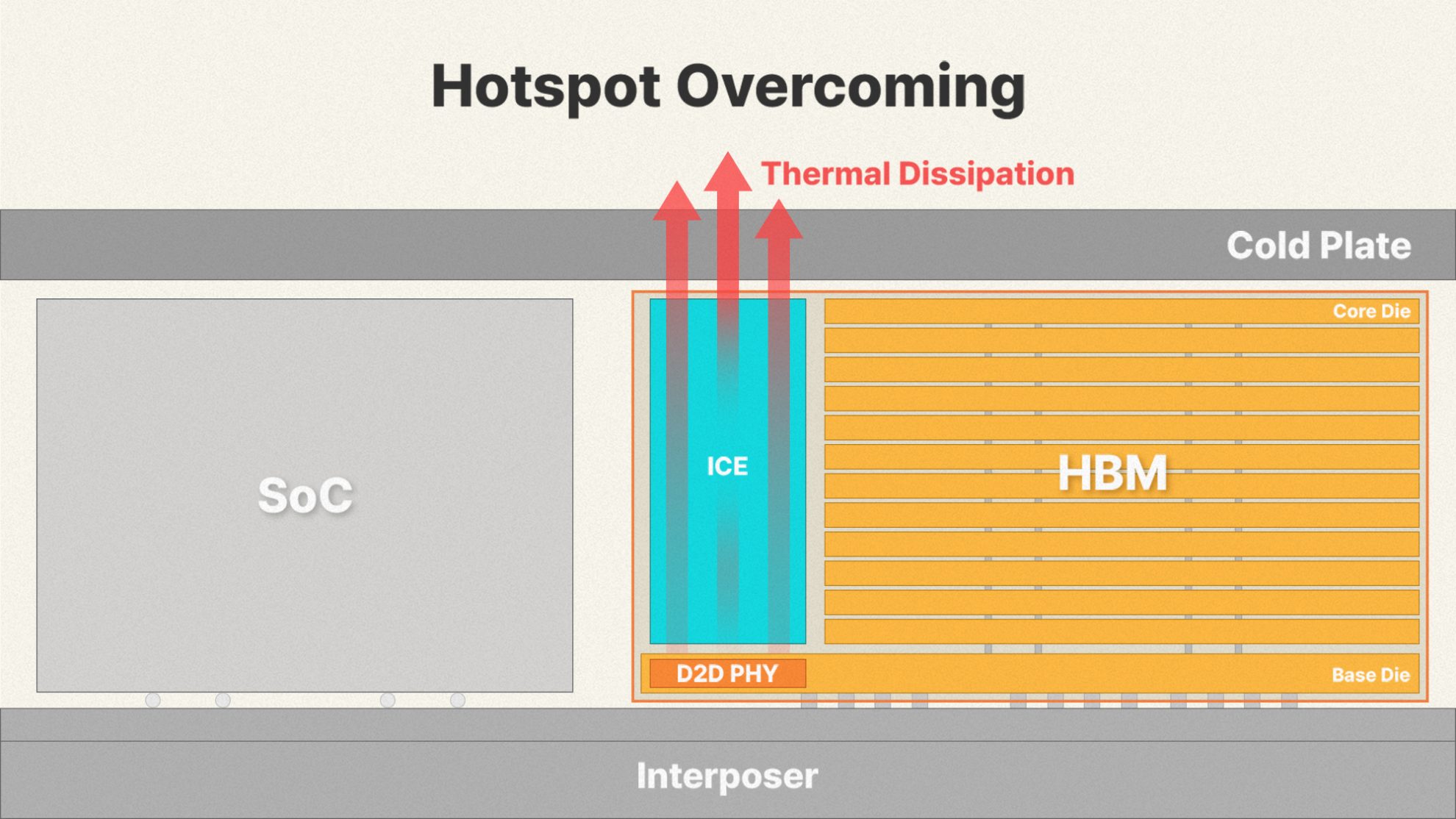
Unlike traditional HBM, which mainly relies on indirect heat conduction through the internal structure of the chip, iHBM adopts a more active heat dissipation design and directly dissipates heat from hot spots through new heat conduction channels. According to data released by SK Hynix, this solution can reduce thermal resistance by about 30%, helping the chip maintain stable operation even under high temperature and high load conditions.
For data centers that continuously run artificial intelligence training tasks, this improvement in cooling capacity is of great significance. Because excessive temperature will cause the chip to automatically reduce frequency, thus affecting computing efficiency, better thermal management capabilities will not only help improve performance, but also improve energy efficiency and system stability.
In addition to performance improvements, SK Hynix also emphasized the feasibility of mass production of this technology. iHBM is based on the company's existing mature MR-MUF packaging process and wafer-level packaging technology, and can utilize existing production systems to achieve large-scale manufacturing. At the same time, this solution maintains high compatibility with the currently widely used system-level packaging architecture, and customers can introduce related technologies without significantly redesigning the entire product.
As HBM continues to evolve to higher stacking layers, the industry generally believes that heat dissipation capacity will become one of the core indicators of competition in the next stage. SK Hynix plans to apply iHBM to next-generation products such as HBM5 in the future to meet the needs of high-performance computing platforms and AI data centers for ultra-high bandwidth and ultra-high-density storage.
Currently, SK Hynix is already a leading supplier in the global HBM market and provides advanced storage products to many AI chip manufacturers. As the artificial intelligence industry continues to expand, whoever can take the lead in breaking through heat dissipation and power consumption limitations and achieving stable mass production of higher-performance HBM is expected to occupy a more favorable position in the future AI infrastructure market. The advancement of iHBM is also seen as an important step for SK Hynix to consolidate its leadership in AI storage.
Comments