
Abstract:
In the early morning of November 20, as soon as the Nasdaq bell fell, Anthropic directly pushed the opening price to $111.50, an increase of 34.3% from the issue price of $83. The intraday high reached $115.10, and the fully diluted market value once exceeded 2 trillion, kicking away the record set by SpaceX just five months ago, and briefly surpassed Tesla and Meta, ranking sixth in the world.
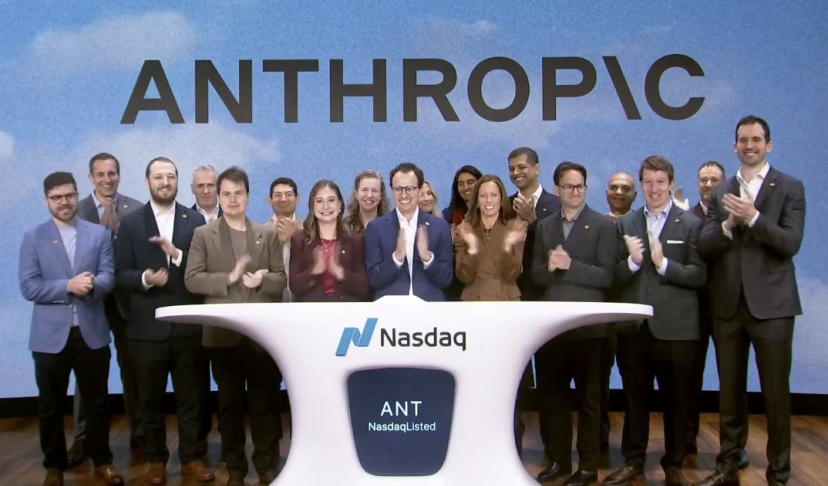
It closed at US$97.17, with the increase narrowing to 17.07%, but the trading volume for the whole day was as high as US$86.63 billion. The entire IPO raised US$107.3 billion - a public offering of US$81.3 billion, plus a private placement of US$26 billion, officially setting a new record for the largest IPO in human history.
But on the other side, just the night before the bell was rung, nearly 90 people signed a letter. Among the signatures are Nobel Prize winner Oliver Hart, Nobel Prize winner in physics Sheldon Glashow, Turing Award winner Judea Pearl, three Fields Medal winners, as well as MIT physicist Max Tegmark, who calls for a moratorium on superintelligence, and hacker George Hotz, who treats AI safety as a joke. These two people who usually dislike each other on the AI route also signed the same piece of paper.
The name of the letter is "The MisAnthropic Statement" - changing Anthropic's company name to "Anthropic" in English.
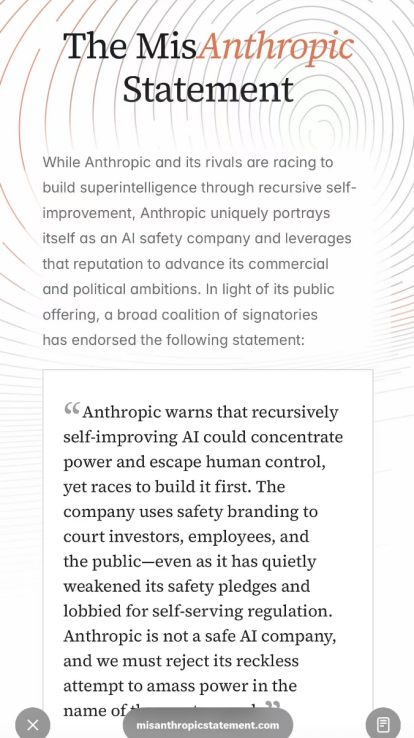
Picture | Objection letter
Their accusations are very specific: While the company is warning that "self-improving AI" may be out of human control, it is rushing to the forefront and rushing to be the first to build it; while using the "AI safe" persona to raise funds, recruit people, and win favor, it is quietly relaxing its own safety commitments.
Seemingly in response to the opposition, Dario repeatedly emphasized in the interview: AI safety issues are far from being resolved, and the company will not lower safety standards in pursuit of commercial growth.
So a rare scene occurred in Silicon Valley: the largest sum of money in human history, and the most luxurious letter of objection, fell on the same company.
Create hundreds of potential billionaires in 5 years
An AI company established only five years ago is creating the latest wealth myth in Silicon Valley.
Just now, Anthropic, the developer of Claude, was listed on Nasdaq with the stock code ANT. This IPO created an amazing wealth effect:
Based on that day’s closing price, the total shareholding value of the seven founders has increased from approximately US$140 billion corresponding to the issue price to approximately US$162.6 billion. Among them, CEO Dario’s shareholding is worth approximately US$23.06 billion, and his sister and company president Daniela’s shareholding is worth approximately US$23.13 billion. The remaining five co-founders’ shareholdings are also worth more than $23 billion.
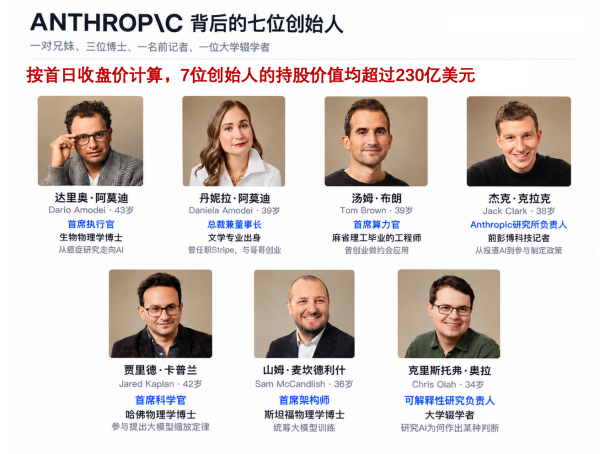
This means that almost all of Anthropic’s seven founders own more than 23 billion U.S. dollars in company stock, and their total book wealth exceeds 1 trillion yuan.
But what is truly staggering is not the founder’s wealth.
Anthropic is distributing an astonishing wealth feast to its ordinary employees.
According to estimates from private equity trading platform Hill, after Anthropic went public, approximately 598 non-founder employees held equity worth at least US$100 million. Sacra, another research firm, estimates that about 2,800 current and former employees have at least $1 million in vested equity.
This means that an AI wealth creation movement is spreading from the company’s founding team to thousands of ordinary employees.
Anthropic’s wealth myth comes first from its astonishing growth rate.
In 2021, Dario Amodei and his sister Daniela Amodei led several former OpenAI colleagues to found Anthropic. At that time, the company was just a startup focusing on AI security research, with no products and no revenue.
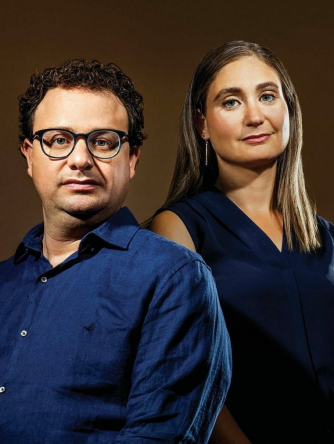
Picture|Dario brother and sister
FTX collapsed at the end of 2022, and its largest early shareholder SBF's $500 million, approximately 13.56% stake, was frozen into bankruptcy liquidation overnight. Money is burning, income is close to zero, and the capital chain may be broken at any time. Fortunately, the two cloud giants Amazon and Google took over the mess, and since then the two have invested more than 30 billion US dollars in total.
But the turning point in business was changing Claude from a "chat assistant" to a "work tool" and finding a paid scenario. Developers, programming, enterprise workflows, Claude Code has become a growth engine. Enterprise customers increased from 1,500 at the end of 2025 to 11,900 in September 2026; revenue increased from US$41 million in 2023, 4.585 billion in 2025, to 33.2 billion in the first three quarters of 2026.
Five years later, it has grown into one of the most valuable AI companies in the world.
Claude's rapid development has allowed Anthropic to establish increasingly strong business influence in the fields of programming, enterprise services and AI Agent. The capital market also gave an extremely generous pricing: US$1.5 trillion.
The rapid jump in company valuations directly amplifies the value of equity held by early employees.
Anthropic disclosed in its IPO documents that as of September 30 this year, book gains from stock options held by employees reached US$119 billion, of which approximately US$73 billion had already vested.
Even more noteworthy is the cost of employee equity.
For options granted before the end of 2023 and still unexercised, the average exercise price is only
$0.52
. This means thatsome employees who join the company in its early stages may be able to obtain shares worth millions or even hundreds of millions of dollars at a very low exercise cost.
This also explains why Anthropic’s IPO had such an exaggerated employee wealth creation effect.
At the end of 2024, Anthropic had approximately 940 employees; by the end of September this year, this number had grown to approximately 5,300.
The early employees who joined the company happened to catch up with the company's valuation jump from a start-up to a trillion-dollar AI giant.
It is worth noting that equity incentives are not just for AI researchers and engineers.
Ifeng Technology noticed a job advertisement for May 2024. At that time, Anthropic was recruiting an administrative assistant to be responsible for arranging schedules, coordinating meetings and travel, handling reimbursements and other matters for the company's management, with an annual salary of US$140,000 to US$190,000. The recruitment also specifically states: "Equity will be an important component of overall compensation."
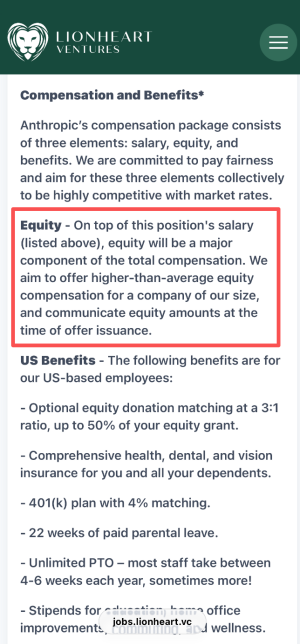
Picture|Administrative Assistant Recruitment Advertisement
This means that even some early employees who are not in core technical positions may achieve a wealth level jump in this listing because of the stock options they received that year.
Interestingly, the sales price of single-family homes in San Francisco appeared almost simultaneously with the wealth creation effect of Anthropic's IPO, with the median price rising nearly 30% year-on-year in October, reaching $2.39 million. This is the largest monthly increase in the borough’s median home price since February 2018.
In traditional technology companies, if an ordinary employee wants to accumulate hundreds of millions of dollars in wealth, he often needs to work for a long time, continue to be promoted, and even wait for the company to go through several rounds of growth cycles. In the AI era, a successful startup and a valuation jump can compress this process to about five years.
AI is becoming Silicon Valley’s latest wealth-making machine
Anthropic is not alone.
In the past two years, the explosion of generative AI has given rise to a new wave of technological wealth.
OpenAI’s previous employee share sale made hundreds of current and former employees gain huge wealth. According to relevant transaction disclosures, more than 600 employees have cashed out approximately US$6.6 billion through share sales, with an average of approximately US$11 million per employee.
Anysphere, the parent company of the AI programming tool Cursor, was founded by four young people from MIT. Initially, they just wanted to make AI coding easier. After Cursor became popular, the company's valuation soared and was later acquired by SpaceX for $60 billion. According to foreign media estimates, the average equity return received by the first 50 employees who joined the company reached tens to hundreds of millions of dollars.
Perplexity, another AI search company established only four years ago, has seen its valuation rise from about US$500 million in the early days to more than US$30 billion, and the equity of early investors and employees has also been rapidly amplified.
At the same time, the investment boom surrounding AI infrastructure, chips and large models is also constantly pushing up the valuations of related companies.
Compared with the Internet era, AI companies have seen new changes in the speed of wealth creation.
On the one hand, large-scale model research and development requires huge capital investment, but once technology and product advantages are formed, there is an opportunity to quickly enter the global corporate market. On the other hand, competition for AI talent is extremely fierce, and companies are increasingly relying on equity incentives in order to compete for top researchers and engineers.
Stock options are no longer just a part of compensation, but have also become an important bargaining chip for AI companies to attract and retain talents.
The case of Anthropic is particularly typical: the company has expanded from a team of less than 1,000 people to 5,300 people, and employee equity incentives have also appreciated significantly with the rapid growth of the company's valuation.
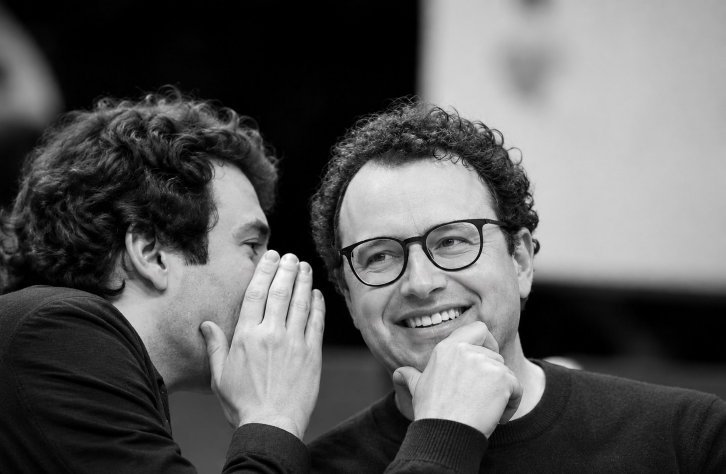
Picture | Founder Dario
The other side of this wealth carnival is that the AI industry is forming a new wealth distribution structure. Early investors, founding teams and early employees have become the most direct beneficiaries of this technology wave.
Beyond paper wealth, how long can the carnival last?
However, being listed does not mean that all wealth can be realized immediately.
There are sales restrictions on Anthropic’s employee stock. Non-founder employees can sell up to 10% of their shares on the first trading day, and an additional 35% after fiscal 2026 results are announced.
Therefore, the so-called hundreds of billionaires and thousands of millionaires are more about the potential wealth calculated based on the issuance price and shareholding status, rather than the cash that has been received.
More importantly, there is an increasingly tight rope hidden in the balance sheet.
Public information shows that as of the end of September, Anthropic has signed long-term purchase and leasing commitments of nearly US$895.4 billion, of which the portion due within the next 12 months is as high as approximately US$69.8 billion. These contracts are extremely rigid, and many are guaranteed payment obligations that “pay regardless of actual usage.”
This means that Anthropic's expenses are rigid, but its income is elastic. Enterprise customers can reduce API calls based on usage, and industry price wars will also drive down unit prices, but computing power bills will not be discounted.
In addition, profitability pressure has emerged. In the second quarter of this year, Anthropic just achieved an operating profit of US$974 million, and immediately turned a loss of US$567 million in the third quarter. The reason is cruel: in the third quarter, computing power costs soared 77% from the previous quarter, and the revenue returned for every US$1 invested in computing power dropped from US$2.08 in the second quarter to US$1.72.
The quality of income is also not as stable as it appears. About 80% of the company's revenue comes from pay-per-use APIs, and fluctuations in customer budgets will be directly transmitted to revenue.
More notably, new model versions released in the six months to the end of September 2026 contributed more than 80% of revenue in the quarter. In other words, Anthropic must continue to launch stronger models in order to maintain the revenue curve. Once the iteration pace slows down, customer usage and willingness to pay may decline at the same time.
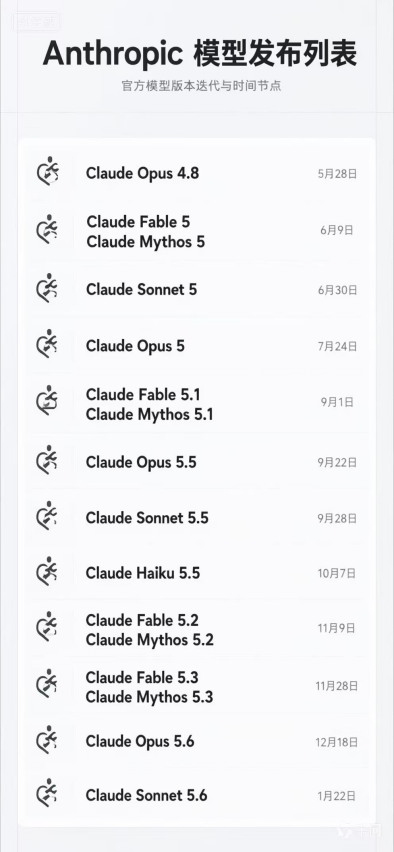
Picture | New models released by Anthropic in the past 6 months, data from the company’s official website
The governance structure is also not easy. Cloud giants such as Google and Amazon are shareholders, suppliers, and competitors with their own large models; while the seven co-founders control the company through high-voting shares, public shareholders have limited influence on major decisions.
Coupled with the fact that there are more than 20 lifting points in the first year of listing, a large number of sellable shares may be released before and after the financial report window. If the stock price does not perform as expected, potential selling pressure will be further amplified.
The valuation of US$1.5 trillion does not buy Anthropic today, but the probability that it will continue to outperform computing power bills, model iterations and the competitive landscape in the next five years.
In the future, whether the company can continue to expand revenue, maintain technological leadership, and convert huge investment in computing power into stable profits will determine whether this wealth feast can continue.
However, no matter how the subsequent stock price changes, Anthropic has demonstrated a new way of creating wealth in the AI era: technological breakthroughs can spawn a super company in a short period of time, while equity incentives further spread wealth from founders and investment institutions to thousands of employees.
When a company established five years ago can make hundreds of employees reach the threshold of billionaires, the story of AI wealth creation has obviously entered a new stage.
Comments