
Abstract:
With the official launch of Apple’s first foldable screen phone iPhone Duo, the outside world is not only paying attention to its folding form, but also has a strong interest in the reasons why it can achieve close to desktop-level performance in a thinner body. Apple's engineering team recently disclosed the design focus behind this device, showing that the company has conducted a large-scale redesign in many aspects such as heat dissipation, battery layout, chip scheduling, and body structure.
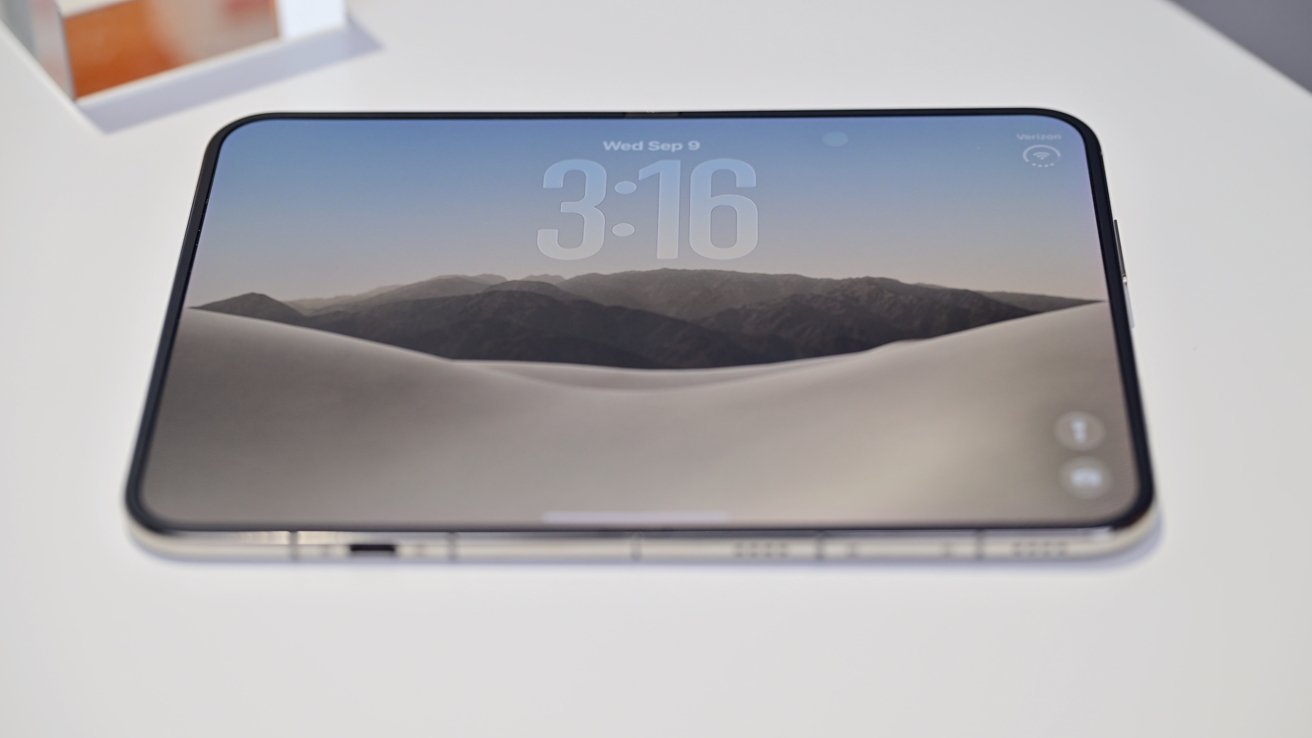
Apple said that iPhone Duo is not just a simple folding of the existing iPhone, but a product rebuilt around the folding form. Since it has a large display space close to that of a tablet when unfolded, it is easier for users to run multiple applications at the same time, handle complex tasks, and even use professional software. Therefore, the device must have sustained performance output capabilities that far exceed those of traditional smartphones.
To meet this goal, Apple has equipped the iPhone Duo with the new A20 Pro chip, which has been specially optimized for its operating environment. Compared with traditional mobile phones that emphasize instantaneous peak performance, Apple hopes that folding screen devices can maintain high-performance operation for a longer period of time to cope with scenarios such as video editing, multitasking, professional creation, and large-scale games.
The cooling system has become one of the core links in this engineering design. Apple has equipped iPhone Duo with a specially designed heat distribution structure to improve heat conduction efficiency through a larger heat dissipation area and optimized internal layout. Since the foldable body has a larger internal space after unfolding, engineers are able to use heat dissipation solutions that are difficult to achieve with traditional mobile phones, thus reducing performance degradation due to heat generation.
The battery design has also been adjusted. Apple adopts a dual-battery architecture and arranges the batteries on both sides of the fuselage to meet the needs of folding structures. This design not only helps improve internal space utilization, but also allows the system to maintain a thin and light design while providing longer battery life, providing a basic guarantee for sustained high-load operation.
At the same time, Apple also redesigned the internal structure of the fuselage. In order to accommodate high-performance chips, heat dissipation components, and folding hinges in an ultra-thin body, the engineering team further compressed the circuit board size and rearranged multiple components. Apple said that this highly integrated design is an important factor in achieving the coexistence of a thin and light folding form and high performance.
At the software level, iOS 27 has also made a lot of optimizations for the folded form. The system can dynamically adjust resource allocation according to the expanded or collapsed state, and is optimized for multi-window, multi-tasking and cross-application collaboration, so that the device can be closer to the desktop system when handling complex workflows.
Apple believes that the future development direction of mobile devices is not only to improve the performance numbers themselves, but more importantly, continuous output capabilities and software and hardware synergy efficiency. With the launch of iPhone Duo, the company hopes to prove that foldable phones can not only bring more display space, but also become a computing platform that combines portability and productivity.
Judging from Apple’s public information, the focus of iPhone Duo’s research and development is not simply to pursue a thinner and larger foldable body, but to conduct comprehensive engineering reconstruction in terms of heat dissipation architecture, battery design, internal space utilization and system optimization, so that it can provide an actual use experience closer to a desktop computer in the form of a mobile device.
Comments