
Abstract:
A research team at the University of California, San Francisco, has developed a new type of brain-computer interface system, which for the first time can simultaneously decode the language and associated body movements of paralyzed patients from a single brain implant device, and drive digital virtual images for expression. The research results were published in the journal Nature Neuroscience on September 14.
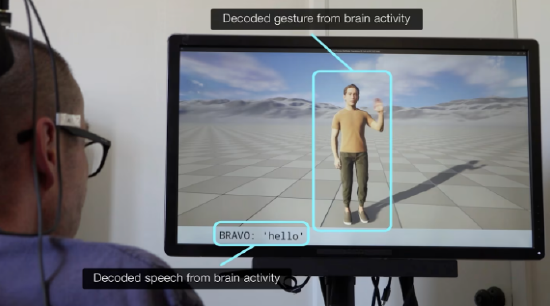
Samantha Brosler, the first author of the research paper, said that this research aims to promote the development of brain-computer interfaces from restoring a single function at a time to restoring multiple communication and movement methods with a single brain interface. She points out that gestures can add meaning, emphasis, emotion and context, and in some cases can completely replace language, such as nodding in agreement, shaking the head in rejection, waving, shrugging or giving a thumbs up.
This proof-of-concept study used 10 and 4 communication gestures among two participants, respectively. The system uses machine learning technology to accurately decode words and gestures from the minds of two people. The team's next goal is to extend the method to a larger vocabulary and a more continuous range of body movements.
An effective prosthetic approach to communication could help millions of patients with intact or near-intact cognitive function but loss of speech due to stroke, the neurodegenerative disease ALS and other brain diseases. In the long term, scientists hope the technology will also help people who have difficulty speaking due to cerebral palsy and autism.
The field of communication prostheses has attracted increasing research attention and investment. Active companies include Elon Musk’s Neuralink and Precision Neuroscience. Echo Neurotechnologies, a company co-founded by UCSF study lead researcher Dr. Edward Chang, is developing brain implant hardware.
Richard Rosch, an expert in brain dynamics and senior clinical lecturer at King's College London, said the research is innovative and provides new clues about how the brain combines language with other forms of communication. He noted that research showing significant overlap in areas of the brain that process language and gesture adds to the emerging literature that the human brain may not be a network of highly specialized, interconnected but separate regions, but instead have substantial overlap in function. But he also warned that the technology is still far from universal, requires major brain surgery, and performs poorly when handling body motion on the contralateral side of the implant.
Scott Wellington, a researcher at the Bath Institute for Augmented Humanity at the University of Bath, applauded the research but pointed out that there are still obstacles to turning it into a standard assistive tool, including that the system needs to be customized for each patient. He said these technologies rely heavily on the individual, and a model trained on one person's brain signals works for that individual but is difficult to generalize to others. Research on universal models requires significant investment, which may hinder their widespread clinical adoption.
Comments