
Abstract:
A famous demography paper published in 1960 made an astonishing prediction: According to mathematical models at the time, the total human population will reach "infinity" in November 2026. As this time point is approaching, the answer given by reality is completely different. The United Nations and other agencies estimate that by the middle of next month, the global population will be about 8.3 billion, which is far from an "infinite population" in the mathematical sense.
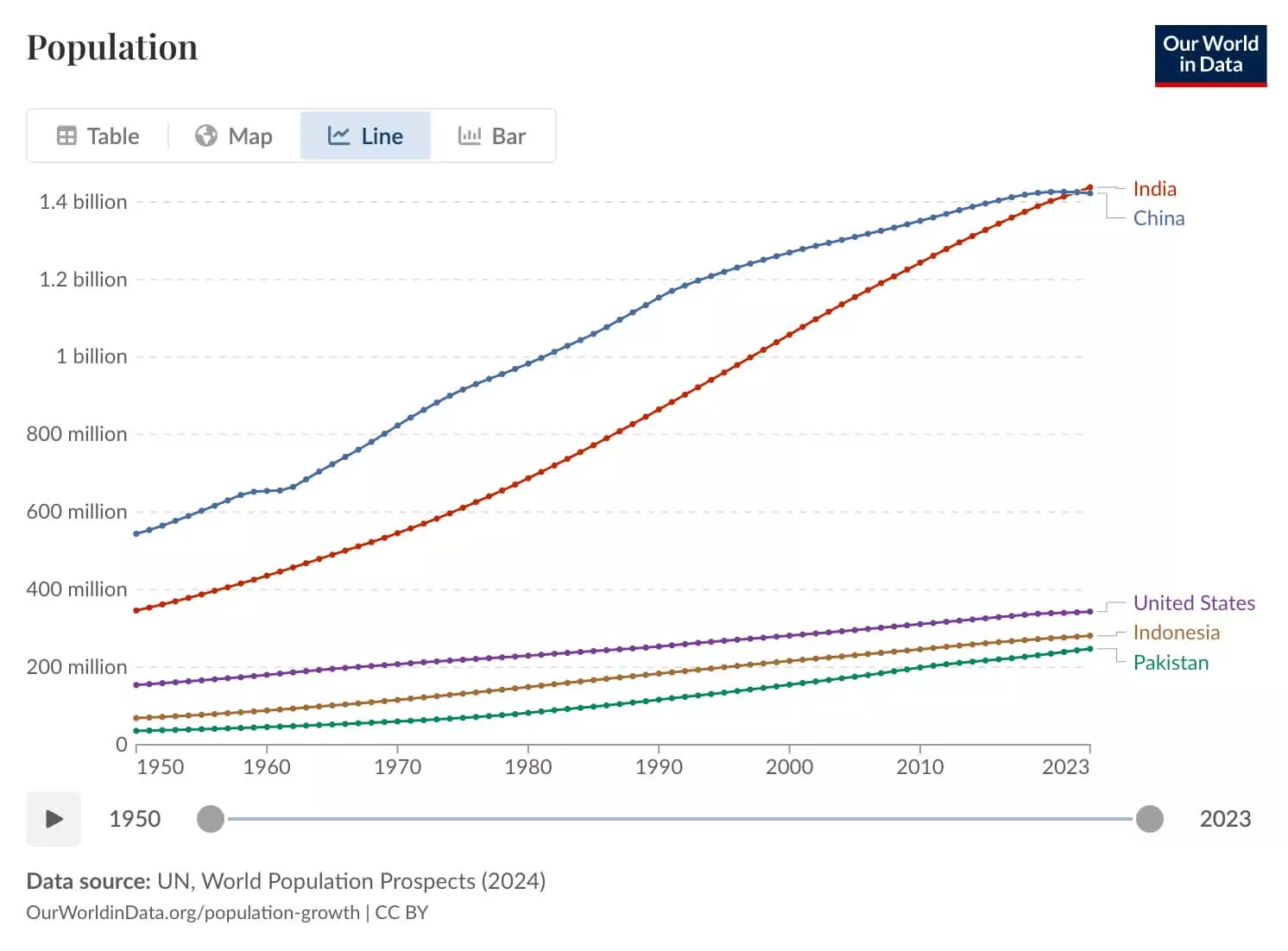
This prediction was made by Heinz von Foerster and colleagues. They use a "hyperbolic growth model." Unlike the traditional exponential growth model, which assumes that the population always grows at a fixed rate, hyperbolic growth believes that as the population increases, the growth rate itself will continue to increase, forming an increasingly strong positive feedback.
According to this theory, the population growth curve will eventually reach a "singular point", that is, it will become infinite in a limited time. The research team set this moment in November 2026 and published it in the journal Science under the title "Doomsday: Friday, November 13, 2026 AD". According to reports, the choice of this date is also related to Foster's birthday.
Judging from the data at the time, this prediction was not without basis. The global population reached 1 billion around 1800, then grew to 2 billion by 1925, and to 4 billion by 1975. Less than 50 years later, the world's population passed the 8 billion mark. The time it takes for a population to double continues to shrink, which does seem to be in line with the trend of faster than exponential growth.
Because traditional population forecasting models repeatedly underestimated population growth in the 1960s and 1970s, the hyperbolic model once performed more accurately. In fact, the model still fit the actual population changes well until the late 1970s, so it gained a lot of attention.
Critics have long pointed out, however, that this model lacks a basis in reality. Although it can fit existing data, it does not fully consider factors such as economic development, technological progress, changes in social systems, and adjustments in human behavior. Even if past population growth trends hold true, there is no proof that the future will follow the same trajectory forever.
The problem is that the conditions that supported the model later changed. Starting in the mid-1960s, the link between population size and growth rate gradually weakened. After entering the 1980s, the fertility rate in many developed countries dropped below the population replacement level, while developing countries also gradually entered the stage of demographic transition.

Although the total global population continues to increase, the premise that the larger the population, the faster the growth rate is no longer true. Because of this, the model can still be close to the real population for a period of time, but it gradually loses its long-term predictive power.
In 1993, economist Michael Kramer re-examined the hyperbolic growth theory. He believes that this super-exponential growth model can explain human population history spanning hundreds of thousands to millions of years. However, as newer data are added, this conclusion is beginning to be challenged.
The researchers pointed out that when United Nations population data as of 2023 were included in the analysis, the positive relationship between population size and growth rate weakened significantly. Although these new data represent only a small fraction of the entire time span of human history, they have a huge impact on the results because they correspond to the largest human populations ever recorded.
Additionally, there are inherent uncertainties in population data from earlier periods. Population sizes for BC and even ancient times rely mainly on archaeological evidence and speculation about technological levels, land use and population density, and therefore have limited accuracy.
In fact, population growth in human history is not a single continuous process. Population changes were very slow over long periods of time, with rapid growth occurring only in specific stages such as the Agricultural Revolution, the Industrial Revolution, and the modern population explosion. Trying to describe all eras with a unified curve can easily obscure the huge differences between different historical stages.
For example, the researchers said that if people living in 200 BC had extrapolated solely based on Neolithic population growth trends since then, they might have predicted that humans would not reach today's population size until around 1000 AD. It can be seen that the historical sample interval selected by the model will have a great impact on the final prediction.
The article points out that this case is also of practical significance to the current discussion surrounding the development of artificial intelligence. In the late 1950s, computer science pioneer John von Neumann proposed that technological progress is accelerating and may reach a critical point where it is difficult to predict the future, but he did not give a specific formula or timetable.
Today, many predictions about artificial intelligence are also based on continued expansion of computing power and model size. If we simply extend the current trend infinitely, it seems that we can conclude that technology will explode and even approach a "technological singularity." However, historical examples of population forecasting serve as a reminder that even if a model accurately describes growth trends over the long term, it does not mean that the conditions driving growth will always exist.
So evidence of rapid progress is not the same thing as evidence that a technological singularity is coming. Artificial intelligence may still make major breakthroughs in the future, but there is still a huge gap between observing an accelerated development trend and asserting that the singularity is bound to come.
Comments