
Abstract:
The Einstein Probe satellite observed a short gamma-ray burst that continued to emit soft X-rays for nearly ten minutes after the initial flash faded, revealing a previously difficult-to-detect phase of activity after the merger of dense objects such as neutron stars. Researchers believe that these X-rays may come from the debris left by the merger and provide new observational clues for understanding the sources of short gamma ray bursts and gravitational waves.
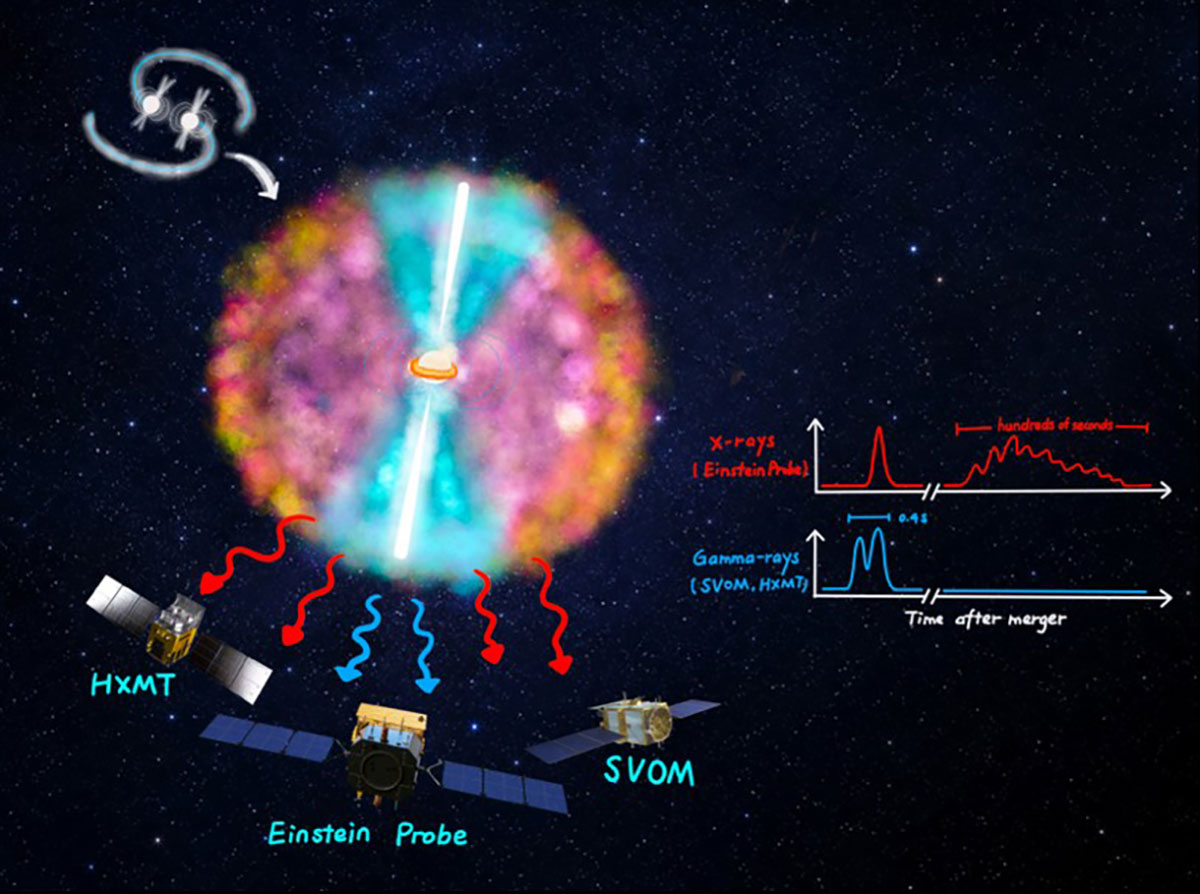
Short gamma ray bursts are generally thought to be caused by compact objects such as two neutron stars orbiting each other and eventually merging. Mergers produce gravitational waves and one of the most powerful bursts in the universe, but the initial gamma-ray flash often fades away in less than half a second. Many traditional narrow-field X-ray telescopes need to receive a gamma burst warning before turning to the target, so they often miss the weaker, lower-energy soft X-ray signals in the initial stage of the burst.
On July 4, 2025, the Einstein probe captured an explosion numbered EP250704a/GRB 250704B during the event. The event initially appeared to be an ordinary short gamma ray burst, but the bright flash lasting less than half a second was simultaneously detected by the SVOM gamma-ray monitor, the Eye satellite high-energy telescope, and the Einstein Probe wide-field X-ray telescope. But the signal did not disappear. The source then released soft X-rays multiple times for nearly ten minutes. Li An, a doctoral student at Beijing Normal University and a researcher on duty for the temporary source of the Einstein probe, immediately carried out preliminary analysis after receiving the satellite alert.
The research team pointed out that this long period of radiation carried considerable energy, but the spectrum mainly fell in the softer X-ray range. For bursts at typical cosmological scales, the signal is below the detection threshold of conventional gamma-ray instruments, such as the Swift satellite's GRB Alert Telescope, so past missions may have recorded only the initial brief flash and missed subsequent activity.
Subsequently, the international team carried out joint observations from X-rays, visible light to radio bands. Eleonora Troia's team at Sapienza University of Rome obtained key redshift data through spectral analysis, confirmed the host galaxy and measured the distance; multi-band observations also ruled out the possibility of accompanying supernovae, providing strong evidence that the signal originated from the merger of compact celestial bodies.
The timing and changing characteristics of the signal indicate that the sustained X-rays may come directly from the merged wreckage rather than from an outward-expanding shock wave. High-energy analysis led by Yin Yihan, a doctoral student at the University of Hong Kong, found that the brightness of EP250704a changed rapidly and the spectrum also changed with time; these features, combined with subsequent changes in X-ray and visible light afterglow, point to the continued activity of the central engine after the short gamma ray burst. One possible explanation is that the merger formed a magnetar, a neutron star with high-speed rotation and extremely strong magnetic field, which provides energy for extended X-ray radiation and continues to inject energy outward; this explanation is still a possible mechanism proposed by researchers.
Since scientists first simultaneously detected electromagnetic radiation and gravitational waves produced by a neutron star merger in 2017, astronomers have been looking for signals that could reveal the merger process and its subsequent evolution. Researchers said that the soft X-ray component discovered this time provides a new observation method, which may indicate that the phenomenon of fast X-ray transients can also become the electromagnetic counterpart of gravitational wave sources, and may originate from the merger of compact celestial bodies. Other short gamma-ray bursts may be accompanied by similar long-duration soft X-rays, but they have been difficult to capture with previous equipment.
The research team believes that this discovery broadens the understanding of neutron star mergers and may also help scientists further study merger debris and constrain the equation of state of neutron stars. The relevant paper was published in "Science Bulletin" on August 10, 2026. The research was completed by researchers from Beijing Normal University, Nanjing University, Sapienza University of Rome, University of Hong Kong and other institutions.
Comments