
Abstract:
Astronomers warn that fast-moving, light-reflecting satellites will leave white bands of light on photos taken by the Vera C. Rubin Observatory. On a mountaintop in the Chilean desert, an $800 million telescope funded by U.S. taxpayers has officially opened. Brand new
Vera C. Rubin Observatory
It was originally planned to launch a groundbreaking cosmic survey project to produce the most complete catalog of galaxies, asteroids, supernovae and black holes in history. But researchers at the observatory ran into trouble: Satellites passing by at high speed and reflecting sunlight would leave white streaks on the astronomical films.
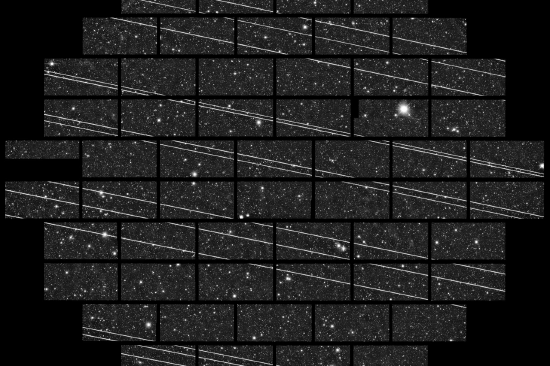
Inter-American Observatory of Monte Tololo in Chile In the starry sky photos taken in 2019, you can see the light trails left by the Starlink satellites.
J. Anthony Tyson, chief scientist of the Observatory, known for his dark matter mapping research, said that the surge in the number of satellites poses an
existential threat to the Observatory's scientific research work
.Tyson and other scientists warn that such orbiting spacecraft will make ground astronomical observations increasingly difficult to carry out; in the long run, the familiar night sky will no longer exist.
Astrophysicist Jonathan McDowell has been recording every orbital rocket launch since 1957. According to his statistics, there are currently more than 17,000 active satellites in orbit, compared with only about 1,000 a decade ago. He predicts that the number of satellites in orbit may exceed 100,000 in ten years.
Satellites reflect sunlight back to Earth. As the number of satellites increases, so will the light pollution from space.
Hanno Rein, an associate professor at the University of Toronto who built a light pollution model of the planned satellite constellation, said: "The number of stars you see in the sky will double, but only half of them are real stars." The other half of the light points across the sky are actually satellites.
SpaceX currently has approximately 11,000 satellites in orbit. In recent regulatory filings, the company disclosed plans to launch up to 1 million more satellites, half of which would operate in twilight orbits.
The boundary between day and night on the earth is called
the twilight line (the end line of day and night)
. For satellites operating in the morning and evening orbits, the solar panels can receive sunlight almost 24 hours a day and obtain uninterrupted power; at the same time, this orbital position will also make the satellite look particularly bright on the ground.The bright light we see from satellites is caused by sunlight reflecting onto the night side of the Earth. Satellites operating in other orbital positions will be obscured by the Earth's shadow and will not reflect sunlight.
Stars are much farther from the earth than satellites. If another 500,000 morning and evening orbiting satellites are added, humans will have to look for real stars through a light curtain when observing the starry sky.
Currently, satellites are mainly used for communications, and most of them belong to Starlink, which provides Internet access services to the world.
In the future, as space launch costs continue to decrease, more companies and governments will launch their own satellites. Blue Origin, Google, Cowboy Space and other companies have said they plan to deploy orbital data centers, and such projects often require hundreds of thousands of satellites. SpaceX’s “Starmind” orbital data center project plans to have more than 1 million satellites.
Nowadays, ordinary satellites are not large: a single Starlink satellite covers an area of about 4 square meters, which is equivalent to a king-size double bed. But the satellites used for orbiting data centers are much larger. SpaceX's public filing documents show that its orbital data center satellite can reach a maximum size of
1,500 square meters
; Cowboy Space’s satellite design area is 4,800 square meters, close to the size of a football field.Tyson said that SpaceX has taken the initiative to suppress the brightness of Starlink satellites. He and SpaceX staff have been communicating on this issue for nearly ten years. Another researcher at the Rubin Observatory said that the observatory has also carried out "constructive dialogue" with six other satellite companies.
"They are willing to help, or at least trying to do so." But he also pointed out that even after processing, the brightness of the Starlink satellites still exceeds the recommended standards of the International Astronomical Union and can be seen with the naked eye. Tyson has not yet communicated with Chinese satellite manufacturers, and scientists say some Chinese satellites are sometimes brighter than American satellites.
SpaceX did not respond to requests for comment; Google and Blue Origin declined to comment; Cowboy Space could not be reached.
The U.S. Federal Communications Commission (FCC) is responsible for approving satellite projects, but it has not issued any regulatory rules regarding satellite brightness. A 2022 "Dark and Quiet Sky Working Group" global satellite regulation survey report states: "Except for a law in the United States banning space advertising, there are no laws in the world that regulate the night sky visual environment."
Samantha Lawler, associate professor at the University of Regina, recently participated in writing a paper on light pollution in the orbital data center. She introduced that the company plans to set the orbital data center satellite to a
sun-synchronous orbit
, almost constantly exposed to direct sunlight. These satellites, which operate on solar energy, will reflect stronger sunlight back to the earth than ordinary satellites. Lawler estimates that such satellites could be as bright as Venus, one of the brightest objects in the sky. Hundreds of thousands of such satellites operate collectively, and it is possible to "completely obscure" the light of the Milky Way and dimmer stars during part of the night.Shane Ross, a professor of engineering at Virginia Tech, created a simulation webpage to deduce what the SpaceX Orbital Data Center would look like from the ground. The simulation results show that thousands of bright light points form a light belt, crossing both ends of the horizon and slowly streaking across the night sky.
According to Shane Ross's model, a 12-second simulation video played at 10 times speed about an hour after sunset in the Northern Hemisphere in December can visually show the effect of the orbital data center from the ground perspective. Source: Shane Ross, Virginia Tech.
Ross commented: "The scene is shocking, but also disturbing."
After he made the simulation results public, public reactions were polarized. "Some people are very excited about this; other people think that we are destroying a common heritage that belongs to all mankind."
Astronomers from Tyson and the Rubin Observatory have just begun a ten-year space survey. Now he is beginning to worry that this scientific research project may be forced to terminate early. Satellites will not only leave traces of light on telescope images, Tyson predicts that giant satellite constellations will also produce diffuse reflections, raising the background brightness of the entire night sky.
It will eventually evolve into: "The night sky is so bright that no astronomical observations can be carried out." Tyson said.
Comments