
Abstract:
Gamma-ray bursts (GRBs), one of the most violent explosions in the universe, usually release astonishing amounts of energy in a short period of time. However, astronomers recently observed a very unusual explosion: the gamma rays it initially released were not prominent, but then produced one of the brightest afterglows in the past 20 years. What is even more surprising is that about three weeks after the explosion, its X-ray radiation increased significantly again and continued to remain at an unusually bright level.
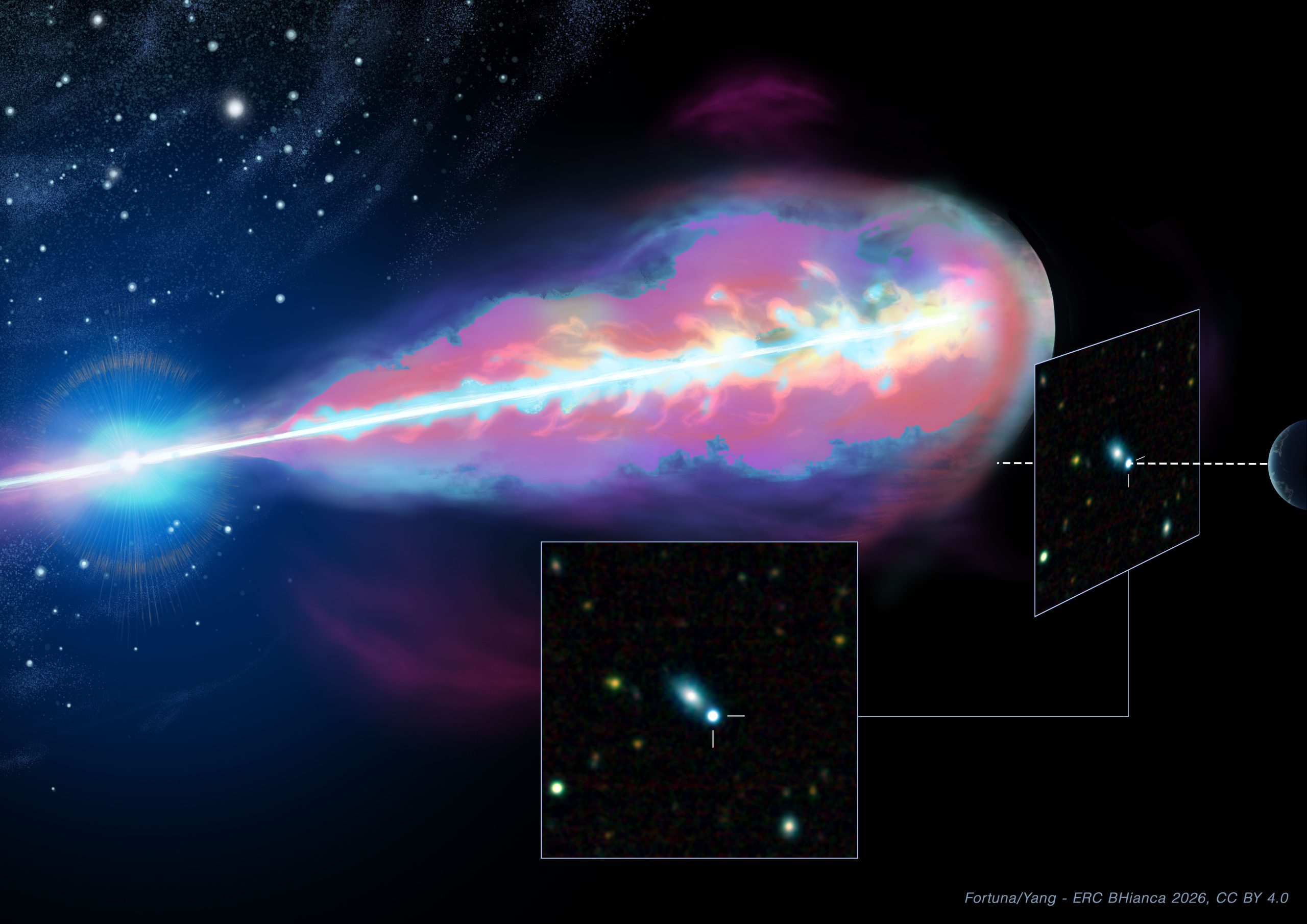
This event was named GRB 260310A and was detected by NASA's Fermi Gamma-ray Space Telescope on March 10, 2026. The initial gamma-ray burst lasted about 53 seconds. Judging from the energy release, it seemed to be just a relatively ordinary gamma-ray burst.
But subsequent observations gradually revealed that the explosion was far from as simple as it initially seemed. The visible afterglow continued to increase for several hours after the outburst, before gradually weakening. Compared with previously observed gamma-ray bursts, its X-ray and optical afterglow brightness are both among the top 1% of the brightest, and its radio radiation also ranks among the top 5% of the brightest.
The most puzzling phenomenon occurred about three weeks after the explosion: the X-ray signal, which had gradually weakened, strengthened again, and the unusually bright state lasted for more than a week, and could still be detected by telescopes for several months afterwards.
The international research team initially even doubted whether the observation results were interfered by other X-ray sources. But after further analysis, the researchers confirmed that this brightness recovery did come from the afterglow of the explosion itself, rather than observational pollution caused by other celestial bodies.
Researchers believe that the key to explaining this anomaly may lie in the high-speed jet of material produced by the explosion and the location of Earth observers.
Gamma ray bursts are one of the most powerful explosions in the universe. A considerable amount of this occurs at the end of the life of a massive star. When the core of a star undergoes gravitational collapse, a black hole or other dense celestial body may be formed, and at the same time, extremely high-speed material is ejected outward along the direction of the rotation axis. These jets travel at nearly the speed of light and interact with surrounding gas to produce an afterglow that can be detected by X-ray, visible light and radio telescopes.
Normally, astronomers are easiest to spot gamma-ray bursts whose jets are pointed almost directly at Earth. Due to the obvious directionality of the jet, the radiation received is strongest when observed along the direction of the jet core; if viewed from the side, the initial signal seen will be much weaker.
GRB 260310A may fall into the latter category.
The research team proposed that the jet produced by this explosion was not a simple structure with evenly distributed energy, but consisted of a narrow, extremely high-energy core, surrounded by slower but wider material flows on the periphery.
Because the Earth is not directly in front of the core of the jet, in the early stages of the explosion, researchers mainly received radiation from the outer area. The radiation in the truly most energetic core is mostly directed in other directions, so it is not initially directly presented to Earth observers.
As time goes by, the jet gradually slows down, and its radiation can cover a larger observation angle. The originally hidden high-energy core region began to enter the field of view of earth observers, and the X-ray signal strengthened again.
This model could explain why a gamma-ray burst that initially seemed inconspicuous ended up producing an extremely bright afterglow. The research team described it as like looking at a flashlight from the side: initially only the weaker part of the outer beam can be seen, and as the beam and observation conditions change, the strong light hidden in the center gradually becomes apparent.
In order to figure out the true structure of this explosion, the international research team used a number of large-scale astronomical observation equipment, including NASA's Chandra X-ray Observatory, the European Space Agency's XMM-Newton satellite, the Chinese Academy of Sciences' Einstein Probe satellite, the United States' large binoculars, and the Karl Jansky Very Large Antenna Array.
In addition, observations from the Cala Alto Observatory in Spain also discovered supernova characteristics, confirming that this gamma-ray burst was indeed accompanied by the death of a massive star.
The research was led by the BHianca research team at the Torvergata Campus of the Sapienza University of Rome, Italy. The first author of the paper is postdoctoral researcher Yu-Han Yang. By integrating observational data from different wavebands, the researchers established a jet model that could explain this unusual afterglow.
Model calculations show that the explosion's true energy may have been far greater than initial gamma-ray observations suggested. Researchers estimate that if an observer happens to be directly in front of the core of the jet, what they may see is an extremely violent cosmic explosion.
According to model estimates, the energy of this explosion is equivalent to all the energy released by the sun in about 1 billion years, but this energy is concentrated in an extremely narrow jet.
This discovery could change the way astronomers search for extreme explosive events in the universe.
In the past, researchers have typically relied on gamma-ray signals to search for gamma-ray bursts, but if the jet is not heading directly toward Earth, the initial gamma-ray signal can be quite weak and not even enough to cause special concern. GRB 260310A shows that some truly massive stellar explosions may have been underestimated due to suboptimal observation angles.
In the future, as large-scale sky survey facilities such as the Vera Rubin Observatory come into operation, astronomers will be able to monitor the sky more extensively and continuously, looking for objects that have no obvious gamma ray signals but have unusually bright afterglow.
Researchers expect to discover hundreds of similar hidden jet events in the future. However, accurately identifying them among millions of ever-changing celestial signals remains a fairly complex task.
This research not only reveals the possible mechanism behind a special explosion, but also shows that astronomers' understanding of extreme events in the universe may be significantly affected by the direction of observation. Some seemingly ordinary cosmic explosions may actually contain extremely large amounts of energy, but the Earth happens to not be in a position to directly see their strongest radiation.
The related research paper "Extremely bright slowly rising afterglow from off-axis jets in GRB 260310A" was published in "The Astrophysical Journal Letters" on October 28, 2026.
Comments