
Abstract:
After a star runs out of nuclear fuel, it does not necessarily end its life with a spectacular supernova explosion. For stars like the sun, they usually shed their outer layers, leaving behind a dense core that is close to the Earth but may be as massive as the sun. This is a white dwarf.
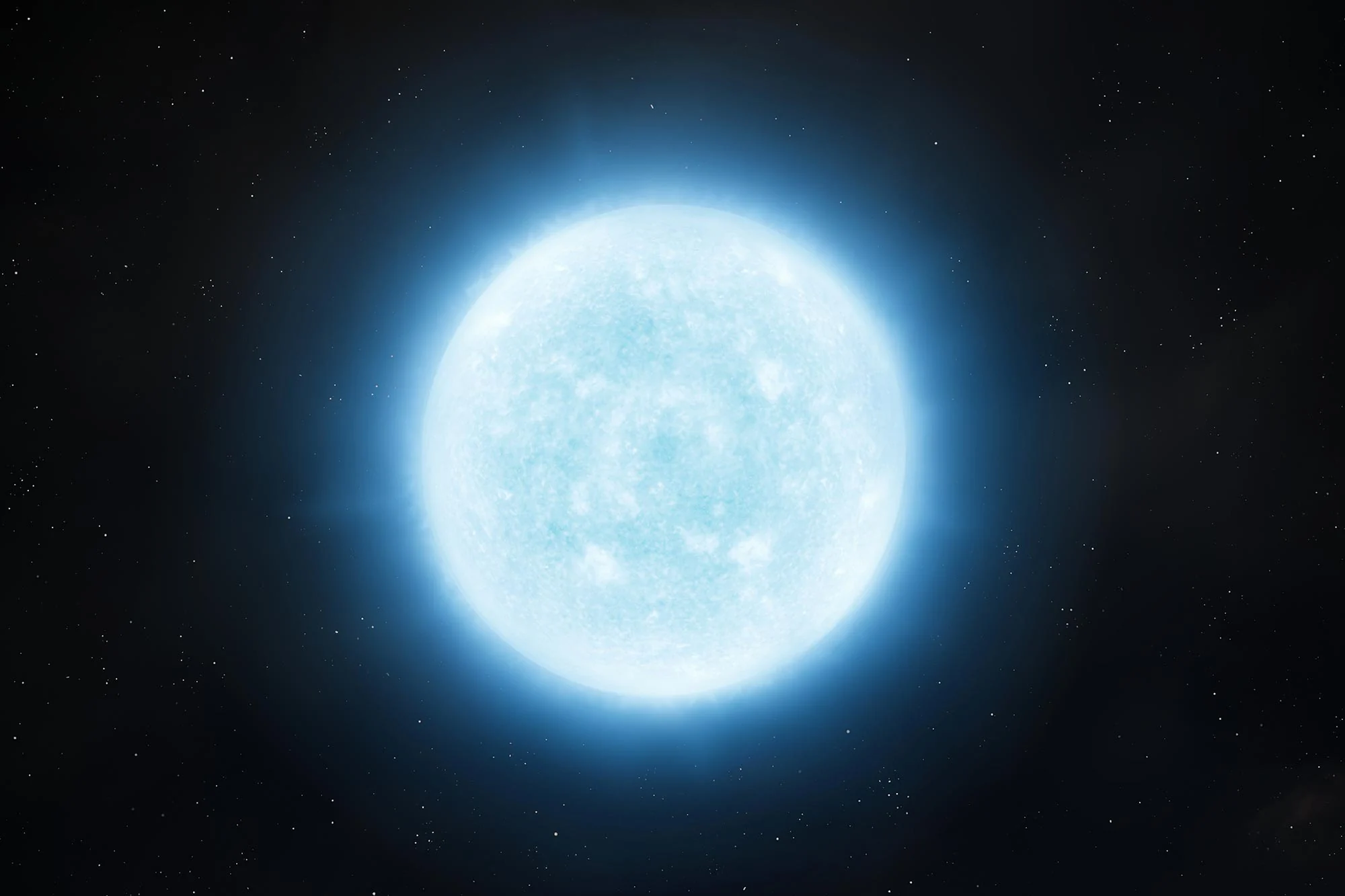
For a long time, the astronomical community has believed that white dwarfs have an insurmountable upper mass limit, known as the "Chandrasekhar limit", which is about 1.4 times the mass of the sun. After exceeding this limit, white dwarfs usually cannot maintain a stable structure and may undergo gravitational collapse or thermonuclear explosion. However, new simulations by a team from the Indian Institute of Science (IISc) found that strong internal magnetic fields could change this limit, making some white dwarfs as massive as about 2.4 times the sun.
The research was published in The Astrophysical Journal Letters. Researchers believe that strong magnetic fields can provide additional internal support for white dwarfs, making it possible for them to remain stable even when their masses are far greater than expected by traditional theory.
The reason why white dwarfs can resist their own gravity mainly relies on a quantum mechanical effect called electron degeneracy pressure. But as the mass continues to increase, the gravity will become stronger and stronger, eventually breaking through this support ability. The Chandrasekhar limit is the theoretical upper limit based on this physical mechanism.
The researchers found that strong magnetic fields may introduce new variables into this traditional model. As the white dwarf accretes material from its companion star, its mass continues to increase, and its internal density rises, causing the star to shrink further. This compression process may enhance its internal magnetic field, and the extra pressure generated by the magnetic field can help resist gravity, allowing the white dwarf to bear more mass.
In order to verify this possibility, the research team modified the stellar evolution program STARS developed by the University of Cambridge to incorporate the magnetic field effect and the cooling process of the white dwarf star into the model. Starting from the time when the star is still in the main sequence stage, it simulates its evolution into a white dwarf star and the subsequent accretion of material from the companion star.
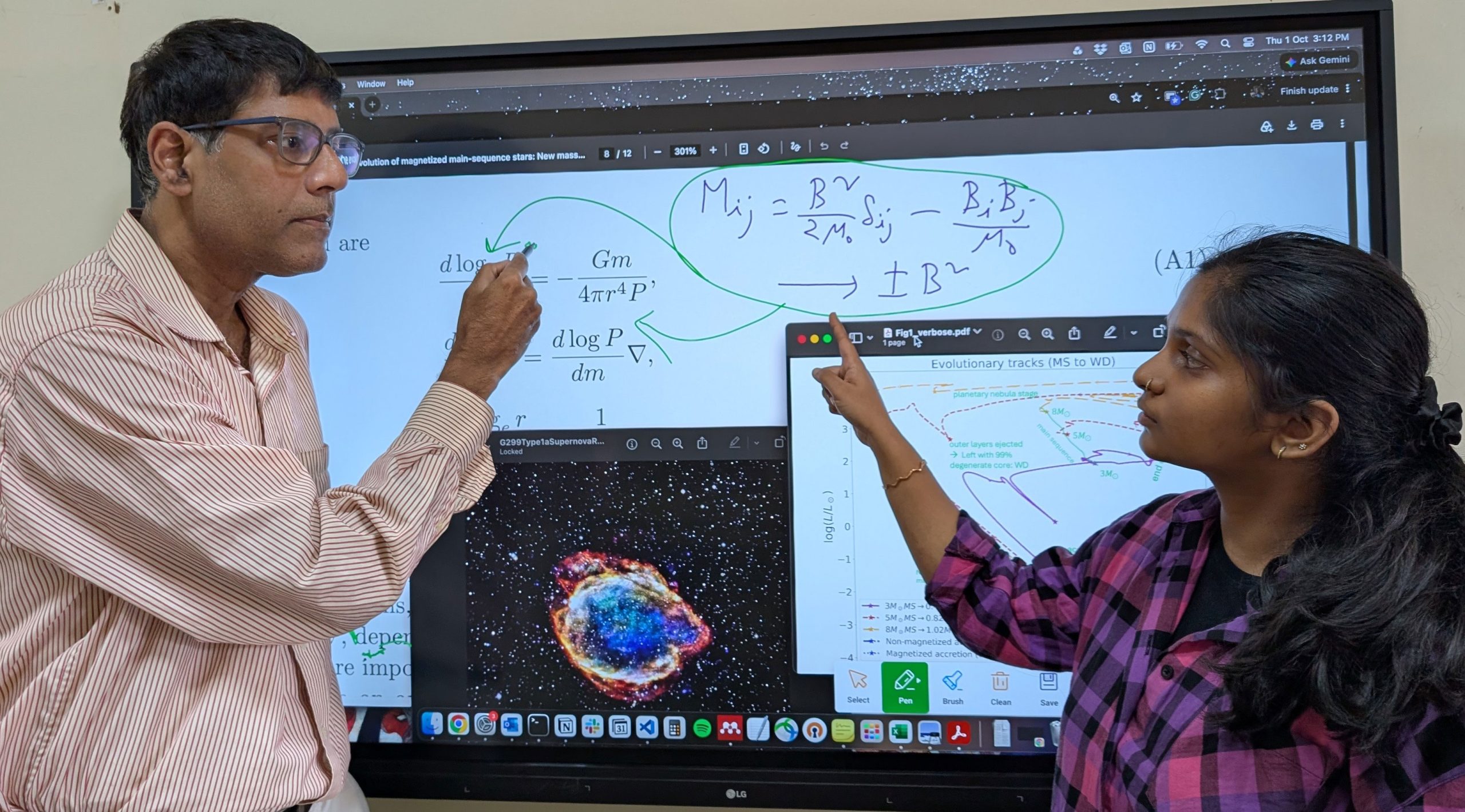
In one of the simulation cases, a star with an initial mass of about 8 times the sun eventually formed a carbon-oxygen white dwarf star with a mass of about 1.02 times the sun. As the white dwarf accreted material at a rate of about one billionth of the solar mass per year, its magnetic field gradually strengthened, and the upper limit of stable mass calculated by the model eventually reached about 2.4 times the mass of the sun. As a comparison, under similar conditions, if the influence of the magnetic field is not taken into account, the upper mass limit is still maintained at about 1.4 times the mass of the sun.
Zenia Zuraiq, the first author of the paper and a doctoral student in the Department of Physics of the Indian Institute of Science, said that the key to the research is not only to prove that white dwarfs with super-Chandrasekhar mass may exist in theory, but more importantly, to verify whether a star can actually form such an object through natural evolution. This simulation tracks the star's main sequence stage all the way to the white dwarf formation and subsequent accretion process, showing that under certain conditions, this evolution path is indeed possible.
In fact, the idea of white dwarfs exceeding the Chandrasekhar limit has been studied by astronomers for decades. Previously, astronomers observed some unusually bright Type Ia supernovae, which were significantly brighter than expected by common models. Therefore, some speculated that these explosions may come from white dwarfs with a mass far greater than 1.4 times that of the sun. Some theories even suggest that the mass of its predecessor may be close to 2.8 times that of the sun.
The significance of this study is that many theoretical calculations in the past focused on whether supermassive white dwarfs can remain stable, but the new study further simulates how they are actually formed through the stellar evolution process. The research team thus provided a more complete theoretical explanation for supermassive white dwarfs supported by magnetic fields. However, this does not mean that such objects are very common in the universe, and research is still unable to determine how often they actually appear.
The discovery may also affect astronomers' measurements of the expansion rate of the universe.
Type Ia supernovae usually occur when runaway thermonuclear combustion occurs inside a carbon-oxygen white dwarf. When the temperature and pressure inside the object reach certain conditions, the carbon element may be ignited, triggering a violent thermonuclear explosion. Because these types of supernovae have relatively stable brightness characteristics that can be calibrated through light curves, astronomers have long used them as an important tool to measure the distance to distant galaxies and to study the expansion history of the universe.
If some Type Ia supernovae actually come from white dwarfs that are more massive and have stronger magnetic fields, then their progenitors may be significantly different from traditional models. These differences may affect the brightness and evolution of supernova explosions, thereby affecting the accuracy of cosmic distance measurements. Further understanding of the formation mechanisms of such supernovae will help improve the physical models astronomers use to study the expansion of the universe.
This research also reminds scientists that some seemingly unbreakable physical limits in the universe may be affected by factors that have not been fully considered before. The Chandrasekhar limit cannot be easily applied under all conditions. Strong magnetic fields may open an evolutionary path for white dwarfs that was previously difficult to identify.
The research paper is titled "Formation of Super-Chandrasekhar White Dwarfs through the Evolution of Magnetized Main-Sequence Stars: New Mass Limits Based on STARS Simulations" and was published in The Astrophysical Journal Letters on October 8, 2026.
Comments