
Abstract:
Scientists have linked evidence of gases typically produced by magma to newly discovered cracks on the Martian surface, pointing to possible volcanic activity on Mars. The discovery is good news in the search for life, because protecting microbes from the frigid temperatures on the Martian surface requires a constant source of heat. On November 4, relevant research results were published in "Science Advances".
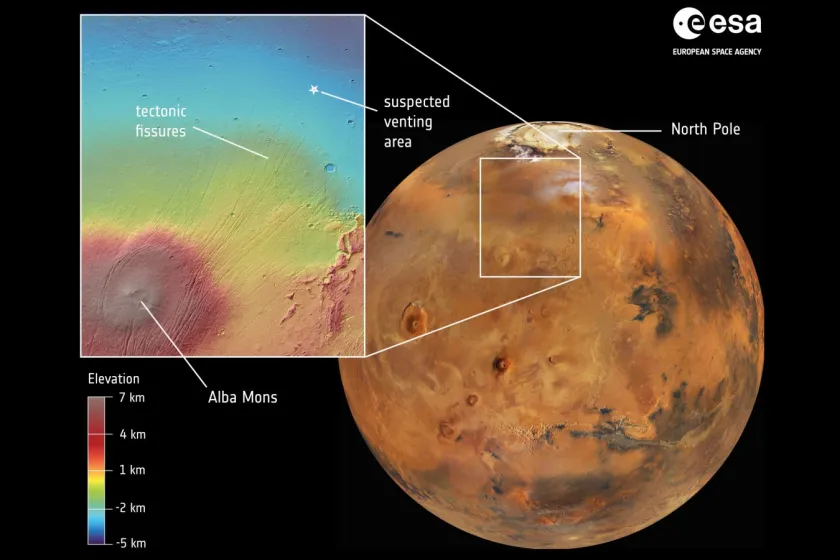
Researchers have found evidence of volcanic activity near Mount Alba on Mars. Image source: Mars Express & HRSC
Scientists have found evidence of volcanic activity on Mars over the past few million years, and seismic activity has suggested that some of the volcanoes may still be active, but no evidence of lava flows or eruptions has ever been found before.
In 2019, ESA’s Trace Gas Mars Orbiter detected the presence of hydrogen chloride in the Martian atmosphere. This gas is commonly associated with magma vents on Earth, so researchers wondered whether something similar existed on Mars.
To explore further, Daniel Mège of the Polish Academy of Sciences and colleagues analyzed the scant gas data and new photos of the Martian surface. They successfully linked recent narrow cracks in the Alba region of Mars to hydrogen chloride emissions, providing strong evidence for the existence of underground lava flows.
To assess whether the hydrogen chloride might have come from these cracks, the team modeled the wind direction at the time of the measurements. "There is a wind distance of 2 kilometers between the two, and dust devils occur frequently this season. Therefore, the atmospheric turbulence is fierce and the situation is very chaotic." Mège said.
Nicolas Thomas of the University of Bern, Switzerland, a member of the research team, emphasized that people will always have doubts about the source of this gas until a close survey of the area is carried out. "Unless you put detection equipment there and actually smell the gas escaping from the ground, you won't be able to get conclusive evidence." But he believes that this discovery provides a basis for further exploration of the Martian surface.
"We know that even in the equatorial region, the night temperature of Mars can be as low as minus 70 or 80 degrees Celsius. That is a very harsh environment." Thomas said, "If this heat source is constant and continuous, then you have to admit that this does improve the situation in terms of the search for life."
Lena Noack of the Freie Universität Berlin in Germany said: "This is undoubtedly a very interesting discovery. Many scientists who study Mars will not be too surprised by this, because the picture of a 'dead Mars' is not consistent with the results of many recent studies."
Related paper information: https://doi.org/10.1126/sciadv.aeb9422
Comments