
Abstract:
Google recently announced the expansion of its artificial intelligence chip product line and the launch of two new tensor processing units (TPU) specifically designed for different application scenarios, named TPU 8tx and TPU 8i Max. These two products are developed based on Google's existing eighth-generation TPU architecture and are designed to meet the growing needs of enterprise customers for data security and large-scale artificial intelligence inference tasks.
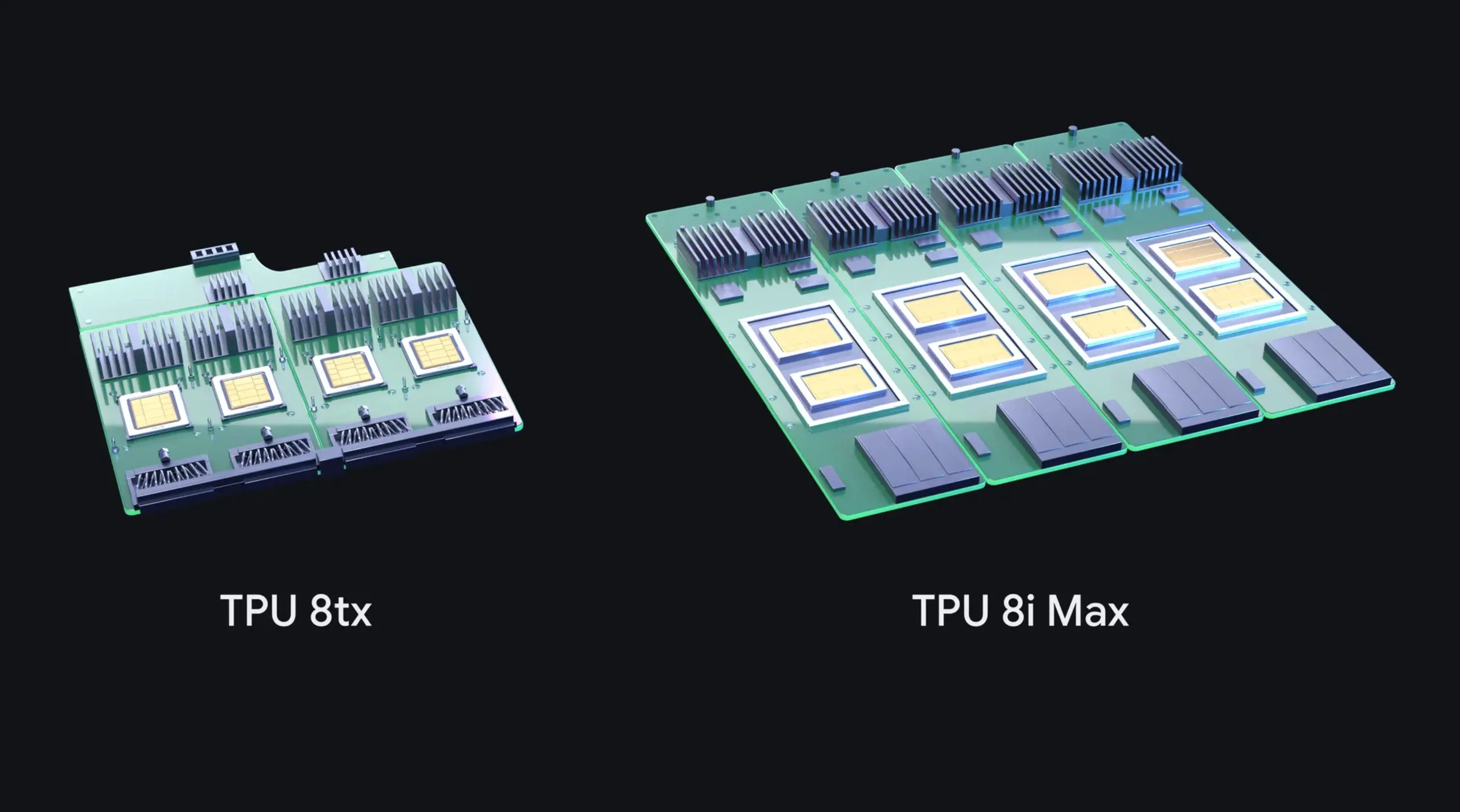
Among them, TPU 8tx focuses on industries with extremely high requirements for privacy protection and data security, including government agencies, financial services, medical health and other strictly regulated fields. Google said that the product introduces confidential computing capabilities to protect model weights and sensitive information during data processing to avoid exposure to unauthorized access.
To achieve this goal, TPU 8tx works in conjunction with AMD processors and deeply integrates encryption functions into the hardware level. Unlike traditional solutions that require decrypting data in memory before performing calculations, the new solution can significantly improve security during sensitive data processing and meet the needs of enterprises to deploy high-security AI systems.
Another new product, TPU 8i Max, is specially designed for large model applications that require extremely long context windows. In recent years, with the rapid development of generative artificial intelligence and AI agent technology, more and more models need to process massive amounts of text, code or data at one time, thus placing higher requirements on memory capacity and inference performance.
According to reports, TPU 8i Max can support longer context windows by enhancing computing power and memory resources, allowing artificial intelligence models to analyze more content in a single request. This capability is particularly important for scenarios such as complex code generation, mathematical reasoning, scientific research, and drug development. It can help the model retain more background information and improve the quality of task completion.
Amin Wahdat, head of Google AI infrastructure, said that these two chips are not new architecture products, but derivative models based on the existing eighth-generation TPU that are specially optimized to meet customer needs. The company believes that instead of developing a general-purpose chip that attempts to cover all market needs, it is better to create multiple professional versions for specific scenarios to provide users with higher value.
Earlier this year, Google has released TPU 8t and TPU 8i in the eighth-generation TPU series. The former is geared towards large-scale model training tasks, while the latter is optimized for low-latency inference. With the addition of TPU 8tx and TPU 8i Max to the lineup, Google's eighth-generation TPU family has expanded to four products, covering multiple segments such as model training, secure inference, low-latency inference, and ultra-long context inference.
Analysts pointed out that this new product release reflects that artificial intelligence infrastructure is shifting from purely pursuing computing power scale to meeting more actual business needs. As AI agents, enterprise-level generative AI, and long-context models become increasingly popular, security, memory capacity, and reasoning efficiency are becoming new competitive focuses after computing power.
Google originally developed TPU mainly to support its own artificial intelligence services, and now it has been opened to external customers for rent as an important part of its cloud computing business. Currently, TPU has become one of the most important AI computing platforms besides NVIDIA GPUs, and is used by many large artificial intelligence companies and cloud computing customers to train and deploy advanced models.
With the launch of the new model, Google hopes to further enhance its competitiveness in the artificial intelligence infrastructure market and provide more targeted underlying hardware support for next-generation AI agents and complex reasoning systems.
Comments