
Abstract:
A latest paleontological and paleogenomic study of ancient human tooth fossils from hundreds of thousands of years ago shows that the evolutionary lineage between early human populations in Eurasia is closer and more complex than previously recognized by the academic community. A joint scientific research team composed of paleoanthropologists and evolutionary geneticists from many countries successfully revealed a set of previously unnoticed genetic continuity clues through micro-tomography and high-precision biomechanical and morphological analysis of ancient human tooth fossils dating back about 400,000 years ago, pushing the genetic connection between modern humans, Neanderthals and earlier ancient humans to a new time point.
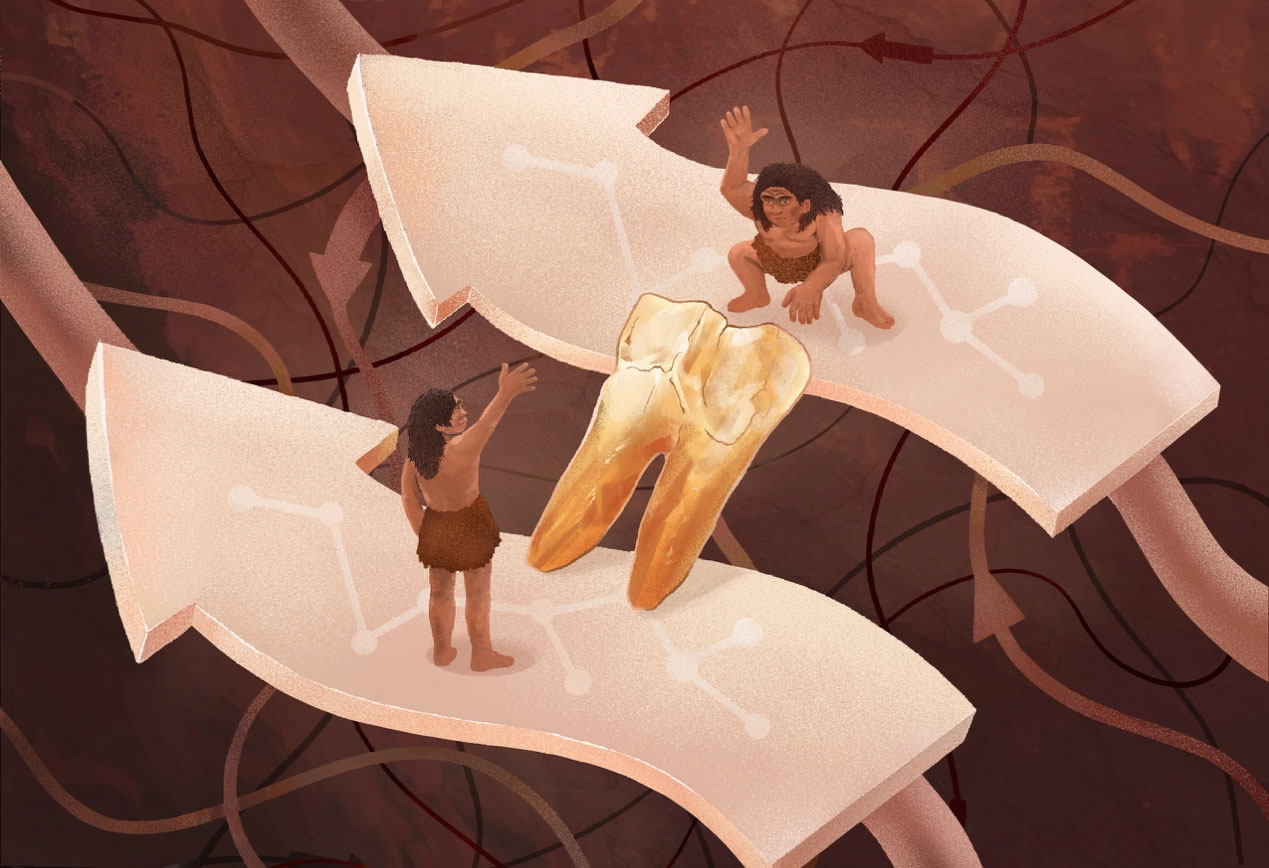
For a long time, the paleoanthropological community has generally believed that during the Middle Pleistocene period, about 300,000 to 500,000 years ago, the ancient human lineages distributed across the Eurasian continent were relatively isolated from each other. Due to geographical barriers and harsh climate changes, people in different regions often evolved independently and eventually differentiated into different branches of ancient humans. However, this study focused on precious permanent tooth fossil specimens unearthed in the key corridor between Europe and Asia. Teeth are the hardest and best-preserved bone structure in the human body. Their enamel microscopic growth lines, dentine surface contours, and tooth root branch directions fully retain highly stable genetic development characteristics. They are known as the "black box" for peering into the evolutionary tree of ancient humans.
The researchers used ultra-high-resolution synchrotron radiation micro-computed tomography (micro-CT) technology to conduct non-destructive digital three-dimensional reconstruction of this batch of tooth samples, and extracted large-scale morphogeometric data of their internal microstructures. By cross-comparing these data with known skeletal databases of contemporaneous hominins, early Homo sapiens, and classic Neanderthals, the research team unexpectedly found that the crown folds, cusp arrangement patterns, and dentine nodule characteristics of these 400,000-year-old teeth showed a highly unique hybrid transitional nature.
Further paleoproteomics and biological structure deduction confirmed that this phenotypic characteristic is not an accidental result of convergent evolution, but directly results from deep and long-term gene flow between populations. This discovery effectively challenges the linear model that strictly isolated the evolution of early humans in Europe and Asia in the past, indicating that as early as 400,000 years ago, there were more frequent migrations, fusions and genetic exchanges between ancient human populations in the hinterland of Eurasia. The completion of this historical puzzle not only retraces the complex network of diffusion and differentiation of ancient humans in the Middle Pleistocene, but also provides strong fossil evidence support to further unravel the mystery of the origin and intersection of various ancient human lineages in Eurasia.
Comments