
Abstract:
A new study shows that the process of life moving from water to land may be more complicated than previously thought, and the species involved may be more diverse. The Nanjing Institute of Geology and Paleontology of the Chinese Academy of Sciences, together with researchers from the United Kingdom, the United States, and Spain, re-study an insect fossil with 24 appendages that dates back approximately 324 million years and found that it may record the key stage of the insect's transition from an aquatic environment to a terrestrial life.
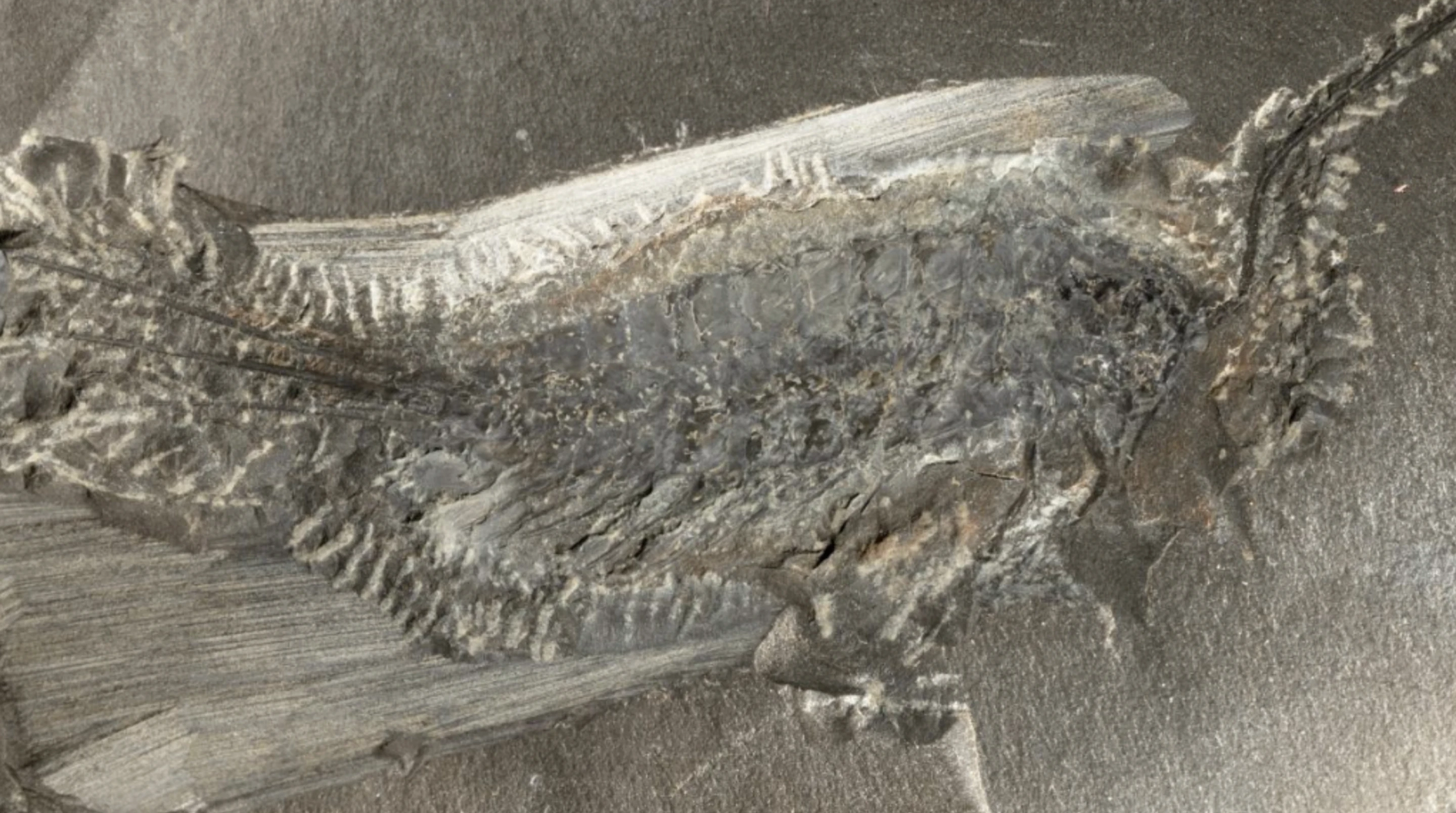
This fossil was originally unearthed in Texas, USA, and was later named "Chosha praecursor". It has been classified as an ancient crustacean in the past due to the fossil's segmented abdominal appendages and other features. Researchers believe that previous identifications were mainly based on structures consistent with crustacean morphology, but ignored some extremely important insect characteristics.
In the latest study, an international team of researchers used cross-polarized light to observe the fossil, making previously elusive structures clearer. The researchers found that it has the most representative features of modern insect body structures: three distinct thoracic segments and three pairs of thoracic legs. This body structure is the basic biological blueprint of modern insects that continues to this day.
However, this ancient animal had more than just six legs. In addition to the three pairs of legs on its chest, it also has nine pairs of appendages on its abdomen, bringing the total to 24. These abdominal appendages are not exactly like legs used for walking on land, but more like structures adapted to life in water, which may help animals move in water or complete other physiological activities.
The discovery suggests that Chosha praecursor may have retained a transitional form as its lineage gradually adapted to life on land, the researchers said. Cai Chenyang of the Nanjing Institute of Geology and Paleontology said this discovery provides an evolutionary bridge between aquatic organisms and terrestrial organisms. About 320 million years ago, ancient insects living at the interface between water and land were gradually evolving new body structures suitable for breathing and moving on land.
Through the fossil shape, scientists also determined that this was an adult female individual. Its body length is about 3.2 cm, and if the tail is fully extended, the length may be close to 5 cm.
The fossil discovery site was likely at the interface between water and land. This transitional habitat may have had an important impact on the evolution of animals. The researchers pointed out that the reasons for these changes in animals are very complex and may include factors such as changes in water temperature, fluctuations in oxygen levels, resource shortages, and the search for new ecological niches.
As this lineage gradually adapted to life outside the water, the 18 appendages originally located on the abdomen gradually disappeared over the long generation. Although insects generally evolve faster than many other animals, this change still illustrates the long and delicate process of evolution: over millions of years, evolution continuously adjusted the biological instructions for assembling animal bodies, ultimately shaping the six-legged body shape that insects have today.
The six-legged structure is perhaps one of nature's most successful body designs. Today, insects are the largest known group of animals, and hundreds of millions of years later, their six legs remain one of their most distinctive features. According to a paper published in 2019, more than 1 million species have been recorded in the order Insecta, or exognathia; together with the smaller endognaths, which have about 5,000 species, they make up the hexapods. Insects have more species than all other known animals, so any project that attempts to count all eukaryotes on Earth, such as the Earth Biogenome Project, must devote a lot of time and energy to insect research.
From a time perspective, the insect landing process recorded by this fossil was later than that of vertebrates. Vertebrates began to emerge from the water around 385 million years ago during the Devonian Period. However, early evidence suggests that invertebrates may have arrived about 50 million years before fish left the water. New research also reminds people that different species may develop similar adaptive characteristics through convergent evolution, even if their appearance and genetic relationship are far apart.
Overall, the history of life from water to land may be far more tortuous, diverse and fascinating than traditional understanding.
The researchers also pointed out that insects tend to receive less attention from the public than other animals. Many of the insects that people come into contact with on a daily basis bite humans, contaminate food, or frequently appear in living spaces. Therefore, insects are usually not easily regarded as animals with independent life value. In addition, insect research itself is difficult, and it is sometimes difficult to obtain sufficient financial support for relevant scientific research projects.
However, insect research still contains many important directions. Paleoentomology is one of them. By studying insect fossils, scientists can understand the history of the evolution of life on earth and further understand the ancient ecological environment and species adaptation processes.
Relevant research has been published in the journal Nature.
Comments