
Abstract:
A Google DeepMind engineer recently demonstrated a creative experiment: he successfully ran Google's Gemma 3 270M small language model directly in an ordinary office laser printer. The number of parameters of this model is about 270 million, and the printer used in the experiment only has 14.1MB of available memory, but it still achieves a generation speed of more than 60 words per second.
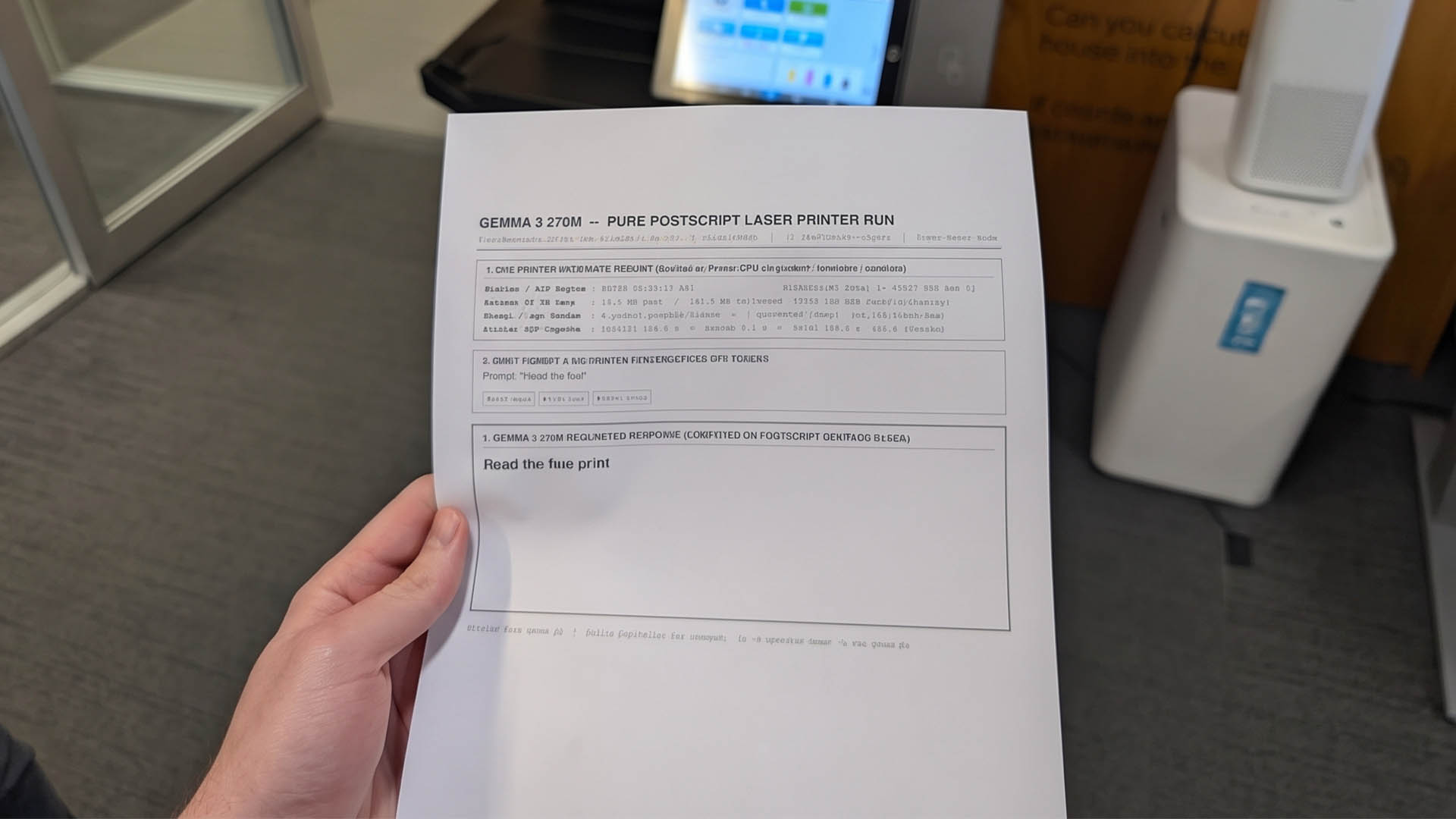
This result was announced by engineer Omar Sanseviero on the social platform X. He said that with the help of the Carbon project, he ran the Gemma model directly on the office printer. The entire experiment did not modify the printer firmware, nor did it use an external computing board or other hardware. Instead, it relied entirely on the PostScript page description language built into modern laser printers.
PostScript is a Turing-complete page description language that is commonly used to control how printers present text, graphics, and page layout. The experimental team used Carbon, a lightweight Transformer inference engine, and paired it with the quantized Gemma 3 270M model to finally generate an original PostScript print file. When the printer executes the file, it actually completes the inference calculation of the language model inside its PostScript interpreter.
In order to avoid running out of printer memory during model inference, the experiment adopted dynamic laminar flow loading technology. The system constantly loads different layers of the model into and out of memory, keeping the peak memory usage at just 14.1MB, while the printer allocates 244.6MB of PostScript virtual memory. Even so, the Gemma 3 270M still achieved a generation speed of 61.3 tokens/s on the printer's CPU.
According to the hardware information captured in the experiment, this Ricoh printer natively performs 18-layer Transformer calculations within the PostScript Level 3 interpreter. When the prompt "Read the fine" containing only four tokens is input, the pre-filling stage takes 184 seconds, while the decoding time to generate a single token is only 0.1 seconds, and the entire processing process totals 184 seconds.
After the calculation is completed, the printer finally prints the three-word answer "Read the fine print" directly on the paper. This result not only proves that the model indeed completes the reasoning inside the printer, but also shows that the potential of daily office equipment at the software level is far beyond people's expectations. Although this mode of operation is not suitable for actual production environments, it demonstrates the boundaries of what is possible when combining small quantitative models, inference engines, and existing hardware capabilities.
Comments