
Abstract:
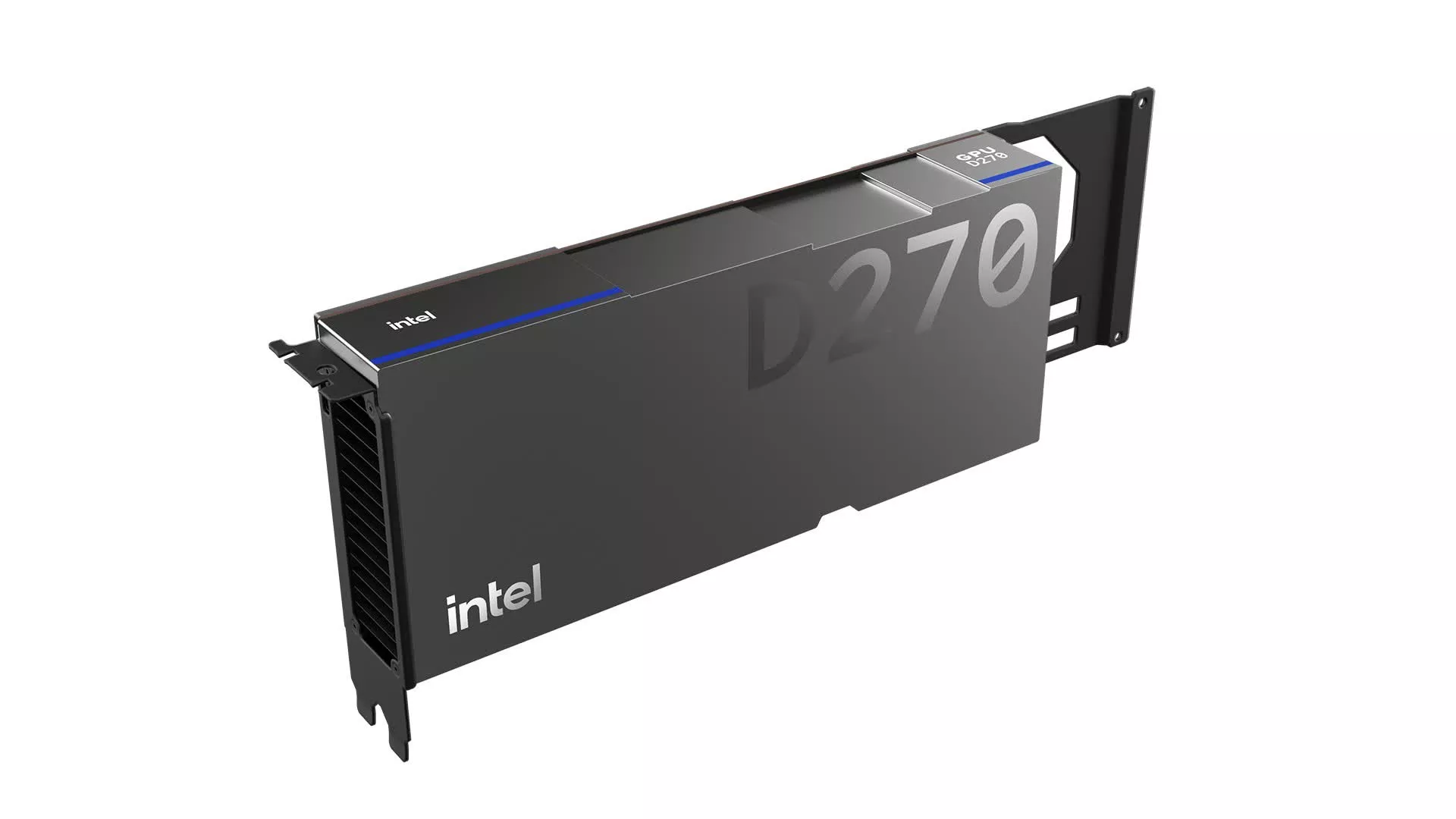
Intel recently publicly demonstrated detailed performance data of its GPU D270 accelerator for the first time at the SC26 Supercomputing Conference in Chicago, USA. This product was previously codenamed "Crescent Island". Unlike traditional graphics cards, it does not have graphics rendering capabilities, nor does it have 3D graphics and ray tracing hardware for games. Instead, more resources are dedicated to artificial intelligence, high-performance computing and scientific research tasks.
According to test results published by Intel, the performance of GPU D270 can reach 1.92 times to 5.9 times that of NVIDIA RTX PRO 6000 Blackwell Server Edition in some double-precision computing (FP64) workloads commonly used in the financial industry. The most outstanding performance project is the European Monte Carlo simulation calculation. D270 achieved a performance advantage of up to 5.9 times; it was 5.6 times ahead in the European Black-Scholes model test, 4.6 times ahead in the binary tree pricing model, and 1.92 times ahead in the American Black-Scholes model.
It is worth noting that the power consumption of D270 when achieving these results is only 350 watts, while the RTX PRO 6000 server version is rated to consume up to 600 watts. This means that in relevant test scenarios, Intel not only demonstrated higher computing performance, but also lower energy consumption.
Industry analysts believe that the main reason why D270 can achieve such a large lead is that it is specially optimized for FP64 double-precision operations. This product is based on the Xe3P architecture. Each Xe computing core can natively support full-speed FP64 computing, so there will be almost no significant performance degradation in financial modeling, scientific simulation and engineering computing tasks that require extremely high computing accuracy.
In contrast, the Blackwell architecture chip used in the RTX PRO 6000 server version focuses more on artificial intelligence and professional graphics processing, and its double-precision computing capabilities are relatively limited. Since the test projects Intel selected this time are highly dependent on FP64 performance, NVIDIA products did not play their main advantages in these specific scenarios.
However, outsiders have also pointed out that the data released by Intel come from the company's internal testing and use pre-production versions of hardware that have not yet been officially launched. In addition, the test platforms of the two products are not completely consistent, so the relevant results still need to be further verified by third-party agencies.
In terms of artificial intelligence inference testing, the D270’s lead has narrowed significantly. Intel said that in the FP8 inference test of the Qwen3-30B-A3B model, D270 only achieved about 12% throughput improvement; in another Drex 2.0 test, it achieved about 29% latency improvement. Given that artificial intelligence was originally regarded as an important application direction of D270, such results appear relatively conservative compared to the huge advantages in the field of financial computing.
In addition to computing power, the D270 also has a considerable memory configuration. Intel's standard version is equipped with 160GB LPDDR5X video memory, while customized models launched by partners can be expanded to up to 480GB capacity. In comparison, the RTX PRO 6000 Server Edition is equipped with 96GB GDDR7 video memory. When dealing with very large data sets, scientific simulations, and financial analysis tasks, larger memory capacity has also become one of the important selling points of the D270.
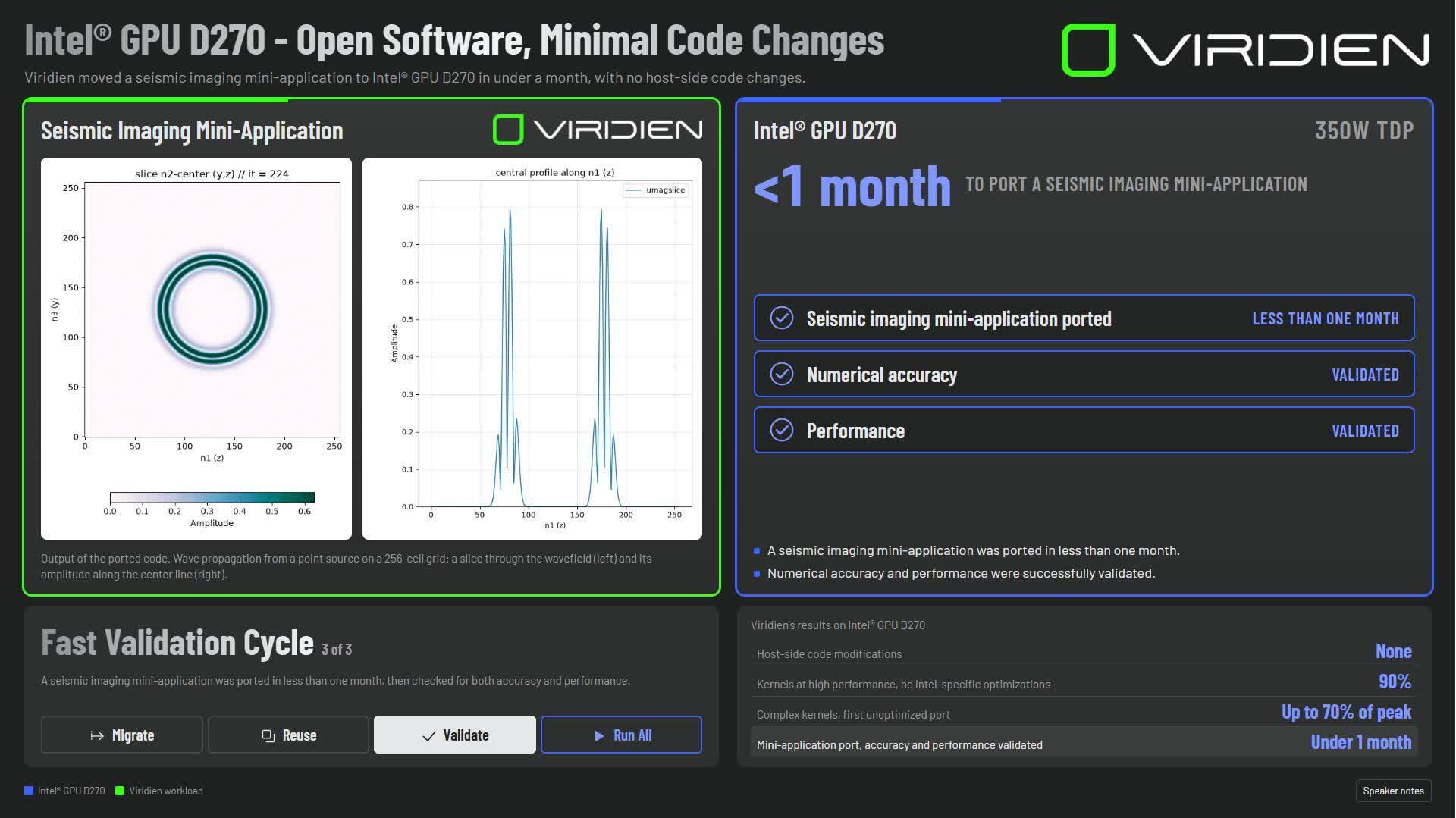
Intel also demonstrated a seismic imaging application porting case completed in collaboration with geophysical technology company Viridien. According to reports, the company migrated the software originally based on HIP and CUDA to the D270 platform in less than a month. Most of the core code does not require special optimization for Intel hardware and maintains computing accuracy and performance.
Despite Intel's high-profile demonstration of the D270's advantages in double-precision computing, analysts point out that these tests reflect more of the capabilities of specific workloads rather than a comprehensive showdown of overall GPU performance. Since the D270 itself is designed for scientific computing and high-precision simulation, while the RTX PRO 6000 focuses more on artificial intelligence and professional graphics applications, the areas of expertise of both parties do not completely overlap.
Currently, GPU D270 has begun to be provided to some customers for testing and verification, and is expected to be officially launched in 2027. However, Intel has not announced the final price and specific release time of the product.
Comments