
Abstract:
Intel's next-generation server processor Xeon 7 "Diamond Rapids" recently made its first public appearance in physical form. Photos circulating on the Internet show that this flagship processor, built for future data centers and artificial intelligence infrastructure, has been packaged, marking that product development is steadily moving towards the official release stage.
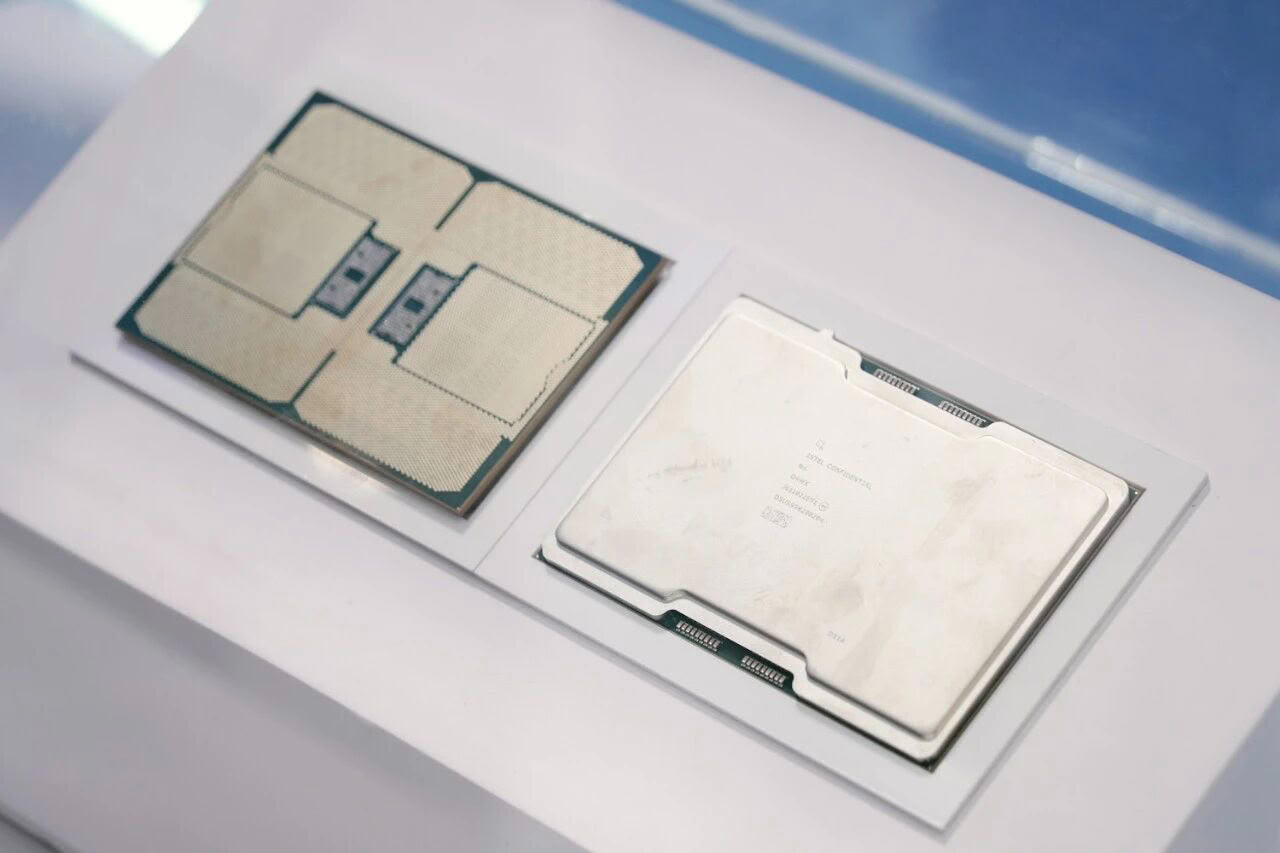
It is understood that Intel displayed two Diamond Rapids samples at the Tencent Global Digital Ecology Conference held in Shenzhen at the end of October, one of which showed the heat dissipation top cover and the other showed the bottom interface design of the processor. However, it was only recently that related photos began to be widely circulated on the Internet, attracting attention from the server and semiconductor industries.
Judging from the exposed pictures, Diamond Rapids adopts an extremely large package design with a dense contact area at the bottom, specifically corresponding to the new LGA 9324 slot platform. This slot is part of Intel's Oak Stream server platform, and it also indicates that future high-end servers will usher in significant upgrades in terms of power supply, interconnection, and expansion capabilities.
While physical photos have appeared for the first time, the core specifications of Diamond Rapids have been previously announced by Intel at the Hot Chips conference. As the next-generation Xeon 7 flagship product, this processor can integrate up to 256 Panther Cove performance cores and adopts a pure P-Core design route without supporting SMT hyper-threading technology.
In order to achieve such a huge core scale, Intel introduced a highly modular core architecture. The entire processor is composed of 16 computing cores, each core contains 16 Panther Cove cores, and is combined into a complete product through advanced packaging technology. The core die is manufactured using the Intel 18A-P process, which is one of the important applications of Intel's next-generation enhanced version of the 18A process.
In terms of cache configuration, Diamond Rapids will provide up to 1.28GB of last-level cache, which is one of the most amazing specifications in the field of x86 server processors to date. A large amount of cache resources can effectively improve the execution efficiency of artificial intelligence inference, large-scale databases and cloud computing workloads.
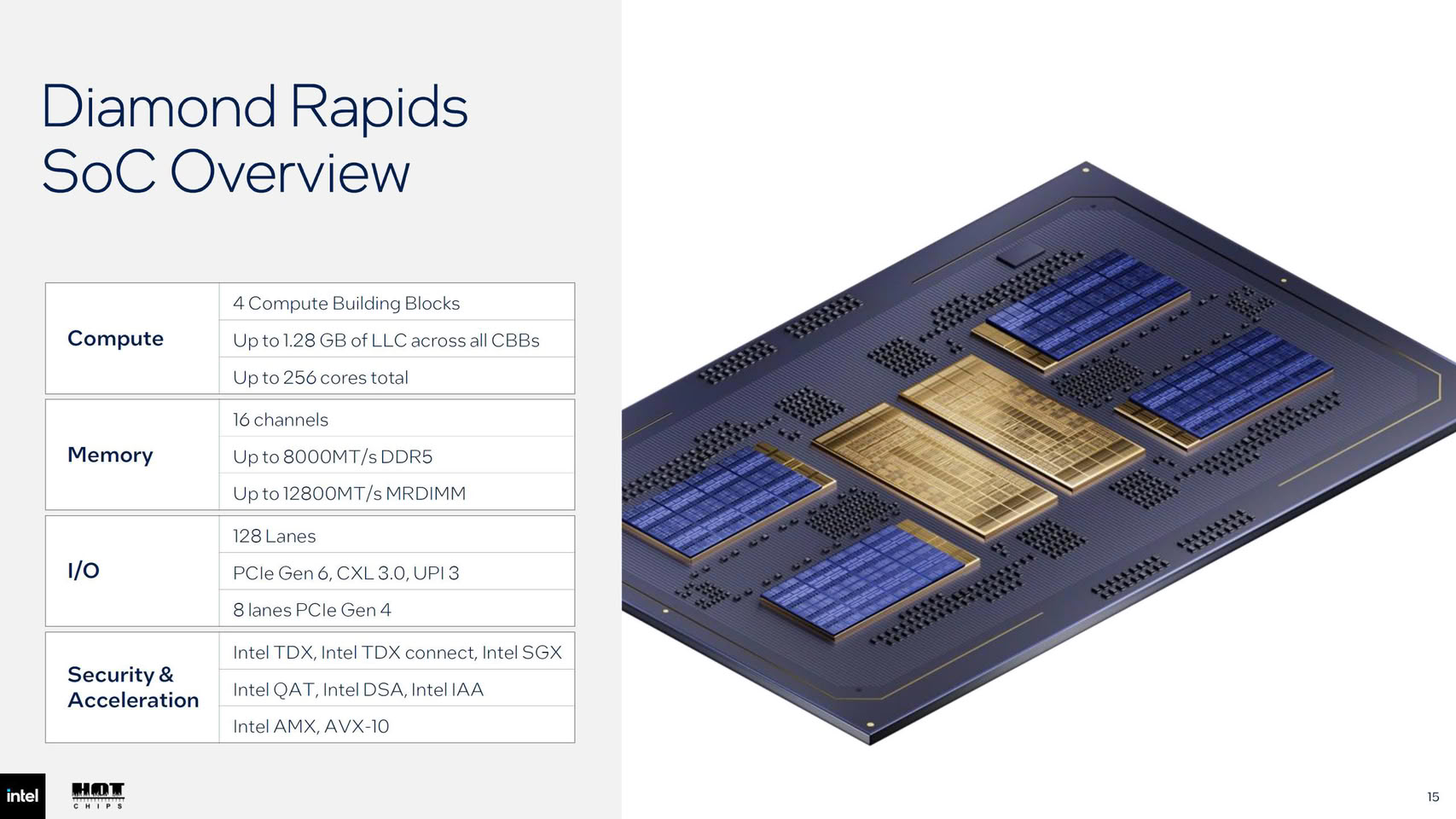
The memory subsystem has also been significantly enhanced. According to published data, the processor supports 16-channel memory configuration and is compatible with MRDIMM memory technology with speeds up to 12800MT/s, providing higher bandwidth support for large-scale AI model training and inference tasks.
In terms of expansion capabilities, Diamond Rapids will provide 128 PCIe 6.0 lanes, providing sufficient connection resources for GPU accelerator cards, high-speed network equipment and next-generation storage systems. In addition, the platform also integrates the latest AI acceleration extension instruction set, including upgraded AMX matrix acceleration capabilities and AVX 10.2 extensions to meet the computing needs of generative artificial intelligence and intelligent agent systems.
Intel positions Diamond Rapids as a processor product specifically for "Agentic AI (intelligent agent AI) infrastructure." The company believes that future data centers need to take into account high core counts, high memory bandwidth and high-efficiency reasoning capabilities, and Diamond Rapids is built for this trend.
It is worth noting that while displaying Diamond Rapids samples, Intel also announced related cooperative development with Tencent Cloud. However, the new generation of cloud instances officially launched by Tencent Cloud still mainly uses Xeon 6+ "Clearwater Forest" processors, and Diamond Rapids is still some time away from official commercial use.
At the same time, competitor AMD has taken the lead in releasing the sixth-generation EPYC "Venice" server processor. Since Diamond Rapids is expected to be officially launched in 2027, Intel will face competitive pressure from the AMD Venice platform, which has already laid out the market in advance.
According to previously disclosed information, the successor product of Diamond Rapids will be Coral Rapids. Intel plans to reintroduce SMT hyper-threading technology in this series to further enhance multi-threaded computing capabilities.
Analysts pointed out that although the physical photos exposed this time did not reveal new technical details, they proved that Diamond Rapids has entered the hardware sample stage. For Intel, which is fully competing for the AI server market, this processor with 256 cores, 1.28GB cache and new generation 18A-P process will become an important weapon to compete with AMD EPYC and other data center platforms in the next few years.
Comments