
Abstract:
After Apple’s first foldable screen phone iPhone Duo was launched, there have been reports of internal screen cracks. Some users and dismantling personnel have focused their suspicion on the hinge mechanism of the device. In the face of continuing public opinion, Apple's supply chain company Fine M-Tec issued a statement on October 26, denying that the components it supplied had quality defects that caused screen damage, and called on the outside world not to rush to identify the responsible party until the real cause is identified.
According to South Korean technology media "The Elec", Fine M-Tec said in a statement that the recent quality problems in some products were not caused by defects in components supplied by the company. Although the statement did not directly name Apple or the iPhone Duo, the release coincided with the controversy over hinge and internal screen failures of the foldable phone, so it was seen as a response to related doubts.
Fine M-Tec is a company that produces internal hinges and metal support plates for folding screen devices. Such components are mainly used to support flexible OLED displays and help the screen withstand mechanical stress when it is repeatedly folded and unfolded. The company is also a component supplier in Samsung's display-related supply chain and has a certain business foundation in the folding screen mobile phone industry chain.
The controversy stems from multiple reports of screen damage after the iPhone Duo was launched. Some users said that the device suddenly experienced abnormal resistance during normal unfolding, followed by a clear breaking sound, and the inner screen had horizontal bright lines extending from the central crease to one side or other display abnormalities. In some cases, the malfunction occurs shortly after purchase, or even after a few hours of use.
Because the damage locations reported by different users are relatively similar, the outside world began to suspect that the problem may not be a simple material defect of the flexible screen, but related to the failure of a mechanical component inside the hinge.
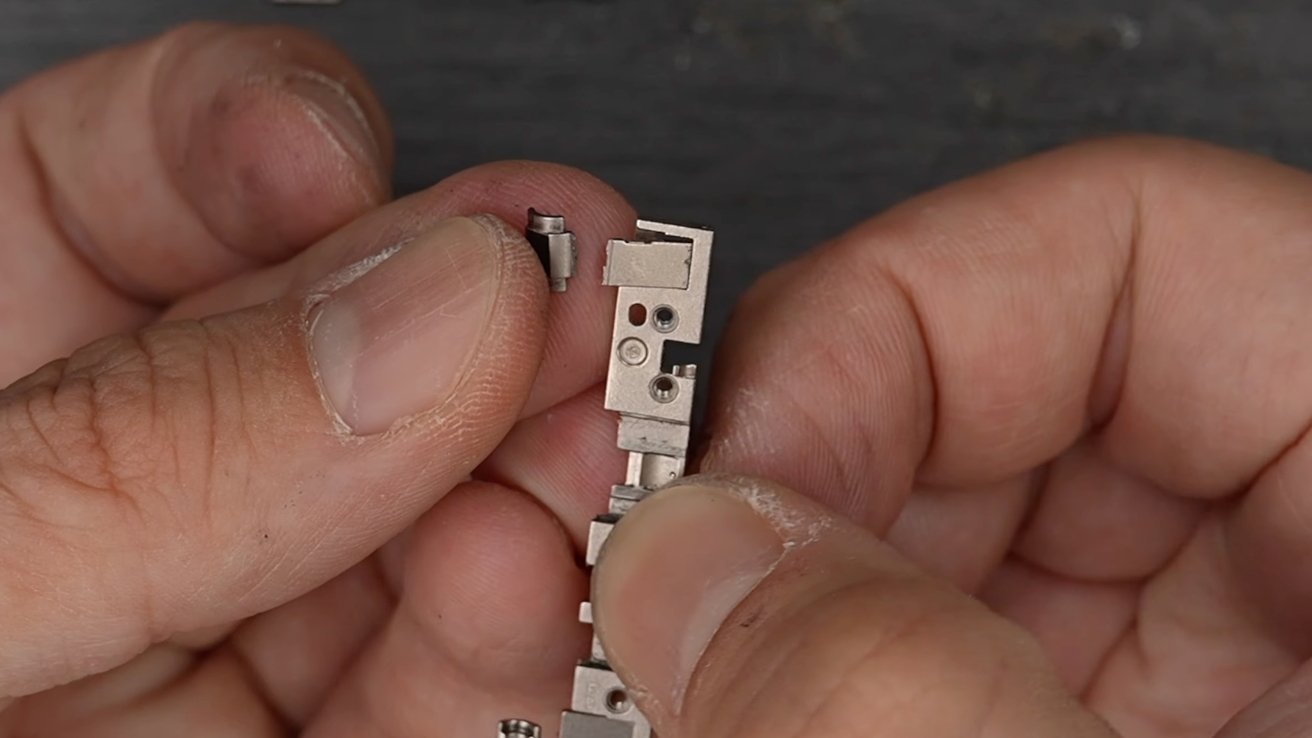
Previously, YouTube creator CuriousHagi disassembled a malfunctioning iPhone Duo and found a broken metal part inside the hinge. This part is located near the center of the screen and differs in size and thickness from surrounding structures. During the disassembly process, it was also discovered that there were traces of suspected mechanical parts extruding or contacting each other in relevant areas.
One possible explanation is that a component inside the hinge became misaligned or jammed during the folding process, and then suffered excessive mechanical stress and broke. The broken metal parts may further contact the back of the screen, causing local stress on the flexible display panel to concentrate, eventually causing display damage. However, this is still speculation based on individual damaged devices, and it cannot be proven that all iPhone Duo failures are caused by the same cause.
Fine M-Tec not only denies that the parts it supplies are defective, but also says it is considering taking legal action against those who allege problems with its components without verification. The company obviously hopes to avoid the supplier being directly identified as the party responsible for the accident by public opinion before the investigation results are clear.
From a technical point of view, the hinge of a folding screen mobile phone is not a simple rotating shaft, but a mechanical system composed of multiple precision components. It needs to coordinate processes such as screen bending, support structure movement, and cable deformation in a limited space. Dimensional deviations, assembly problems or abnormal wear of any component may affect the operation of the entire mechanism. Therefore, even if the damage is concentrated near the hinge, this phenomenon alone cannot be used to determine that a supplier's parts have a manufacturing defect.
Apple has previously admitted that a small number of iPhone Duo has problems affecting the internal screen, and recommended that users who encounter display problems contact AppleCare for after-sales treatment such as replacement equipment. Apple has not announced the specific number of affected devices, nor has it publicly confirmed the final cause of the failure.
As of October 26, AppleInsider learned through the Genius Bar service points of 20 Apple retail stores it contacted that a total of 4 devices were known to have related internal screen failures and were returned for processing. This number comes from only a limited sample of U.S. retail stores and does not represent the total number of global failures and cannot be used to calculate the actual failure rate of the product.
Currently, Fine M-Tec’s statement does not prove that there are absolutely no problems with its parts. Likewise, the broken parts found by dismantlers are not enough to prove that the supplier should be held responsible. To determine the cause of the accident, it is still necessary to further inspect the faulty equipment, analyze the actual movement process of the hinge, and check the design, manufacturing tolerances and assembly of parts.
For Apple, this incident is not only related to the early reputation of its first folding screen mobile phone, but will also test the long-term reliability of its complex mechanical structure and supply chain quality management capabilities. As more users start using iPhone Duo, whether failure cases continue to increase, whether they are concentrated in specific production batches, and whether Apple can ultimately find a clear root cause will become the focus of subsequent attention.
Comments