
Abstract:
In 2007, "Lost" ushered in the third season finale, which also left one of the most classic twists in the history of American dramas. Previously, the audience had always thought that the flashbacks in the play were about what happened before the characters were stranded on the desert island. Unexpectedly, they discovered in the end that these fragments were actually stories that took place in the future. After three seasons of desert island survival, the protagonists Jack and Kate have returned to Los Angeles safely. Escape from the deserted island has always been the core goal of the show. The audience originally thought that as long as they successfully left, everything would be over. Until Jack broke down and shouted: "We have to go back!" Now, I find myself having similar feelings about many technology products.
Not long before that episode of Lost aired, I spent $1,000 on my first high-definition monitor. This is a 26-inch Samsung LCD screen with a resolution of 1366×768. I was in college at the time, and this monitor served as both my dorm room TV and my computer monitor. In that era, it was definitely considered a high-end product. Compared with the old CRT monitor still in use at home, it is thinner, clearer, and looks more advanced.
But is this really the case?
Nearly 20 years have passed, and there are still some experts who are well versed in display technology, trying to find ways to get back what we abandoned back then.
“People over 40 years old usually still remember how clear the CRT monitor was when the picture was moving, but young people have never used a CRT, so naturally they don’t have this memory.” Mark Rejhon, founder of the Blur Busters website, said.
For years, the "Test UFO" browser testing tool on the Blur Busters website has been regarded as one of the standard tools for testing the dynamic sharpness of modern monitors. There is a green man sitting in a red flying saucer in the test screen, which is used to help users observe the clarity of the screen when it moves.
Compared to older CRT monitors, mid-2000s LCD monitors are simply inferior in this regard. LCD pixels at the time took a long time to switch colors, resulting in a noticeable afterimage trailing behind fast-moving objects.
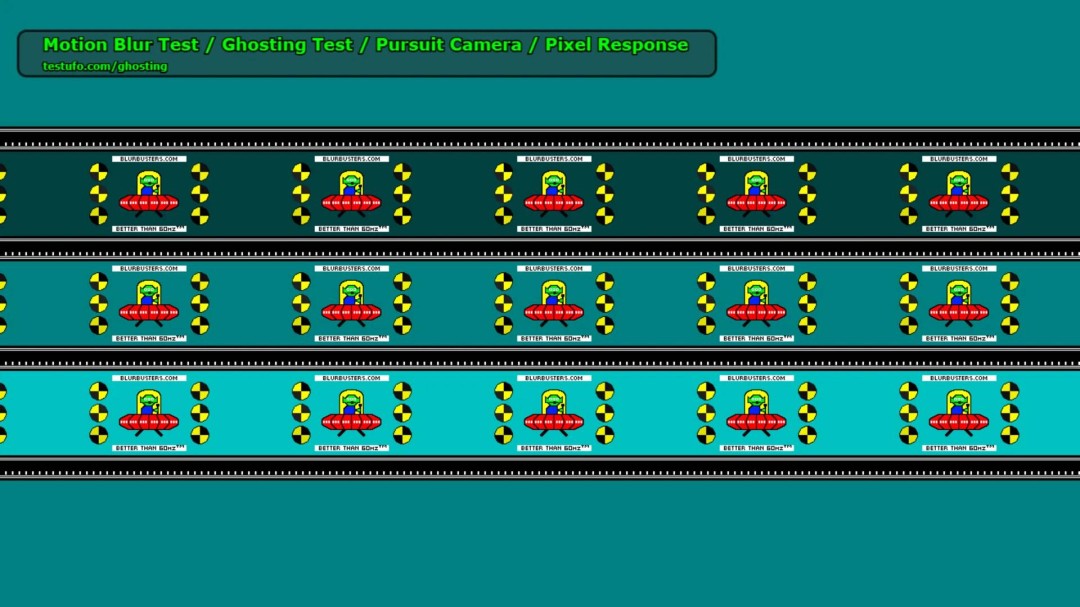
The TV I spent a whole month’s salary on was already considered a good product at the time. But the high-definition era has just arrived, and the freshness brought by new technologies has made me overlook a problem: Although I have gained a higher resolution, I have also lost the more vivid colors and smoother dynamic images of the CRT monitor.
And this loss lasted nearly 20 years.
Today's high refresh rate monitors have long since gotten rid of the blurry, whitish images of LCD screens in the 2000s. But even the top products still cannot fully catch up with CRT in terms of dynamic clarity. This is exactly the problem Lei Hong has been trying to solve.
Rediscover the feeling of CRT
At the end of 2024, Lei Hong collaborated with former Nvidia developer Timothy Lottes to launch a breakthrough algorithm that was claimed to be able to simulate the effects of CRT picture tubes. It can take advantage of high refresh rate displays above 240Hz to drastically reduce motion blur in retro games and other 60-frame content.
Simply put, this technology attempts to simulate a key feature of CRT displays: the process by which phosphors gradually extinguish light after emitting light.
CRT monitors work differently from today's LCD screens. The electron beam scans the screen line by line, causing the phosphors to glow, creating the picture. After the phosphor emits light, it will not extinguish instantly, but will gradually dim. This effect can make the picture look clearer without causing too strong flickering.
Previously, in order to reduce motion blur, a common method was to use black frame insertion technology (BFI), which is to insert black frames between normal frames. Although this can reduce image retention, the picture will flicker significantly and may make people feel uncomfortable when watching it for a long time.
Lei Hong explained that there are two main ways to reduce motion blur on a display: one is to make the screen flash quickly like a CRT, and the other is to increase the refresh rate. Both methods shorten the time each frame is in front of your eyes, just like a camera using a faster shutter, thereby reducing motion blur.
The advantage of CRT is that it can make pixels glow briefly in less than a thousandth of a second, so you don't need a particularly high frame rate to get very clear dynamic pictures.
In addition to software simulation, NVIDIA is also trying to solve this problem from the hardware level.
Nvidia’s G-Sync Pulsar technology has been applied to some gaming monitors. It combines variable refresh rate (
VR
R), backlight strobe and line-by-line refresh mechanism from the top of the screen downwards, simulating the CRT display method, allowing the picture to achieve a dynamic clarity equivalent to 1000Hz.However, this technology has not yet been applied to OLED displays, and can only be used with NVIDIA graphics cards.
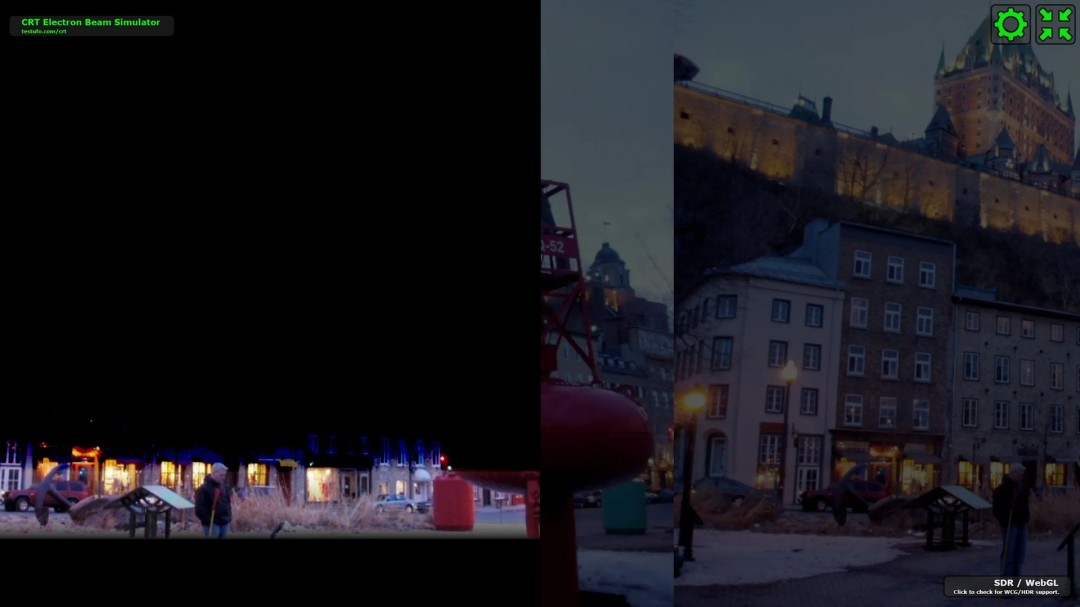
Blur Busters' browser testing tool simulates the process of a CRT electron beam scanning down from the top of the screen
If you still find it difficult to understand, you can understand CRT simulation technology as DLSS specifically for dynamic images.
DLSS mainly uses technical means to improve the picture resolution and performance of games, while CRT simulation technology makes the picture in motion clearer.
Ideally, for a game that is locked to run at 60 frames, after this technology is processed, the dynamic clarity can be close to the effect when running at 540 frames, and does not require a top-end graphics card like RTX5090 to hard stack the number of frames.
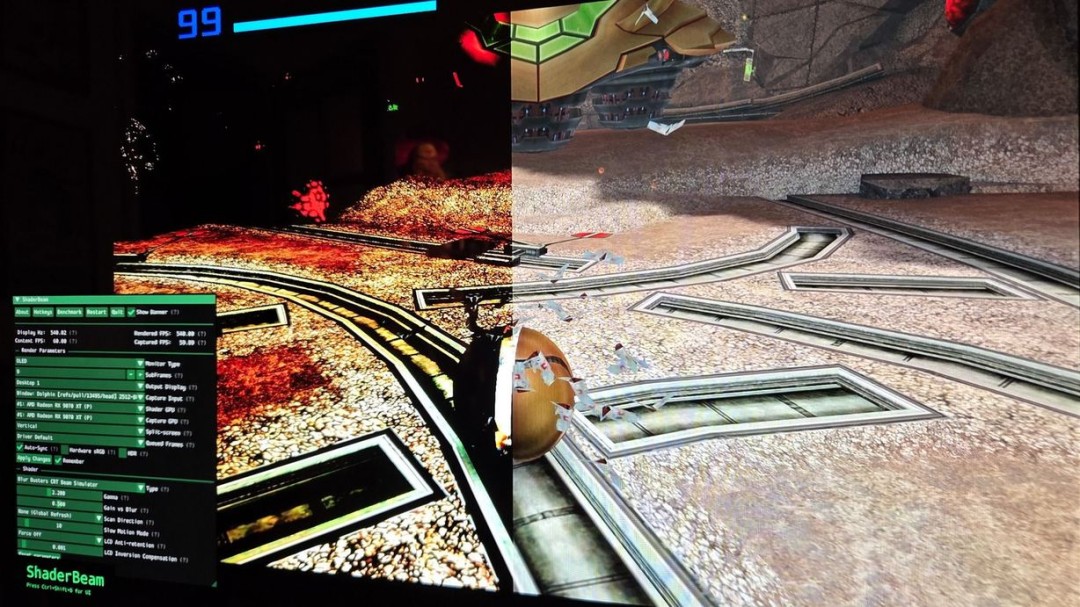
540Hz monitor may not be easy to handle
To test this technology, I used a ROG PG27AQWP-W monitor sent by ASUS.
The refresh rate of this monitor reaches 540Hz. If the resolution is reduced to 720p, the 720Hz mode can also be turned on. The higher the refresh rate, the easier it is for CRT simulation technology to work, further reducing motion blur.
OLED screens also have their own advantages. Unlike LCDs that require backlighting, OLED pixels can be turned off directly to display true black, and the brightness is high enough, so it can be closer to the original contrast performance of CRT. Coupled with a high refresh rate, it is easier to simulate the effect of a CRT electron beam progressive scan screen.
This technology isn’t just for satisfying nostalgic gamers, either.
Lei Hong pointed out that traditional 60Hz black frame insertion technology and backlight strobe will produce relatively obvious flickers because the system needs to insert a black frame between each frame of normal frames.
The CRT simulation technology uses a progressive scanning method from top to bottom, and the effect will be much softer. Because there is always some area of the screen that is glowing, the entire screen will not repeatedly turn black like traditional black frame insertion.
However, even though I had a monitor that was perfect for testing, I was still overwhelmed by this new technology when it came time to actually play with it.
I spent several hours trying to make the picture clearer
Blur Busters technology was first used in the shaders of the simulator front-end software RetroArch. Later, it was added to an experimental version of a separate tool called ShaderGlass.
ShaderGlass is a very practical Windows picture special effects tool that can superimpose hundreds of visual effects on various contents on the desktop, such as scanning lines, analog signal interference, etc., making the picture look like an old-fashioned TV.
But the complexity of CRT electron beam simulation is far beyond that of ordinary shaders, so developer Mausimus finally decided to separate it separately and develop it into a new tool: ShaderBeam.
Mausimus explained that for this technology to work best, two things must be done at the same time: First, it must be accurately synchronized with the monitor, even missing one frame at such a high refresh rate may cause obvious flickering; second, it must be synchronized with the game screen to ensure that each frame output by the game can correctly correspond to the simulated CRT scanning process.
Currently, ShaderBeam is the best way to use Leihong’s algorithm.
The operation of ShaderBeam does not seem complicated. After starting the program, press the shortcut key to superimpose the special effects on the game window. But it looks simple, but that doesn’t mean it’s easy to implement. After all, this kind of operating system, graphics card driver and monitor originally did not have the technology specifically optimized for it. It is not a big company like Microsoft, AMD or Nvidia that can easily do it if they want to.
Mausimus said that ShaderBeam can only use existing screen capture, window transparency and other functions to complete the work as much as possible. These functions were not originally designed for this purpose, and precise execution timing cannot be guaranteed. The program must also be limited by the internal scheduling mechanism of the operating system and graphics card driver. It must strive for sufficient running resources as much as possible to ensure that each frame is output on time.
In order for ShaderBeam to run stably, users even need to turn off many functions that are usually useful.
For example, turn off the variable refresh rate, adjust the graphics card driver settings, unplug the second monitor cable, use Process Lasso to increase the running priority of the program, and even modify the Windows registry.
What’s more interesting is that you can also try to let two GPUs work together: one is responsible for running the game, and the other is responsible for CRT screen simulation. If the processor itself has a core display, you can try to let the core display take on the latter's work.
Mausimus said that handing over the simulation task to another GPU can reduce the competition between it and the main graphics card for resources, allowing the program to obtain a more stable running time. The improvement brought by this is quite obvious.
The problem is not that the performance of a single graphics card is insufficient, but that the time when the operating system allocates GPU resources is not stable.
If ShaderBeam does not obtain enough GPU resources in time to output the picture, flickering may occur. I encountered this problem: when trying to make the Intel processor's core display output images at 1440p resolution and 540Hz refresh rate, the flickering problem was quite obvious.
After that, I switched to different simulators and shooting games for testing, including "Quake" and "Amid Evil", but I was always troubled by lagging.
This also led me to delve into the issue of subframe timing in displays. As research deepens, various details in display technology become more and more complex, even confusing.
To be honest, it sounds a little crazy to put so much effort into getting better graphics in a game like Metroid Prime 2: Echoes.
This game is one of the titles I used for testing. I hope to use the GameCube emulator Dolphin to rediscover the feeling I had when I first played this game on a CRT monitor in my high school friend’s bedroom.
I spent hours troubleshooting issues like stuttering, flickering, and color breakage. I felt like a mad scientist, and that was all about the madness.
Even if you have all the settings in place, that doesn't mean everything will be fine. The game itself may also influence the effect.
For example, some Unreal Engine 5 games often experience freezes, which disrupts the frame interval of the screen and affects the normal operation of CRT simulation technology.
When the picture is really clear, all the trouble will be worth it
However, I finally saw the true value of this technology when I started having Samus zip around tight areas on his morph ball.
Even if the camera rotates rapidly, the pillars in the room are still clear and sharp, and they are not blurred due to the movement of the screen.
At that moment, I finally understood what Rehon and Mausimus had been striving for.
Mausimus explained that after using this technology, when objects move or players rotate their perspective, pixel details that are easily swallowed up by motion blur should still be clearly presented.
He gave the example of the pillars in Quake. There are many fine textures on the surface of the pillars. When the lens moves on an ordinary monitor, these details are often mixed together due to motion blur. However, after CRT simulation processing, the textures should still be clearly visible even if the screen moves.
Factorio is also a good test subject. Under normal circumstances, when the player moves the perspective, the entire scene looks very smooth, but the pixel details in the picture are easily blurred. With this technology enabled, players should be able to see details even if the entire scene is moving.
This is exactly the point of CRT simulation technology: it is not simply adding scan lines to the picture, or applying a layer of retro filters, but trying to solve the long-standing dynamic blur problem of modern monitors.
We have spent nearly 20 years pursuing higher resolutions, thinner screens and higher refresh rates, but now we have discovered that some of the advantages that old-fashioned CRT monitors once had are still worth pursuing again today.
Comments