
Abstract:
In people's daily lives, one second seems insignificant, but for the global time system, this extra second has caused countless technical problems. As the international community advances the reform of time standards, a special mechanism that has been used to calibrate the world's clocks since 1972 - the "leap second" - is gradually moving towards the edge of the historical stage.
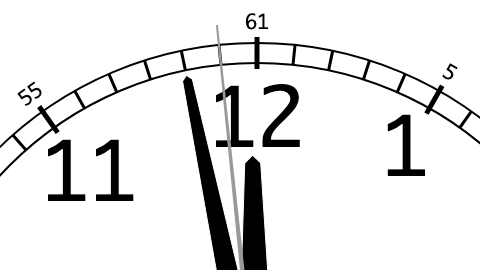
The so-called leap second is a time correction mechanism established to compensate for the difference between the atomic clock time and the earth's rotation time. The modern world's standard time, UTC, mainly relies on extremely accurate atomic clocks, and the length of "second" defined by atomic clocks is constant. At the same time, the Earth's rotation is not absolutely stable, and its speed will fluctuate slightly due to factors such as tidal action, geological activities, atmospheric changes, and adjustments in global mass distribution.
Over time, there will be a gradual deviation between atomic time and the time of the Earth's rotation. In order to prevent this deviation from accumulating, the International Earth Rotation and Reference System Service regularly monitors the difference between the two and announces the addition of a leap second when necessary. At that time, there will be an extremely rare "23:59:60" after 23:59:59 UTC before entering a new day.
This practice was first formally implemented in 1972. At that time, the international community redefined the Coordinated Universal Time system and introduced the leap second mechanism as a time correction method. In the decades since, a total of 27 leap seconds have been added around the world, the most recent of which occurred on December 31, 2016. Since then, the world's clocks have not made a leap second adjustment for nearly a decade.
Leap seconds are of great significance in the fields of astronomy and traditional time measurement. It ensures that the civil time used by people is always synchronized with the movement of the sun and the earth. In other words, noon still roughly corresponds to the moment when the sun is at its highest point in the sky, without deviating significantly over time.
However, this seemingly reasonable system has become increasingly unpopular in the digital age.
The Internet, cloud computing, satellite navigation, financial trading systems, and large data centers all rely on a continuous, uniform, and predictable flow of time. For humans, an extra second is almost imperceptible; but for a computer system, a sudden "60 seconds" may cause various abnormalities.
Over the past few decades, many technology companies and Internet service providers have experienced system failures due to leap seconds. Some servers cannot recognize the special time format of "23 hours, 59 minutes and 60 seconds", leading to program crashes, database errors, network service interruptions, and time synchronization failures. In order to avoid risks, different institutions have developed their own solutions, such as completing time adjustments by slowly spreading the second over several hours, but these practices further increase the complexity of global time synchronization.
At the same time, changes in the Earth's rotation itself are becoming increasingly difficult to predict. Scientists have found that although the Earth's rotation generally shows a decelerating trend in the long term, on shorter time scales it is affected by factors such as core movement, earthquakes, melting glaciers, atmospheric circulation and ocean changes, and sometimes even briefly accelerates. This makes scheduling leap seconds more complicated.
What is even more concerning is that the scientific community has begun to discuss the possibility of "negative leap seconds" in recent years. Unlike a traditional leap second that adds one second, a negative leap second means directly deleting one second, causing the time to jump directly from 23:59:58 to zero o'clock the next day. While this has never actually happened in history, its theoretical possibility has come under scrutiny following unusual changes in the Earth's rotation speed. Many engineers believe that deleting one second will pose more severe challenges to existing computer systems than adding one second.
It is against this background that the International Conference on Weights and Measures passed a resolution in 2022, deciding to gradually abolish the leap second system. According to relevant arrangements, Coordinated Universal Time will no longer be corrected by adding or subtracting single seconds in the next few decades. Instead, the difference between Earth time and atomic time will be allowed to slowly accumulate, and will be uniformly processed through other methods in the future.
Supporters believe that this reform will significantly reduce the technical risks faced by the global information infrastructure and provide a more stable time environment for the Internet, communication networks, satellite navigation and financial systems. Opponents worry that human time will eventually gradually break away from astronomical time, weakening the connection between the traditional time system and the natural movement of the earth.
No matter what the outcome of the debate is, one fact has become increasingly clear: the leap second system, which occasionally allows the world clock to add one second and keeps countless programmers awake at night, is entering a countdown phase. For the next generation, "23 hours, 59 minutes and 60 seconds" may become a special moment that can only be seen in historical materials.
Comments