
Abstract:
A special version of GeForce RTX 3060 from Chinese modders has recently attracted attention in the hardware circle. The biggest feature of this graphics card is not the performance improvement, but the complete elimination of the external power supply interface, and it only relies on the PCIe slot for power supply. Although this design has successfully achieved extreme miniaturization, the price has been a significant reduction in performance, even lagging behind the GTX 1060 graphics card that has been around for ten years.
According to the exposed information, this graphics card was demonstrated by WestmereX, the creator of Bilibili. When it first attracted attention from the hardware media, it sparked discussions due to its unusually compact design. The entire graphics card adopts a single-slot, half-height specification, and the overall size is similar to a smartphone. It only provides one HDMI interface and one DisplayPort interface. The heat dissipation part adopts a turbofan design, which discharges hot air from the rear of the chassis through a single fan.
From the appearance point of view, this special RTX 3060 is very different from common products. The large-area cooling fins, backplane and complex heat pipe system common in traditional graphics cards have been cancelled, leaving only a simplified version of the radiator and a layer of metal shell for auxiliary heat dissipation, thereby minimizing volume.

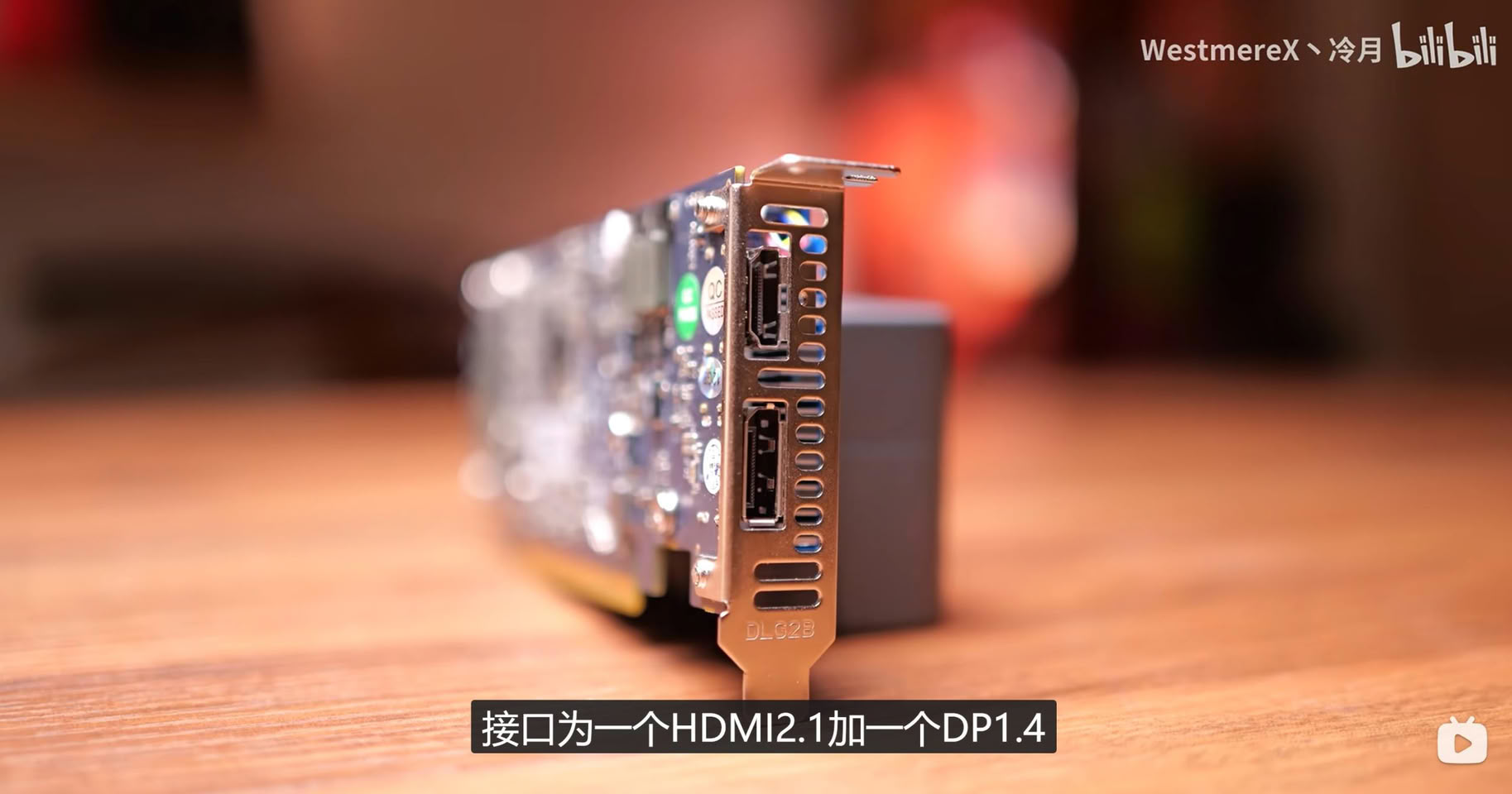
The real technical challenge comes from the power supply system. The official thermal design power consumption of the standard version of the RTX 3060 is about 170 watts, and the PCIe x16 slot can only provide up to 75 watts of power according to the specification. This means that if you want the RTX 3060 to run completely away from the 6-pin or 8-pin external power supply interface, the graphics card itself must be significantly modified.
According to analysis, the manufacturer may have changed the GPU's judgment logic for its own power consumption by modifying the graphics card's power detection circuit, thereby allowing the graphics card to accept a power supply limit that is far lower than the original design target. In this mode, although the graphics card can start and run normally, its performance is extremely limited.
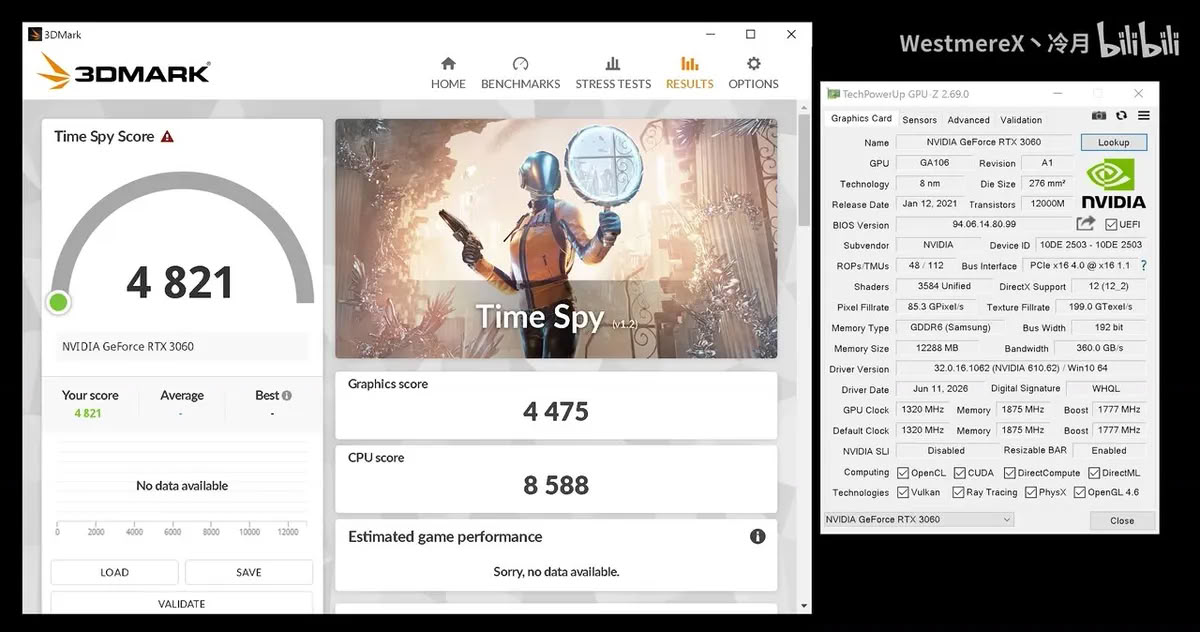
Test data shows that the core frequency of this graphics card cannot even exceed 900MHz, while the official acceleration frequency of the standard RTX 3060 can reach 1777MHz. Due to long-term severe power shortage, the GPU can hardly maintain its normal operating frequency.
Performance test results are more intuitive. In the 3DMark Time Spy benchmark test, this special version of the RTX 3060 only scored 4821 points, while the ordinary RTX 3060 can usually reach around 9000 points, and its performance was almost cut in half. Even more surprising is that its results are even lower than mid-range graphics cards from years ago such as the GTX 1060 and Radeon RX 580.
The problem of heat dissipation is also prominent. Due to the compact size of the graphics card and the extremely simplified heat dissipation structure, the hot spot temperature exceeded 90 degrees Celsius during the test. Limited power supply and limited heat dissipation together form a double bottleneck, causing the GPU to run at reduced frequency for a long time.
Nevertheless, this renovation project still shows certain technical value. For ultra-small hosts, industrial computing equipment, or some special platforms with extremely limited space, independent graphics cards that do not require additional power supply lines are indeed attractive. The producer even stated that the actual power consumption of the graphics card is about 80 watts, which is only slightly more than the standard power supply capacity of the PCIe slot.
However, from a practical application perspective, this solution is more like an experimental work to verify the concept, rather than a mature product that is truly suitable for market promotion. Since the performance after extreme compression is far lower than the normal RTX 3060 should be, its actual gaming and graphics processing capabilities have been unable to reflect the original value of this Ampere GPU.
Industry insiders pointed out that if users only want to obtain small-volume graphics performance, the latest generation of integrated graphics cards equipped with many high-performance mini-hosts may already be able to provide a closer or even better actual experience, while also avoiding a lot of compromises in power supply, cooling and compatibility.
Although the results are not ideal, this shot of an RTX 3060 running solely on power from a PCIe slot still showcases the amazing creativity of the DIY hardware community. It proves that modern independent graphics cards can still be transformed and redefined under extreme conditions, but at this stage, this attempt reflects more of the spirit of engineering exploration rather than practical value.
Comments