
Abstract:
When Apple launched the affordable notebook MacBook Neo in March 2026, it surprised many Windows notebook manufacturers. This device is capable of meeting most daily computing and home PC use needs. However, the 8GB of memory equipped with the MacBook Neo may affect its long-term service life because the system often runs out of memory and is forced to rely on swap files on the SSD to keep running. A recent SSD durability test showed that the MacBook Neo may consume a considerable portion of the SSD's service life simply due to frequent reading and writing of swap files.
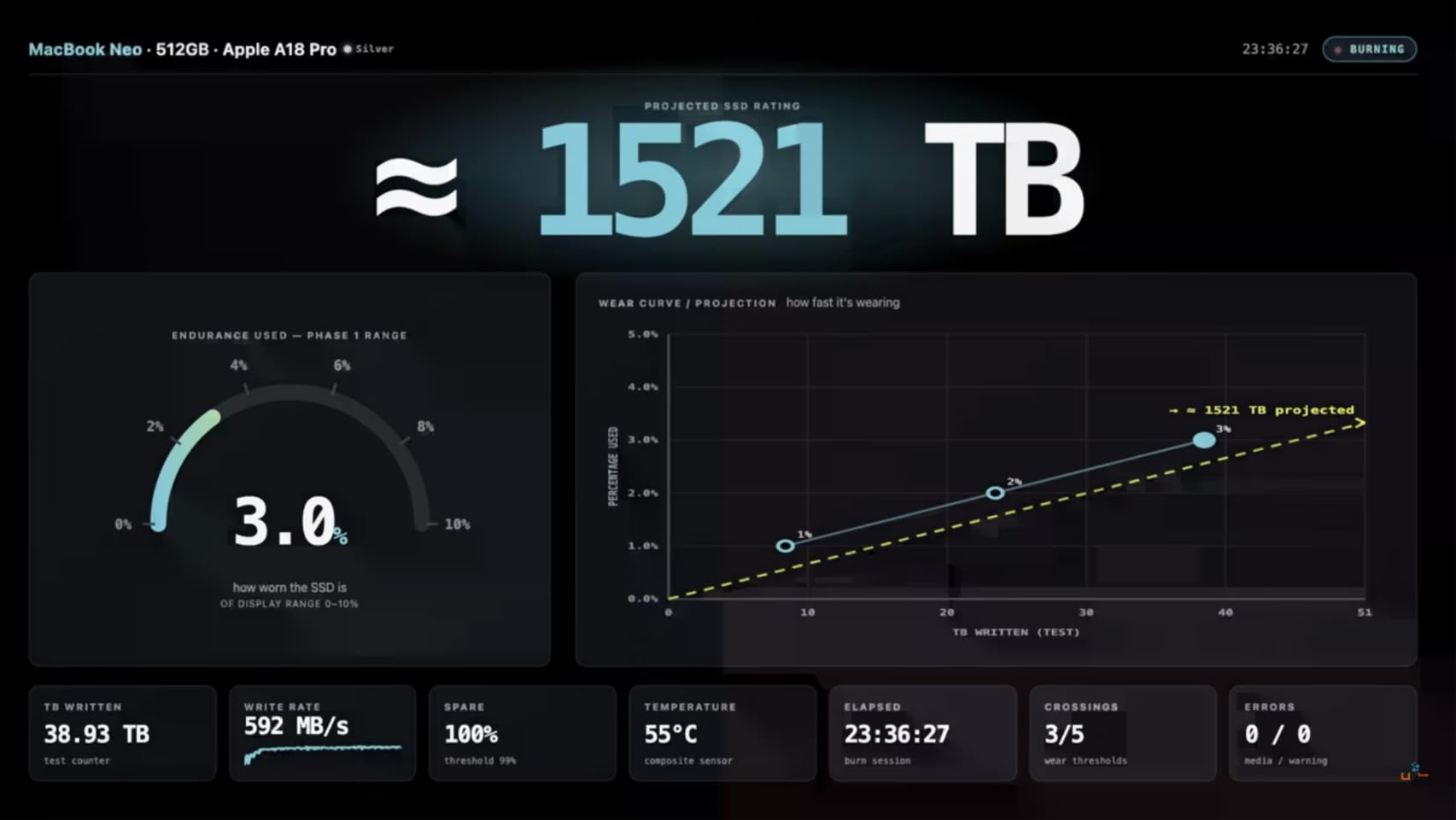
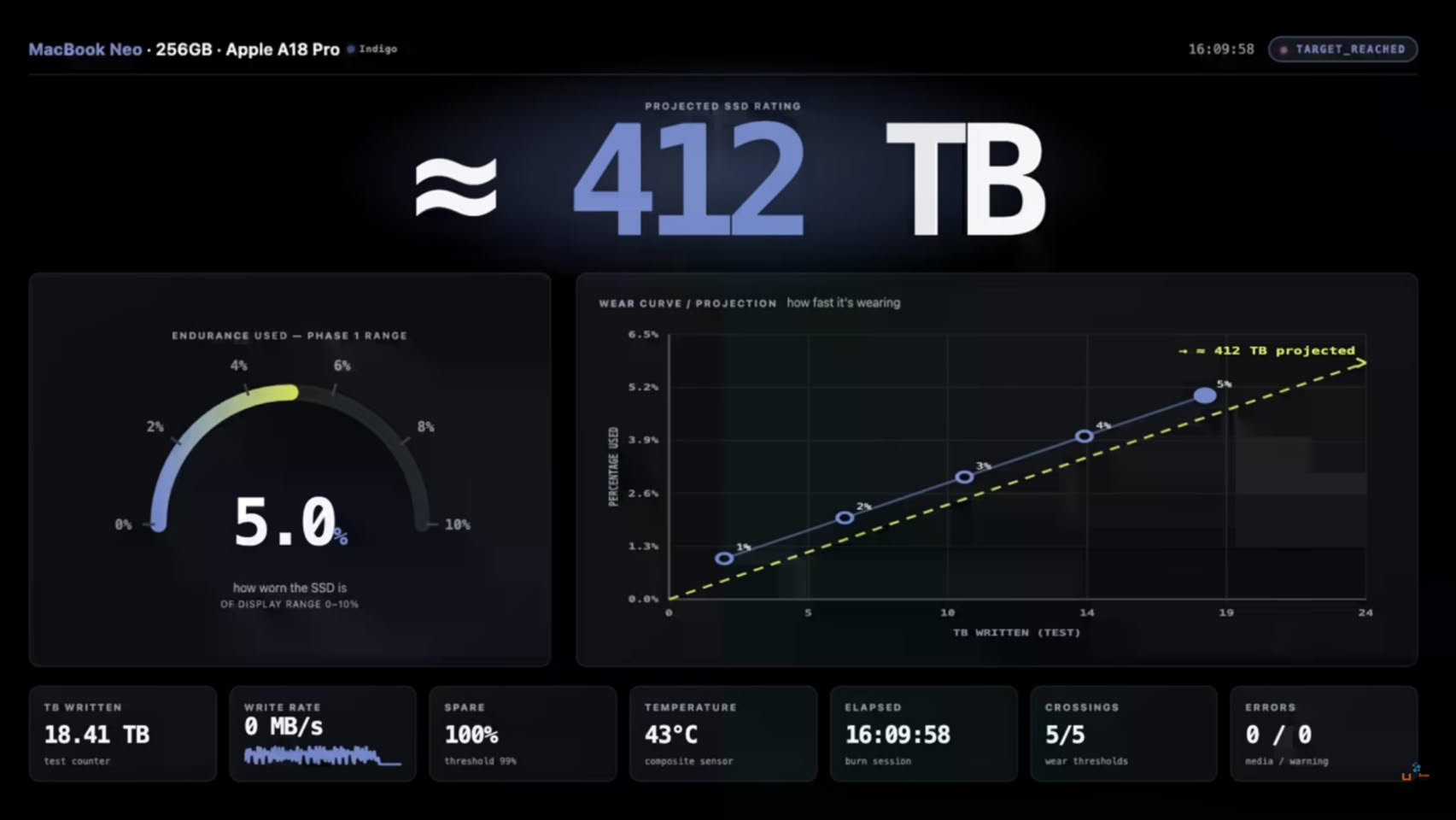
YouTube channel UFD Tech conducted a test using the SSD write test tool. The results show that after writing 20TB of data, the 256GB version of MacBook Neo is expected to have consumed about 5% of its overall life. Based on this, its rated write life is estimated to be about 414TB; the 512GB version's estimated rated life is about 1521TB.
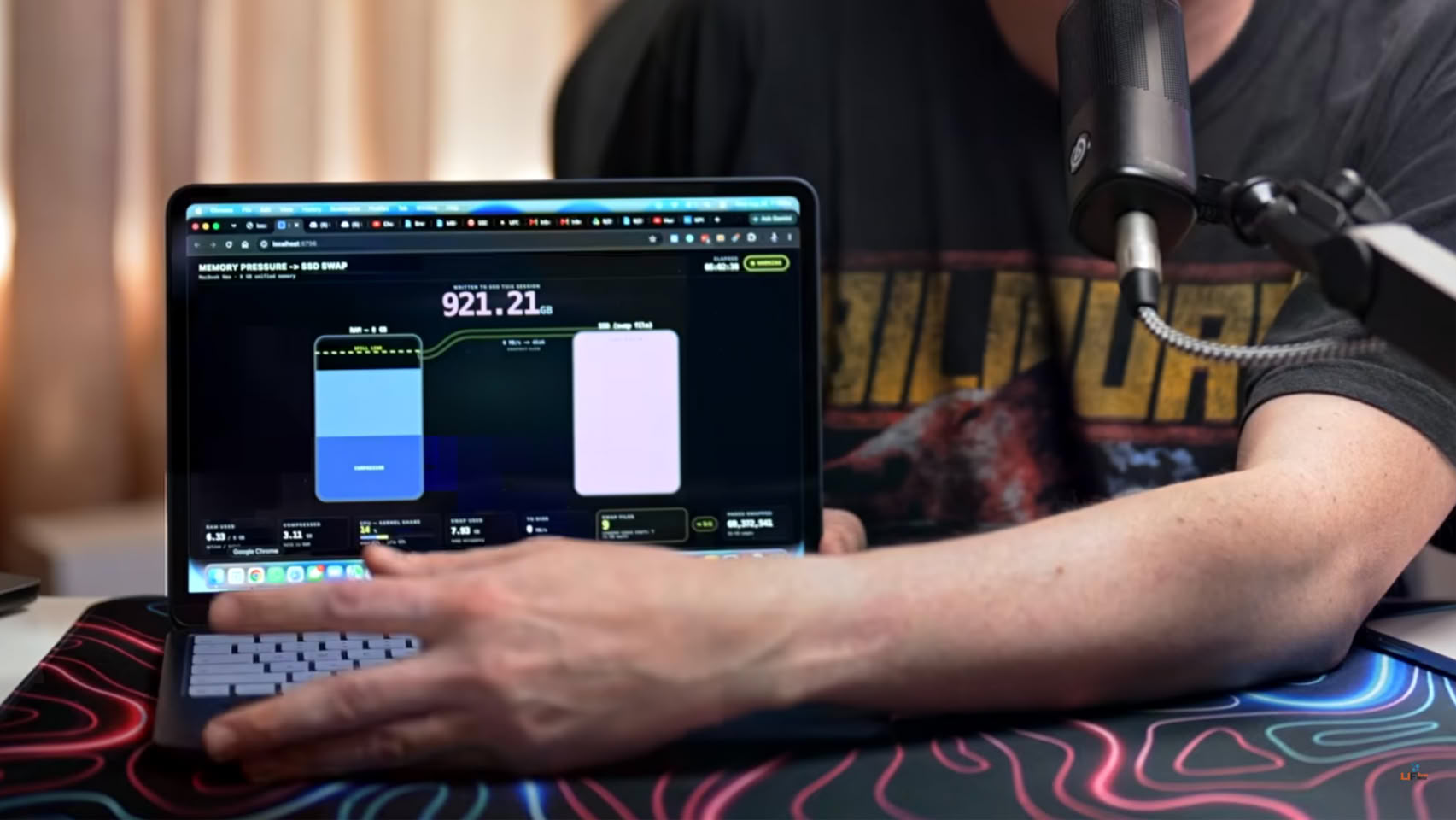
Subsequently, Brett, the host of the channel, used the MacBook Neo for a day to estimate how much data the swap file would write to the SSD every day when the device was running out of memory. During the test, he mainly used this laptop as a network terminal, including searching for information, reading and communicating through Chrome, and running WhatsApp and Discord. The results showed that after just three hours of use, the MacBook Neo wrote "nearly 900GB" of data to the SSD.
If calculated based on the MacBook Neo's estimated durability of about 400 to 420TB, its SSD is expected to only last about 1,400 hours, or about 58 days, when it is used for basic office tasks around the clock. Relatively speaking, the MacBook Neo's 512GB SSD seems to have about 2 to 3 times the durability of the 256GB version. Under continuous use, it is expected to run for about 5,000 hours before reaching the rated write limit.
Of course, the actual results will vary greatly depending on the user's usage, and the SSD's nominal life cannot be completely equal to the actual use time of the hard disk. However, the test did raise concerns about Apple's reliance on swapping, especially when device memory capacity is limited.
What’s even more worrying is that the SSD on MacBook Neo cannot be replaced. When the SSD eventually uses up all its write cycles, repair costs may be higher than buying a new hard drive outright, and there may also be a risk of data loss.
Apple also seems to realize that memory capacity is the weakest link of MacBook Neo. There have been rumors recently that Apple may soon switch to the A19 Pro chip for this product and increase the memory capacity from 8GB to 12GB.
Comments