
Abstract:
A 16-inch M1 Max MacBook Pro user recently encountered something quite special. Although the device still maintains 83% battery health after completing 470 charging cycles, Apple customer service stated that the battery replacement service is only eligible when the battery health drops to 79% or lower.
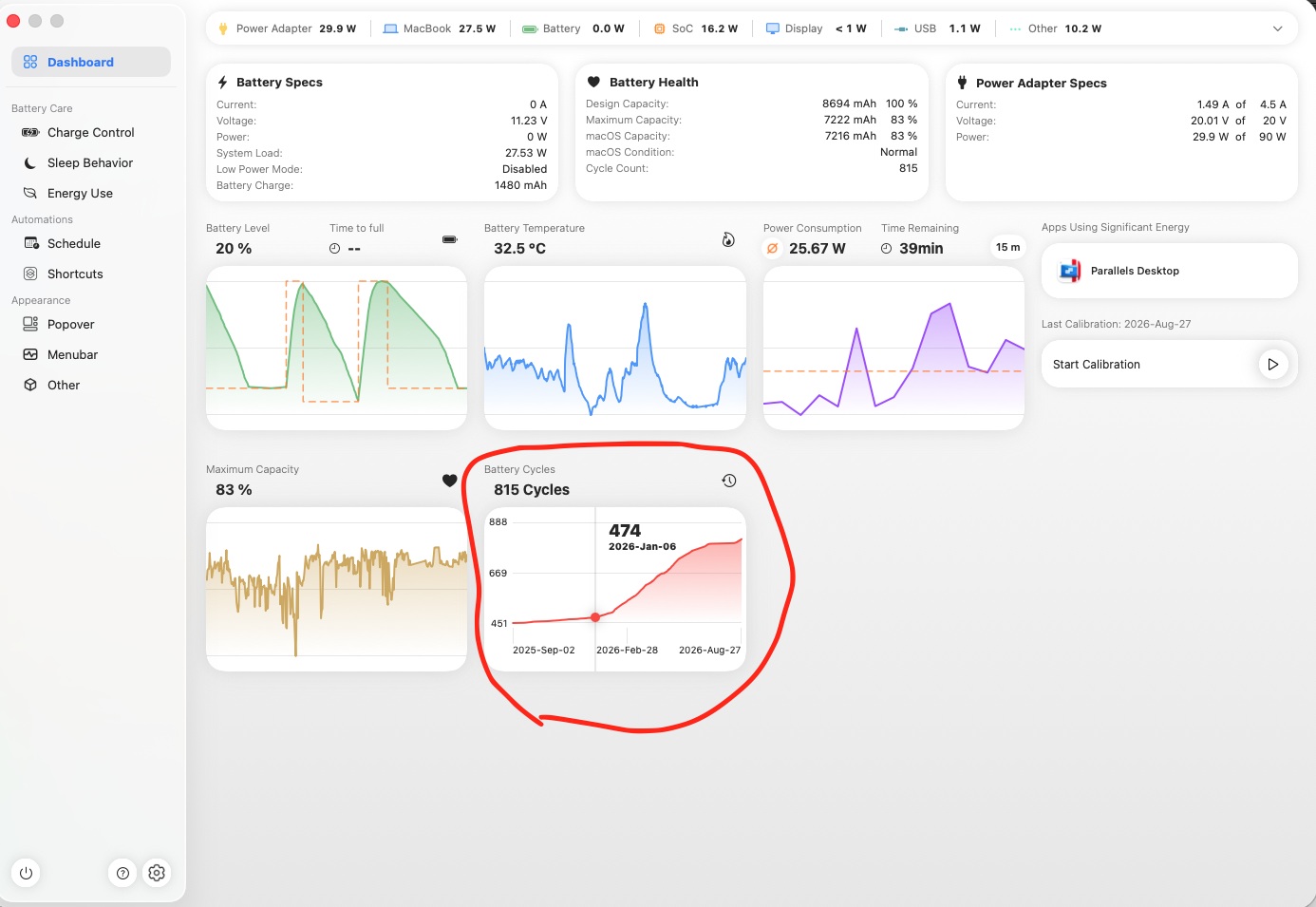
In order to qualify for a free battery replacement, the Reddit user nicknamed "Salty_Ad_6909" tried to drain the battery through continuous use and increasing the number of charging cycles. However, after an additional 73% of charge cycles, the battery health percentage remained unchanged.
According to the third-party software screenshot shared by the user, the number of charging cycles of this M1 Max MacBook Pro has increased from 470 to 815 times, but the battery health is still maintained at 83%. This means that the system shows no degradation in health, even after undergoing numerous charge and discharge cycles.
The main reason for this phenomenon is that the battery health report of macOS does not change linearly. Apple's battery management system smoothes out the decline in battery health, rather than immediately updating the percentage with each charge and discharge cycle. Therefore, an increase in the number of charging cycles does not necessarily lead to a simultaneous decrease in battery health.
In addition, MacBooks using Apple’s self-developed chips are also equipped with a built-in charge controller, which can specifically reduce the loss of batteries caused by high temperatures and charging cycles. Therefore, battery health usually needs to gradually decline with natural use, rather than rapidly decreasing simply by increasing the number of cycles.
If you want to further accelerate the decline of battery health, users can subject the device to greater thermal stress by running high-load tasks. However, this approach involves risks such as battery bulging, which may cause more serious damage to the MacBook Pro, and ultimately bring repair costs that are much higher than replacing the battery, so it is not worth advocating.
Currently, this user’s AppleCare subscription does not need to be renewed until January 2027, so he still has a few months to wait for the battery health to naturally drop to 79%. However, considering that the battery management mechanism of the Apple chip MacBook is relatively complete, there is still uncertainty about whether this goal can be achieved.

Comments