
Abstract:
You've most likely seen a Hoberman Sphere—a dynamic lattice of articulated rods that can collapse or expand with just a little manual force. Inspired by the ancient Japanese art of origami and paper-cutting, a research team from Harvard University in the United States and the University of Tokyo in Japan developed a series of expandable structures.
They are similar to Hobermann balls, also connected by rods and scissor joints. The researchers call it a "foldable scissor surface and planar composite lattice," but it might be cooler and easier to type if it's called "Hobegami."
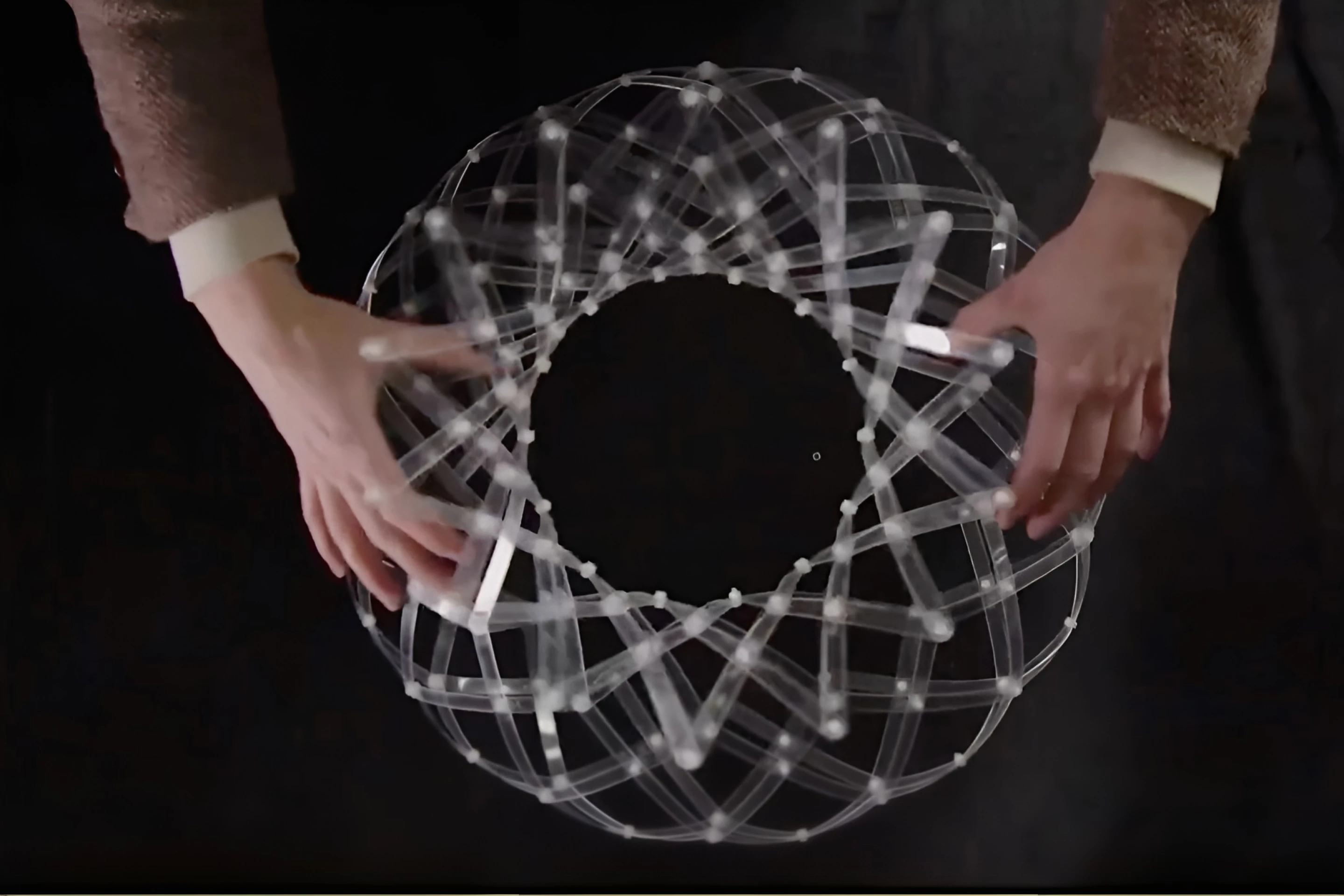
In this study, a torus-shaped planar composite lattice can be folded into a cylinder. "Origami shows how creases encode shape, and kirigami shows how cuts release movement and give structure function," said senior author Lakshmi Narayanan Mahadevan, professor of applied mathematics, organismal biology, and physics at Harvard University. "This study presents a complementarity. Question: What can be achieved when the basic building blocks are no longer creases or cuts, but connections? ”
For objects, tools, structures, and vehicles, foldability is a valuable design feature when volume, not just mass, is the limiting factor. Whether you are flying a submarine, a cargo plane, or a spacecraft to resupply the space station, if you can bear the fuel costs of the extra weight, then instead of reducing the number of items you carry and choosing non-foldable items, you can load more foldable furniture, helmets, surgical implants, habitats, cubesats, spacesuits, flight torus and flying wings, thus reducing the number of expensive and risky transports.
To make foldability a core feature of object design, Toyonaga's team devised an analytical design algorithm that can gradually build complex scissor surfaces. Toyonaga explains: "The overall form can be understood through purely local rules, which can shape the complete structure based on a series of simple geometric decisions."
This "block-by-block" approach is to build joint by joint to be precise, starting from a single connection and working upward to construct the whole, rather than starting from the complete shape and then working backwards to derive the discrete joints within it. The entire process requires only a few design parameters.
Using this method, Toyonaga's team, together with Colter J. Decker and Robert J. Wood of Harvard University, and Seri Nishimoto and Tomohiro Tate of the University of Tokyo, designed and fabricated structures in a variety of shapes, including spirals, toruses, and "egg box" structures.
These dynamic structures may not entirely match the imposing descriptions in the research team's paper, but Harvard's planar composite lattice does have another additional advantage not mentioned in the paper: aesthetics. With their elegant geometric forms, these "Hobegami" structures may inspire more designers to incorporate foldability into product designs. After all, who would choose a static item if you could choose a product that dynamically changes form like a low-tech version of Transformers over a utilitarian box, chair, table, tent, or other item?
Comments