
Abstract:
Meta released the open weight artificial intelligence model Muse Spark Open on October 15, and cooperated with Apple to optimize the local running solution of the model for Mac Studio.
Meta stated that the model has 816 billion total parameters, of which approximately 42 billion are actually activated for each inference, supports a context window of up to 1 million Tokens, and is focused on programming, complex reasoning, and AI agent tasks. With two Mac Studio equipped with M5 Ultra chips and each equipped with 512GB of unified memory, users can run this large-scale model in a desktop environment without having to rely entirely on cloud AI services.
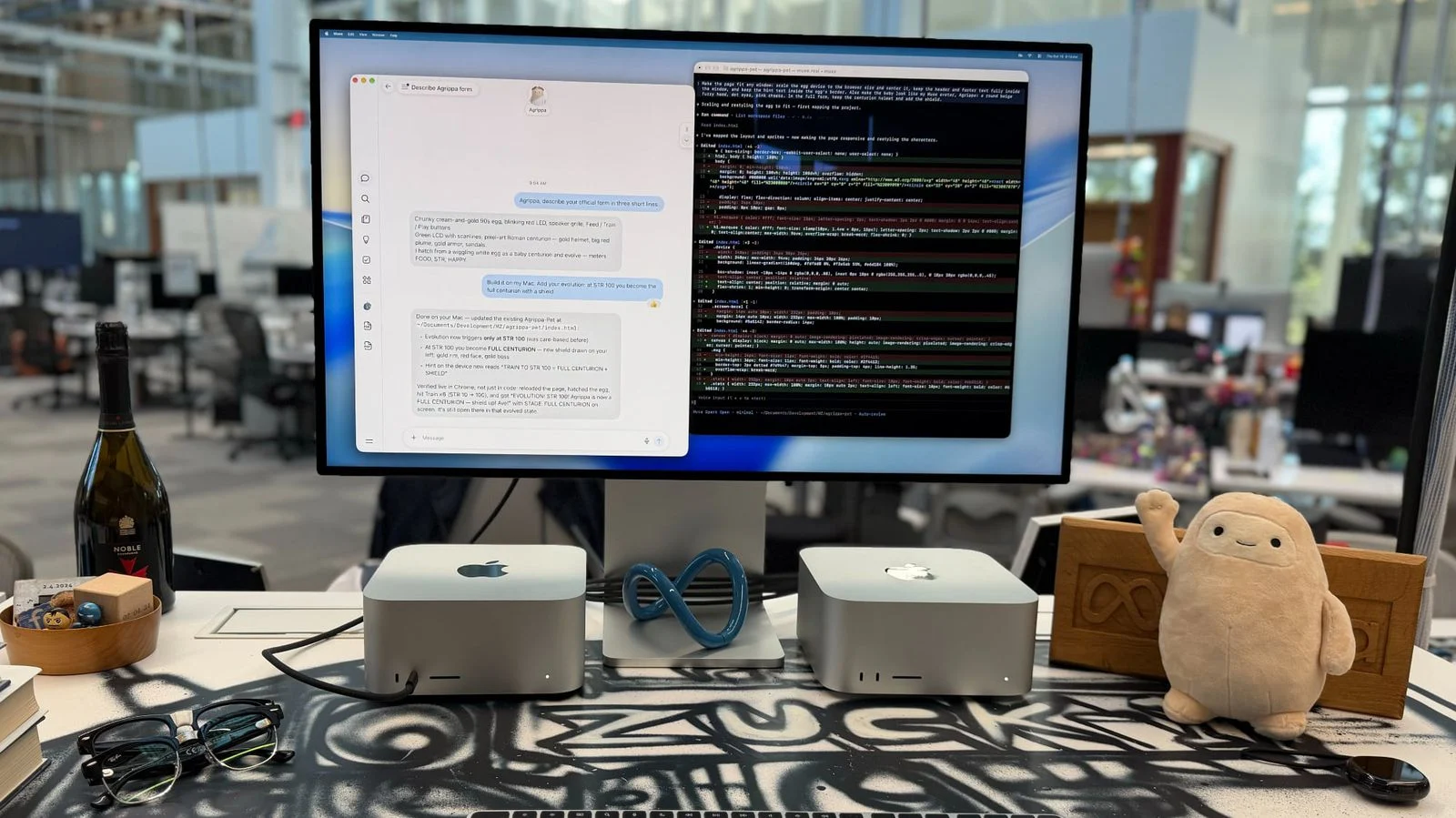
This collaboration is quite eye-catching. Apple and Meta had significant differences in privacy policies, platform rules, and application ecology in the past, but this time both parties jointly promoted the operation of the open weight model on Apple hardware. Meta CEO Mark Zuckerberg thanked Apple CEO John Ternus for participating in the cooperation. Ternus also publicly stated that Muse Spark Open can run efficiently on desktop devices, demonstrating the potential of Mac Studio in local AI computing.
Muse Spark Open is the open-weighted version of the Meta Muse model family. Unlike closed models that can only be accessed through remote services, open weight models allow users to obtain model weights and deploy them themselves, subject to licensing conditions. This gives developers, researchers, and enterprises greater control over the operating environment and the ability to tailor their inference processes to their needs.
The model has 816 billion total parameters, but uses a sparse activation design, with only about 42 billion parameters activated for each inference. In other words, the model does not need to involve all parameters in the calculation when processing each Token, but calls the corresponding part according to the task and input content. This design helps reduce the amount of inference computation, but it does not mean that the model can be run using only the memory required for 42 billion parameters, because the weights of the full model still need to be stored or otherwise managed.
Context window is another important indicator of Muse Spark Open. This model supports 1 million Token contexts and can theoretically process very long texts, code bases, or multiple documents in one task. For software engineering tasks, this means that models have the opportunity to reference large amounts of source code and related materials simultaneously, reducing the risk of missing critical information due to insufficient context. However, the actual available context length, processing speed, and memory footprint still depend on the specific running configuration and inference framework.
Meta said that Muse Spark Open has been optimized for Mac Studio and can run using the unified memory architecture of Apple chips. Traditional discrete graphics systems typically require model weights to be placed into video memory, while Apple's unified memory architecture allows the CPU and GPU to share the same memory pool. On Mac Studio that supports large-capacity unified memory, the GPU can access up to 512GB of unified memory, providing a hardware foundation for running large open-weight models.
According to Meta, two Mac Studio can run the model collaboratively through the corresponding software framework, so that the system has about 1TB of unified memory. The M5 Ultra chip equipped on each device has a memory bandwidth of up to 1.2TB/s. Meta believes that this configuration can run Muse Spark Open locally while utilizing the sparse activation mechanism to only read some of the parameters required for each Token inference.
The key to this solution is not simply to connect two computers, but to work together through a unified memory architecture, model sharding and inference framework, so that models that originally require larger-scale computing infrastructure can be run on desktop devices. Apple’s MLX machine learning framework powers model execution on Apple Silicon, and Meta is tuned accordingly for Muse Spark Open.
However, it is necessary to distinguish between the two concepts of the model being able to load and run and the model being able to run at high speed. Having enough memory only solves one major obstacle in the deployment of very large models. Model sharding, cross-device communication, memory bandwidth, compute unit utilization, and context length all affect the final inference speed. The information released by Meta this time emphasized the runnability and hardware configuration of the model, but did not provide complete benchmark test data that is sufficient to fully judge the actual performance.
Price is also an important limitation of this plan. Apple has not yet officially launched the Mac Studio equipped with 512GB of unified memory, which is expected to be available at the end of October. Existing high-end Mac Studio models with 256GB of unified memory already cost over $10,000, so a system consisting of two 512GB versions is expected to be an expensive investment. For ordinary individual users, this is obviously not a low-cost local AI solution, but for development teams and research institutions that need to run large models and value data control, it provides an alternative to traditional servers.
Meta stated that Muse Spark Open can not only run on Mac Studio, but can also be called through multiple cloud AI platforms, including Baseten, Fireworks AI, Groq, Modal, Nebius, OpenRouter and Together AI. For users who wish to download the model weights themselves, relevant files can be obtained through Amazon SageMaker AI, Google Cloud Model Garden, Hugging Face, and Microsoft Foundry Models.
This model uses a license that allows limited commercial use, rather than a general open source license with no restrictions. Therefore, before using it in commercial products, developers and enterprises still need to carefully read the specific license terms and confirm whether their deployment method, user scale and application scenarios meet the requirements.
This cooperation also reflects the emerging new development direction of local AI computing. In the past, running large models with hundreds of billions of parameters usually required multiple professional GPUs, large amounts of video memory, and complex server clusters. Apple is trying to use a unified memory architecture and high-bandwidth chips to enable high-end desktop computers to host larger-scale models. While this approach is still limited in terms of cost and inference performance, it opens up new possibilities for users who don’t want to send all their data to the cloud.
For Apple, Muse Spark Open also helps demonstrate Mac Studio’s positioning in the field of AI development. As more and more developers try to run models locally, unified memory capacity and bandwidth have gradually become important indicators for measuring the AI capabilities of high-end computers. Apple hopes that through the M5 Ultra and MLX ecosystem, Mac will not only be suitable for video editing, 3D design and music production, but also become a local AI development and reasoning platform.
For Meta, releasing an open weight model and supporting running on Apple hardware will help expand the developer coverage of the Muse series. Users can choose cloud API or local deployment according to their needs, and Meta can also attract more developers to build applications and tools around the model.
Overall, the significance of Muse Spark Open lies not only in the number of 816 billion parameters, but also in that it demonstrates the possibility of combining large-scale open weight models with high-end desktop hardware. Two Mac Studio equipped with 512GB unified memory can provide about 1TB of memory space for the model, making it suitable for local running, but the actual experience still depends on the inference speed, hardware cost and software optimization.
This cooperation is not enough to prove that ordinary personal computers can easily run very large-scale models, but it shows that local AI hardware is developing towards higher memory capacity and stronger collaborative computing capabilities. As model architecture and inference software continue to be optimized, some AI models that could only be deployed in large data centers in the past may gradually enter studios, laboratories, and developer desktop environments in the future.
Comments