
Abstract:
Meta recently launched its flagship artificial intelligence model Muse Spark 1.3. This model is mainly oriented towards programming and intelligent agent tasks, and is currently available through Muse Code and Meta API. Meta CEO Mark Zuckerberg also said that in the future the company will launch a version of Muse Spark released in an open weight form.
Muse Spark 1.3 is another update of Meta's continuous improvement of artificial intelligence models in the field of programming. It is less than a month after the release of Muse Spark 1.2. Meta said that the new model uses more long-term programming tasks for training, aiming to reduce ineffective operations in daily work.
According to testing by the Meta engineering team, compared with Muse Spark 1.2, Muse Spark 1.3 requires approximately 20% fewer tool calls to complete relevant tasks, and uses approximately 25% fewer tokens. The company also says the new model will reduce lengthy responses and unnecessary rounds of interactions.
These improvements are especially important for programming tasks, because more complex and longer tasks require the AI to continue to remember the user's original request and advance the task accordingly. Meta said that Muse Spark 1.3 can handle multiple workloads in the same conversation, and can also identify gaps in its own plans and save relevant instructions for subsequent development tasks.
Meta also pointed out that when there is ambiguity in a user's request, the new model is more likely to ask clarifying questions first rather than proceed directly based on incorrect assumptions.
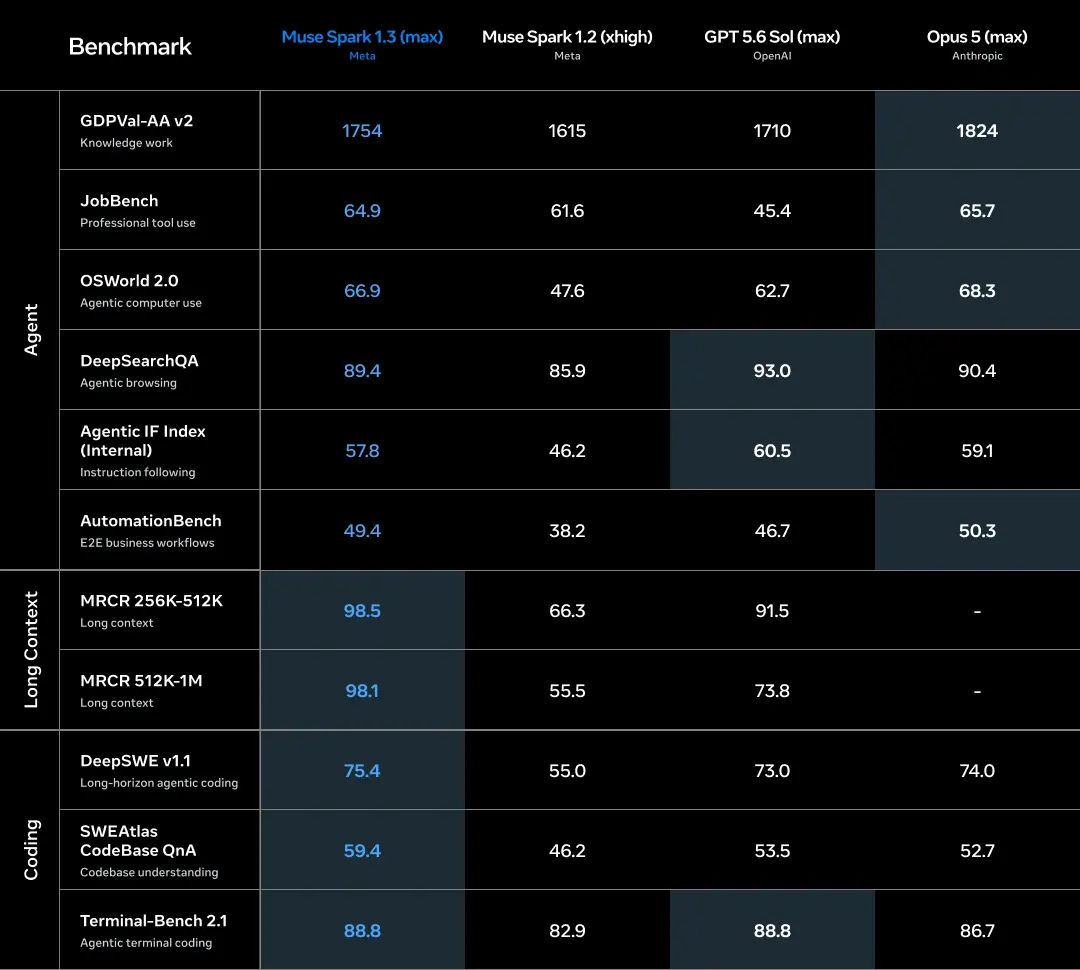
In terms of benchmark testing, data released by Meta shows that Muse Spark 1.3 achieved 75.4 points in the DeepSWE v1.1 test, which is higher than the GPT 5.6 Sol and Opus 5 results listed in the chart. This model also achieved significant improvement compared to Muse Spark 1.2 in Meta's long context test. In other test categories, however, rival models still held the lead.
In terms of price, Meta has not increased the API charging standard for Muse Spark 1.3. The model remains priced at $1.25 per million input words, $0.15 per million cached input words, and $4.25 per million output words.
Like the previous generation model, Meta continues to offer developers a lower-priced "contributor" tier. Developers participating in this tier need to allow Meta to use their data to improve the model, and the fee is $0.10 per million input words and $0.20 per million output words.
Comments