
Abstract:
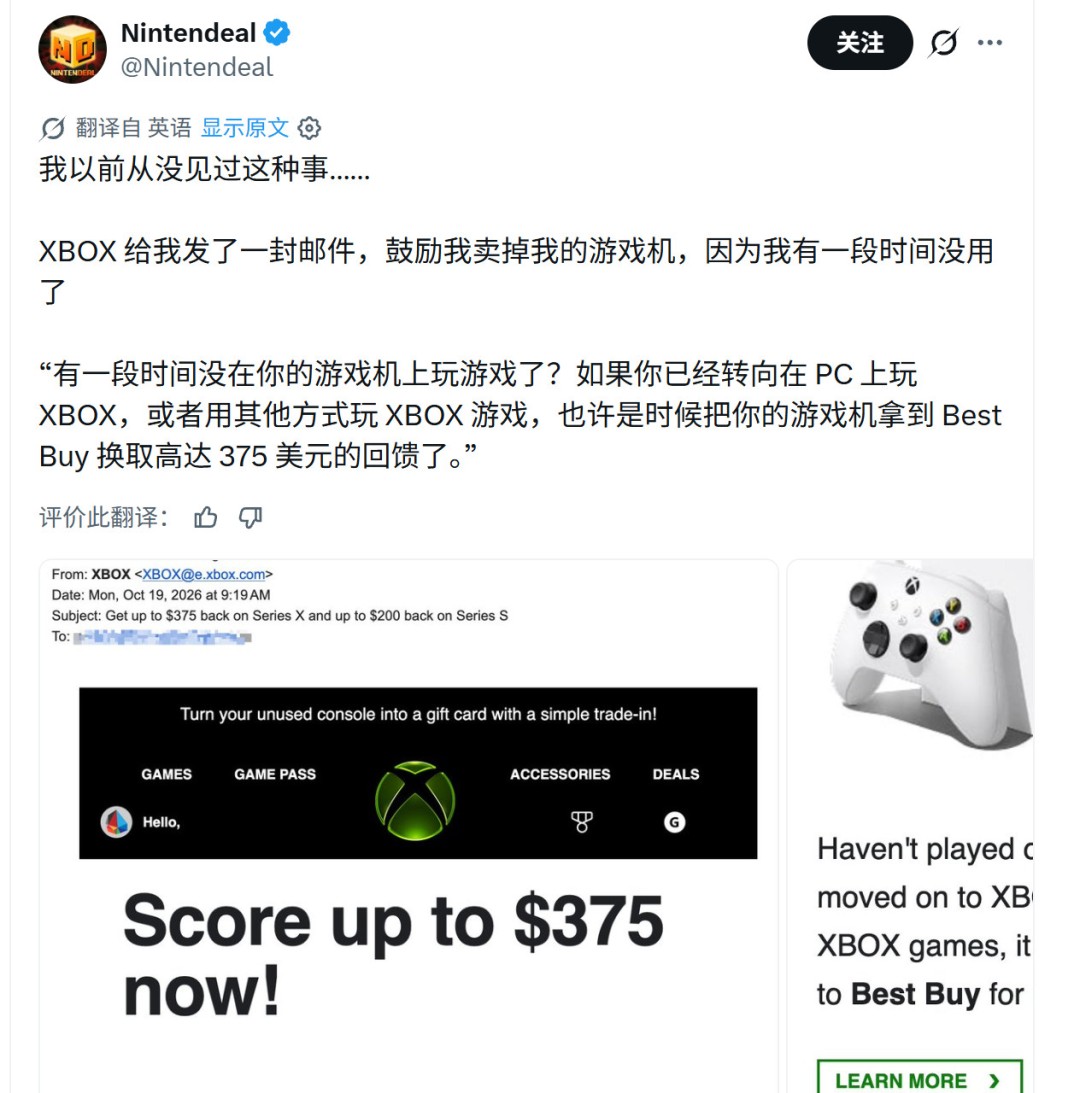
The promoter Nintendo posted an email from Xbox on social media. The content actually encouraged him to sell his console because he had not used it for a while.
“It’s been a while since you’ve played a game on your console? If you’ve switched to playing Xbox on PC, or another way to play XBOX games, it may be time to take your console to Best Buy to redeem up to $375 in rebates.”
Obviously, Microsoft's target users of this email are users who have idle Xbox Series X or S (these people may have given up on Xbox or switched to PC or other devices). Best Buy will offer these players gift cards of up to $375. The move comes as many markets face rising prices and console shortages. It can be speculated that the model with the most storage space and the optical drive will receive the highest trade-in price.
Fair deal?
$375 is far lower than the U.S. non-digital Xbox Series X, which sells for $800 or more. Globally, actual prices tend to be higher due to the many production challenges Microsoft faces. Still, the price is at least comparable, if not lower, than what competitors like GameStop are willing to pay.
Fans are hotly discussing Microsoft’s strategy for this trade-in event. Microsoft may have struck a lucrative deal with Best Buy, but it may also be trying to increase its inventory of used Xboxes in brick-and-mortar stores.
When Xbox announced its latest price increase in June, it explained other measures to deal with parts shortages, including interest-free installment plans and buy now, pay later plans. What's more, the company says it's "working with retail partners to launch new programs to offer pre-owned consoles at lower prices."

Attract new players
Even as Microsoft plans to launch Project Helix, it still relies on game publishing revenue and the Game Pass subscription service. However, the installed base of Xbox Series X|S lags far behind that of PS5, limiting its sales potential. The second-hand market can reach new customers who cannot afford rising official retail prices.
This approach may serve as a temporary solution in the hope that the cost of memory and SSDs will come down. Even so, CEO Asha Sharma still needs to find another way to find users for Project Helix.
Asha Sharma hinted at the launch of a series of next-generation devices that may use cheaper OEM hardware and lower configurations. She also promises more efficient use of memory and storage space, but it's unclear exactly how.
Comments