
Abstract:
Although Microsoft has stopped the development of the Windows Mixed Reality platform in recent years, this does not mean that the company has completely withdrawn from the mixed reality field.
The latest signs show that Microsoft is still continuing to promote cooperation with Meta and is further strengthening the deep integration between Meta Quest and Windows 11.
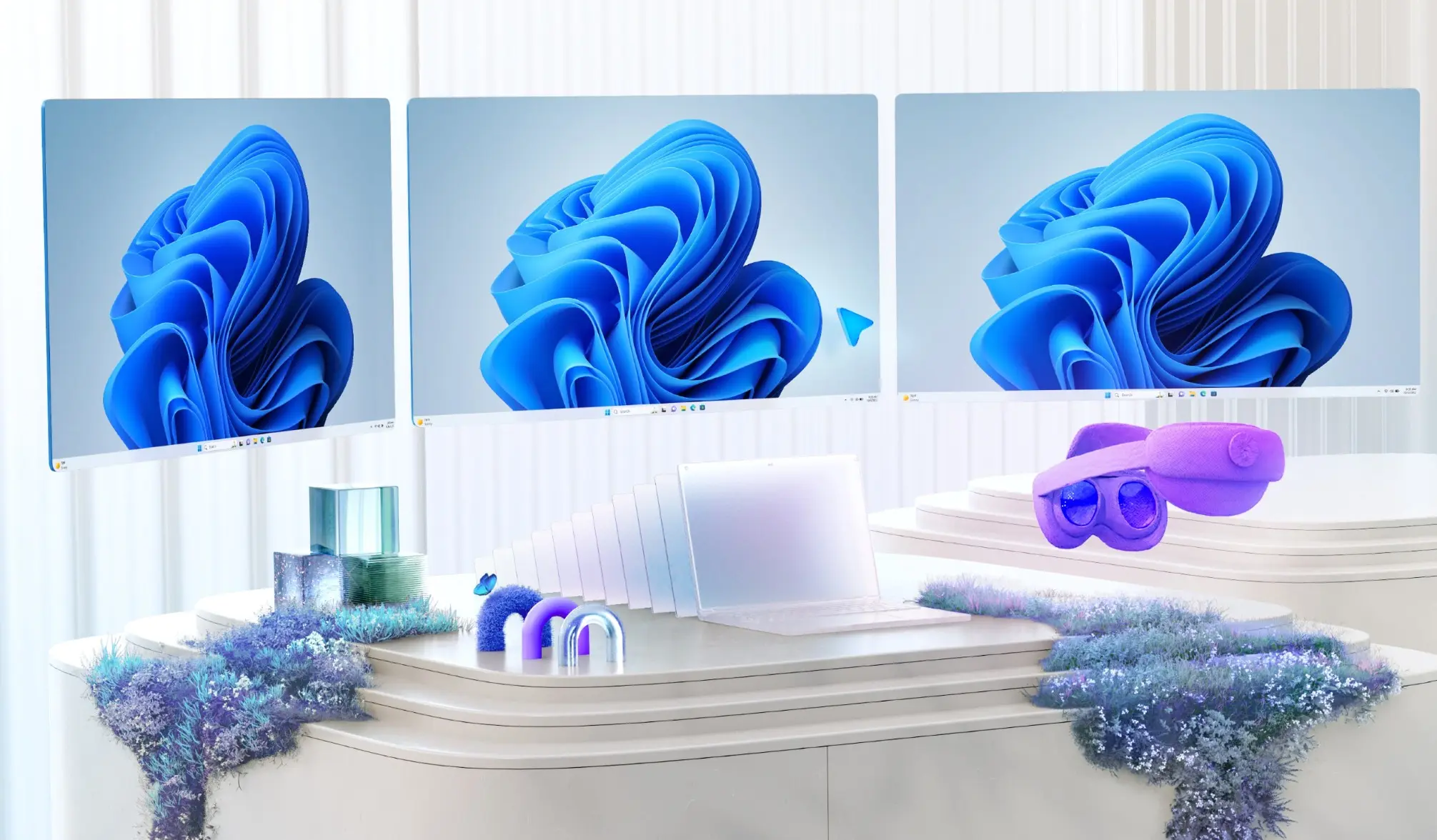
Microsoft recently released a new version of the Mixed Reality Link application update, which brings camera and microphone streaming capabilities to Meta Quest 3 and Quest 3S headsets. This upgrade means that the Quest device is no longer just a virtual display for Windows computers, but has begun to become a complete audio and video input device.
Mixed Reality Link will initially be officially available to Meta Quest users in 2025. With this feature, users can connect the Quest headset to a Windows 11 computer, create multiple virtual displays in a mixed reality environment, and switch freely between real-world perspective mode and an immersive virtual office space as needed.
In previous versions, Quest played more of a display and input terminal role. Now, with the launch of new features, Windows can directly call the built-in hardware resources of the headset.
Among them, the microphone streaming function allows Windows to recognize the Quest built-in microphone as an independent audio input device "Mixed Reality Link Microphone". Users can make voice calls, online meetings, game voice communication and artificial intelligence assistant interactions directly through the headset without connecting to an additional computer microphone.
Compared with the audio function, the addition of camera support has attracted more attention. After the update, Windows applications can directly access the Quest headset camera footage. In this way, users can share what they see with others in real time, achieving first-person perspective display.
Microsoft believes that this capability can significantly improve the remote collaboration experience. For example, in technical support, education and training, or product demonstration scenarios, users do not need to repeatedly describe what they see, but can directly transmit their perspective to the other party.
At the same time, Microsoft and Meta also jointly launched a new feature called Avatar Camera. Through this function, users do not need to turn on the traditional camera in Windows applications, but can directly use their Meta virtual image as a video source to participate in meetings or online communications.
In actual use, other participants in the video conference will see not the real camera footage, but the real-time driven Meta Avatar digital image, thus providing more privacy protection space while maintaining a sense of online presence.
According to information announced by Microsoft, the upgraded Mixed Reality Link will add multiple input sources to Windows, including "Mixed Reality Link Microphone" for audio input, "Mixed Reality Link Passthrough" for head-mounted camera screen transmission, and "Mixed Reality Link Avatar Camera" for virtual character video output.
The new feature requires Mixed Reality Link 26.9105.9070.0 or higher, and requires users to use a Meta Quest 3 or Quest 3S headset with a computer running Windows 11 22H2 and above.
This update shows that Microsoft still maintains a strong interest in mixed reality office scenarios. Although the company has abandoned its own Windows Mixed Reality hardware ecosystem, by partnering with Meta, Microsoft is building Windows into an important productivity platform in the Quest ecosystem.
With the gradual integration of cameras, microphones, multiple virtual displays and digital avatar functions, Meta Quest is transforming from a traditional VR entertainment device to a mixed reality office terminal. For Microsoft, this cooperation model also allows it to continue to compete in the mixed reality market without having to reinvest in the research and development of its own consumer-grade head display hardware.
As Apple's Vision Pro and Meta Quest continue to promote the development of spatial computing, Microsoft has obviously not left this track, but has chosen to continue to expand mixed reality application scenarios through the Windows ecosystem and software services in a more pragmatic way.
Learn more:
https://techcommunity.microsoft.com/blog/mixed-reality-link/microphone-and-camera-streaming-for-mixed-reality-link/4558081
Comments