
Abstract:
A "microwave laser" technology born in 1954 is making a reappearance using diamonds as a carrier, and is expected to help quantum computers break through the measurement bottleneck. A research team at Okinawa Institute of Science and Technology University in Japan has developed a diamond maser amplifier that can amplify weak microwave signals more than 1,000 times while introducing only extremely low noise, providing new ideas for building more powerful and more scalable quantum computers.
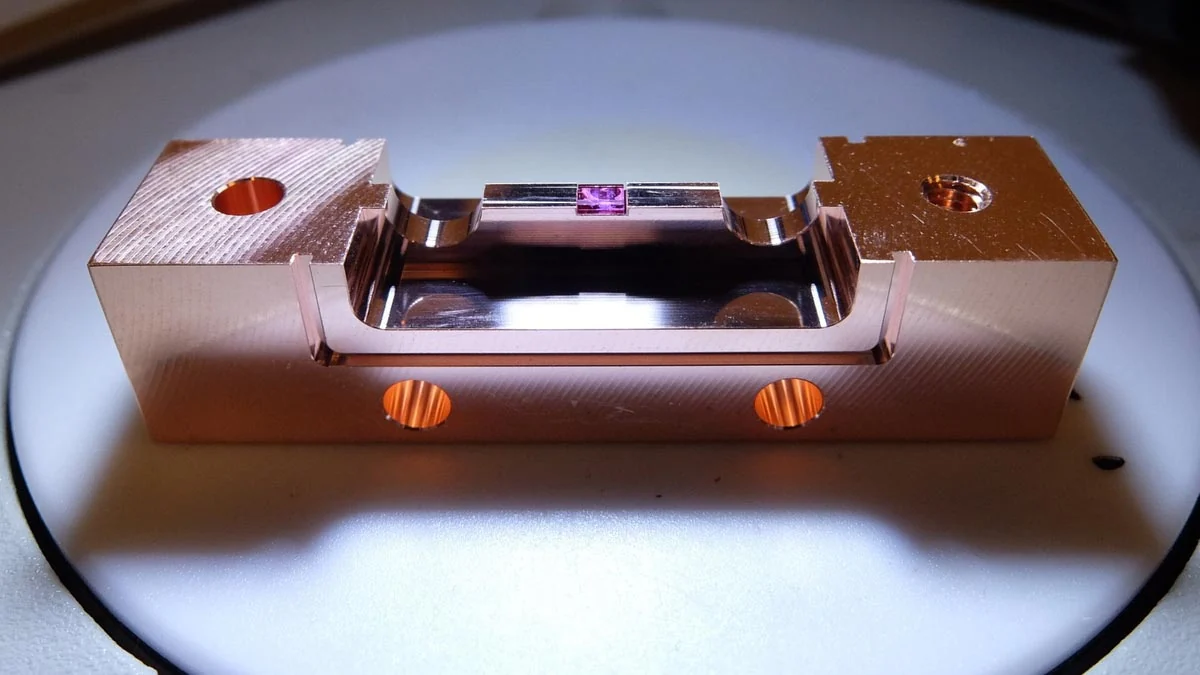
Quantum computers rely on qubits to process information, but to read the results of their calculations, extremely weak microwave signals associated with the qubits must be measured. These signals are highly sensitive to interference and must be amplified before they can be accurately identified. However, the amplification process itself brings additional noise; once the noise is mixed into the measurement, subsequent amplifier stages will amplify it together with the valid signal, thereby increasing the risk of misreading.
To suppress thermal noise, superconducting quantum computers usually need to operate in extremely low temperatures close to absolute zero. But even so, the noise introduced by the amplifier itself cannot be completely eliminated. Although traditional Josephson parametric amplifiers can detect weak signals with extremely low noise, they are prone to saturation when measuring multiple qubits simultaneously, limiting the number of signals that can be reliably processed at one time. Although another type of kinetic inductive parametric amplification technology can withstand stronger signals, it often requires more power and wiring. As the scale of quantum computers expands, the cost and complexity will also increase. In addition, some qubits based on electron spin require magnetic fields, which can interfere with conventional superconducting amplifiers.
Yumaru Kubo, head of the hybrid quantum device team at Okinawa Institute of Science and Technology University, said the team chose to revisit an old technology that predates the advent of lasers - masers. The maser was first demonstrated in 1954, six years before the laser. Both use stimulated radiation to amplify electromagnetic waves. The difference is that lasers process light waves and masers process microwaves. When an incident photon of appropriate energy excites an electron in a high-energy state, the electron emits a photon identical to the incident photon. This process occurs repeatedly, allowing the original signal to continuously increase.
Jubo pointed out that although microwave masers were invented earlier than optical lasers, their development has been limited for a long time because they usually require a low-temperature environment to work. Now that quantum computers themselves operate at temperatures close to absolute zero, the technology has found new applications and is a strong candidate for amplifying quantum signals with extremely low noise.
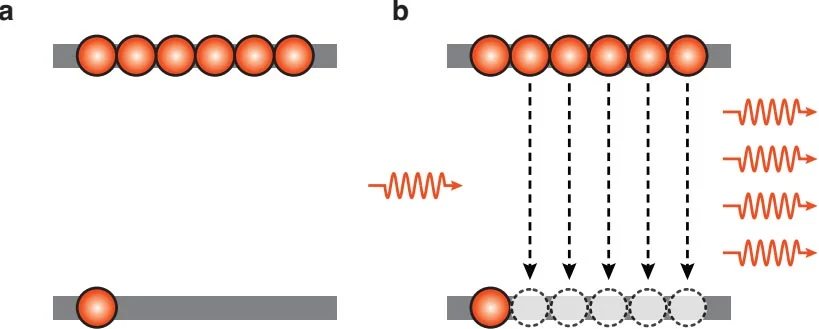
The research team used a specially treated diamond that contains nitrogen impurities known as P1 centers. The electrons in these impurities have spin, an intrinsic quantum property of electrons that causes them to behave like extremely small magnets. The researchers applied a weak microwave field to the diamond to provide energy for the electron spins, causing most spins to enter higher energy states, causing particle number inversion. When a weak microwave signal enters the amplifier, it stimulates these spins in the excited state to release the stored energy and generate additional microwaves with the same frequency as the signal.
Effectively, diamond transfers the energy stored in excited electrons to the incident signal, enhancing it without the need for a powerful microwave source. Kubo said the team was surprised to be able to achieve such a large amplification with such a small amount of microwave power.
In tests, this diamond maser amplifier amplified microwave signals more than 1,000 times while introducing only 2.55 quanta of additional noise. Quantum is a discrete unit that describes a microscopic scale of energy. For comparison, the basic quantum limit of this type of amplification is 0.5 quanta, which means that even an ideal amplifier cannot completely eliminate the additional noise.
The device can also withstand much stronger input signals than traditional Josephson parametric amplifiers and can operate in magnetic fields. That means it could be particularly suitable for quantum computers that rely on spin qubits. The research team believes that this technology still needs to be further developed for commercialization, but its potential is not limited to quantum computing.
Highly sensitive microwave amplification is also valuable in spectroscopy, where scientists can study the properties of materials, and in nuclear magnetic resonance, the physics behind magnetic resonance imaging equipment. In addition, fundamental physics experiments searching for dark matter could also benefit, as detecting extremely weak signals could help researchers explore one of the most elusive mysteries in the universe.
This study was jointly completed by researchers such as Kota Mori, Li Jingping, Sitsis, Kostelev, Bauer, Moroshkin, Hamamoto, Kobayashi, Onoda, Oshima, Isotani, Takahashi, and Yumaru Kubo. The paper was published in "Nature Communications" on November 16, 2026. The research work has been supported by various projects such as the Okinawa Institute of Science and Technology University Innovation Concept Proofing Program, the Japan Science and Technology Agency's "Moon Landing R&D Program", and scientific research grant subsidies.
Comments