
Abstract:
Engineers at the University of California, San Diego, have developed a six-legged robot made entirely of soft materials and powered by compressed air. The robot can reach a maximum speed of 4.72 meters per second, or about 10.6 miles per hour, making it the fastest soft robot of its kind.
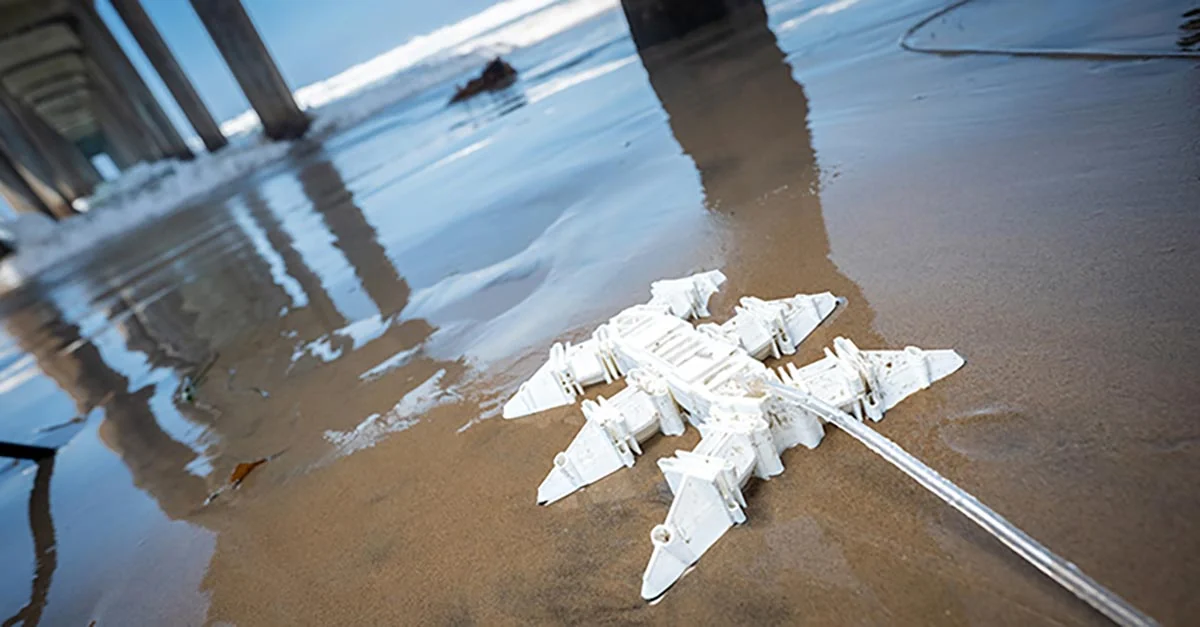
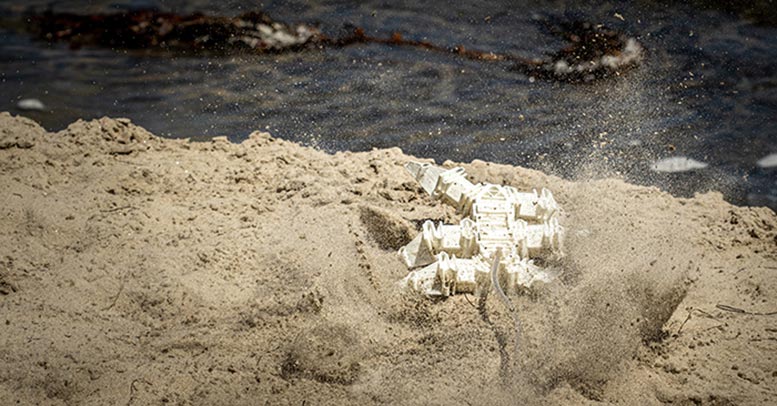
The robot, developed by a team of researchers at UC San Diego's Jacobs School of Engineering, can traverse sand, gravel and concrete, run down stairs, and even swim in water and continue working underwater. What’s even more striking is that the entire robot is made of a single material and is integrated through 3D printing. It does not require any electronic components inside to complete motion control.
This research result has been published in the magazine "Science Robotics". Researchers say the design was inspired by centuries-old steam engines. By drawing on the principle of efficient use of pressure by a compound steam engine, the team increased the movement speed of this soft robot by more than 100 times compared with earlier versions.
Soft robots, usually constructed of flexible materials, have the potential to adapt to complex terrains, are impact-resistant and are low-cost, but have long suffered from insufficient speed. The project originally grew out of a 2022 study. At that time, researchers at the University of California, San Diego developed a 3D printed pneumatic walking robot that could travel at only 4 centimeters per second, or about 0.09 miles per hour.
Early designs demonstrated that the robot could move solely by relying on a network of air chambers and valves embedded in its flexible body, without the need for traditional motors or electronic control systems. However, its speed is limited by the air pressure and airflow that the internal structure can withstand. Zhai Yichen, a former postdoctoral researcher in Professor Michael Tolley's Biomimetic Robotics and Design Laboratory at the University of California, San Diego, said that the first generation of walking robots showed the possibilities of this technology, but it was too slow. The research team wanted to break through this limitation and eventually found a way to make the new robot 100 times faster.
The research team knew that increasing the air pressure could make the robot run faster. The robot's interior is made up of a network of interconnected air chambers, valves and pipes through which compressed air drives the legs. If these structures are made larger and stronger, more air can pass through at higher pressure, but this will also bring new problems: when running at high speed, the robot may discharge high-pressure gas before fully utilizing the energy of the compressed air, resulting in a waste of energy.
Researchers found a solution in a compound steam engine. The compound steam engine does not release all the steam at once, but gradually expands the steam in multiple cylinders to extract more effective energy. The team introduced a similar principle into the robot, allowing the compressed air to perform two tasks when flowing through the fuselage: it first enters a smaller high-pressure air chamber to drive the valve; it then enters a larger low-pressure air chamber to push the robot's legs.
This two-stage system makes better use of compressed air, allowing the robot to reach speeds far beyond those of its predecessors. At the same time, the design retains the most attractive feature of the original solution: all moving parts and their control structures can be printed out in one go, eliminating the need to install separate electronic control devices.
The researchers summarized this engineering challenge as applying the long-proven technical solution of the composite steam engine to a soft running robot that can be printed and molded in one go using a single material. They see this as a step toward printing complex and powerful robots on desktop devices using cheap materials.
To test the robot's adaptability, the research team conducted tests on a variety of surfaces including concrete, gravel, grass, mulch and sand. The robot successfully traversed these different terrains and also completed tasks such as running down stairs, swimming in water, and operating continuously underwater. The researchers note that this ability to move in a variety of environments shows that a relatively simple, flexible and completely air-driven structure can achieve considerable functions.
However, the bot currently has a key limitation. While it requires no electronics, it still requires connection to an external source of compressed air, such as a regular air compressor. The research team hopes to further reduce its air consumption, allowing future versions to carry a portable air supply or even use a small compressed air tank. They also plan to develop more complex locomotion capabilities that would allow the robot to turn and manipulate objects.
The research team predicts that this type of robot, which can be printed in one piece, requires no electronic components, and is low-cost, may be used in scenarios that traditional equipment is difficult to handle in the future, including disaster relief, space exploration, and scientific reconnaissance in environments with strong radiation or strong magnetic fields. In these environments, conventional electronics may not function properly, and robots that operate entirely on pneumatic structures may have unique advantages.
This research was funded by the National Science Foundation. The paper is titled "Printing Powerful Soft Robots on the Desktop", co-authored by Zhai Yichen and Michael Tolley, and published on November 18, 2026.
Comments