
Abstract:
The research team of the Sixth Institute of Physics of the University of Stuttgart in Germany announced that it has set three world records at the same time on a special quantum system called "circular Rydberg atom", including atomic life, atomic size and retention time in a laser trap. Researchers believe that this breakthrough is expected to promote the development of high-performance quantum simulators and lay the foundation for building more powerful quantum computers in the future.

Quantum simulators can reproduce the behavior of complex quantum systems in a controlled environment and are an important platform for exploring new quantum phenomena and verifying quantum computing technology. Rydberg atoms have long been regarded as promising candidate units in the fields of quantum simulation and quantum computing. However, they are extremely sensitive to the surrounding environment and often can only remain stable for a very short time. This has also become one of the key obstacles limiting the development of related technologies.
Tilman Pfau, head of the research team, said that improving the stability of Rydberg atoms has always been a core challenge in the development of high-performance quantum simulators. The team successfully increased the atomic stability time to 20 times the previous level, creating more favorable conditions for subsequent quantum technology applications.
The so-called Rydberg atom refers to an atomic structure in which electrons are excited to high-energy orbits away from the nucleus. Because the distance between electrons and the nucleus is greatly increased, the size of such atoms can reach thousands of times that of ordinary atoms. The larger size enables quantum interactions with neighboring atoms over greater distances, a property important for building and controlling quantum systems.
Researchers said that the interaction distance between Rydberg atoms can reach about 5 microns, which is about one-tenth the thickness of a human hair. Although it is still extremely small on an everyday scale, it is already quite far away in the atomic world. This is one of the reasons why neutral atom quantum technology favors Rydberg atoms. This type of technology enables quantum information processing by trapping and manipulating uncharged atoms with laser beams.
The object of the team's research this time is circular Rydberg atoms. In this state, the excited electrons move in a nearly circular orbit around the nucleus. In the experiment, the researchers successfully constructed an electron orbit with a diameter of about 1.1 microns, which is about 10,000 times larger than the electron orbit of ordinary atoms.
To achieve this goal, the team developed a special experimental platform to create extremely stable giant atoms at room temperature by suppressing blackbody radiation interference in the environment. In the past, similar experiments often required expensive and complex ultra-low temperature environments, but this achievement was achieved under milder conditions, further improving the practicality of the technology.
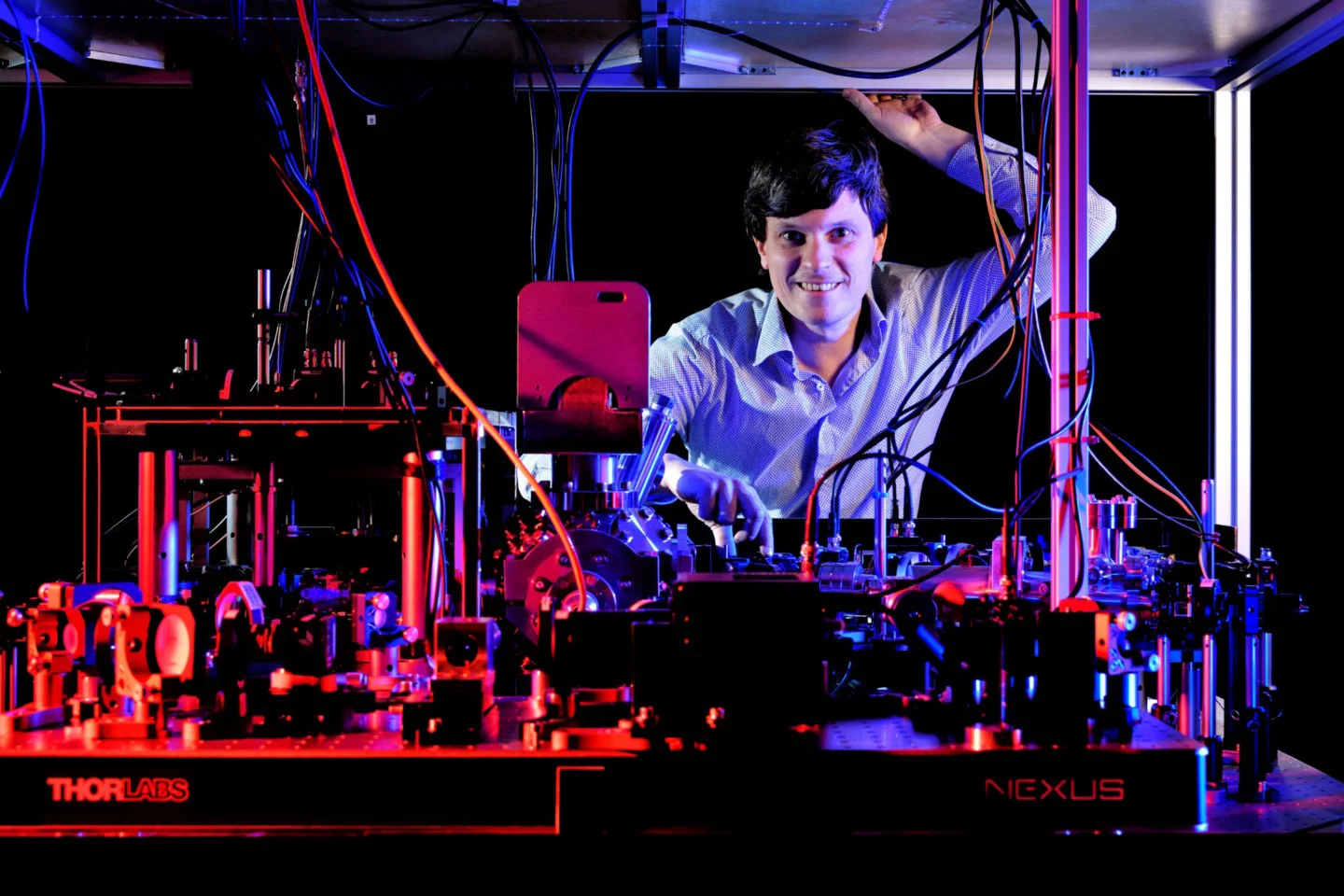
During the experiment, the researchers successfully set three international records. First, they measured the longest lifetime ever recorded for a single round Rydberg atom. By controlling the excited electrons to move along a stable circular orbit, the atoms remain in a stable state for 11 milliseconds, which is more than 20 times higher than the previous similar state in free space.
Secondly, the research team created the largest controllable circular Rydberg atom to date, with an electron orbit reaching about 1.1 microns, setting a new record in related fields.
The third record comes from the time of atomic capture in laser optical tweezers. Researchers used laser beams to successfully keep these giant atoms in the trap for 133 milliseconds, also setting a new world record.
The researchers pointed out that round Rydberg atoms not only have longer lifespan, but are also more stable to external perturbations, while still retaining the important advantage of the strong interaction of Rydberg atoms. These characteristics make it an ideal candidate for future quantum simulators and quantum computing platforms.
As quantum computing research continues to advance, the industry generally believes that future practical quantum devices need to have high stability, low error rates, and strong scalability. The results achieved by the University of Stuttgart prove for the first time that circular Rydberg atoms can achieve long-term stable control at room temperature, which is expected to significantly reduce the error accumulation problem in quantum operations.
The research team stated that the next step will be to try to build a programmable quantum system composed of multiple circular Rydberg atoms to further explore its practical application potential in quantum simulation and quantum computing. As the control technology for these "giant atoms" continues to mature, quantum computers may be one step closer to higher performance and larger-scale operation.
Comments